Proteomic Aging Scores and the SomaScan Platform
How a blood protein test measures aging across your body's organs and cells.
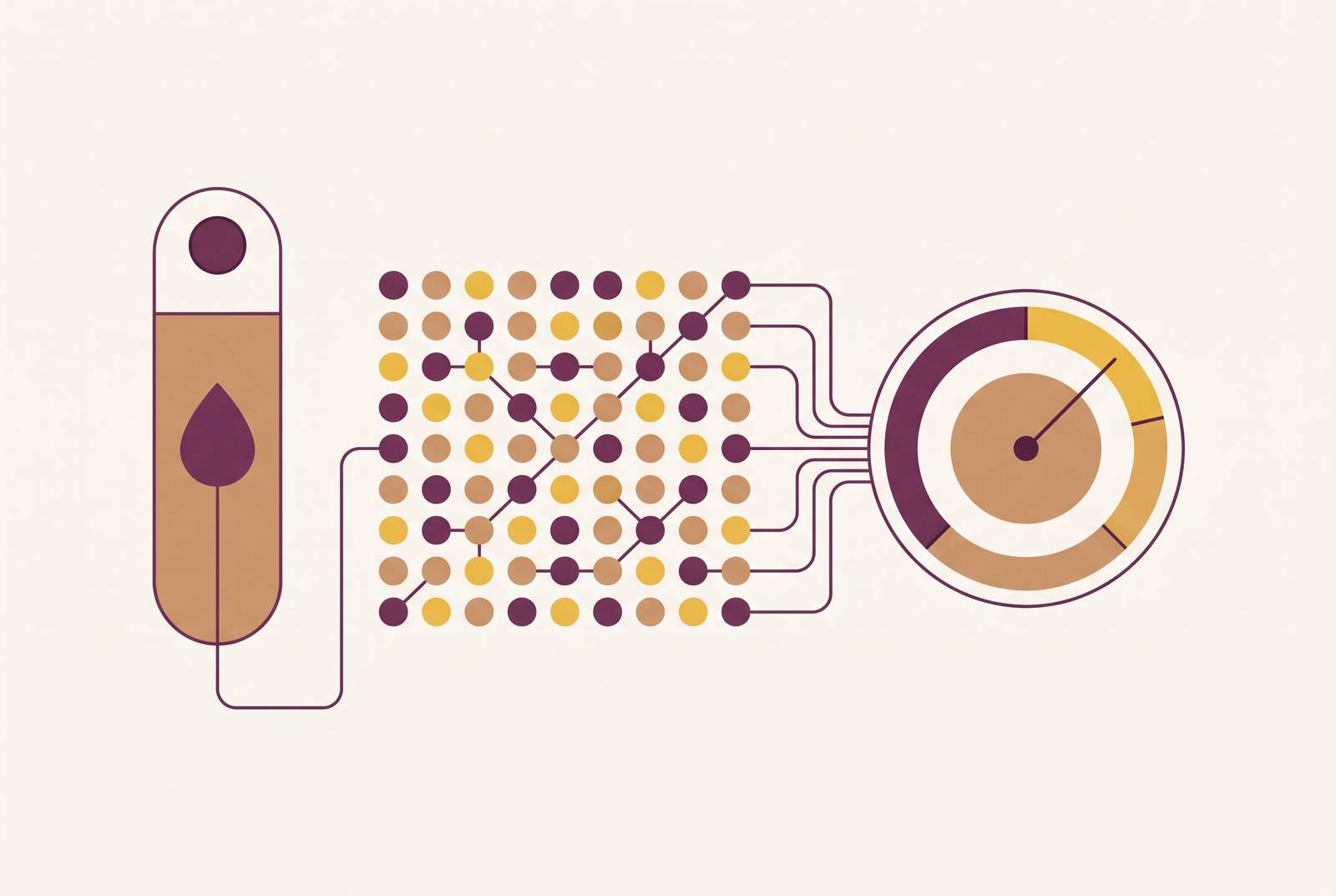
Proteomic aging clocks measure age by reading the proteins floating in a small vial of blood, and the technology behind them didn't exist fifteen years ago. This piece walks through how the SomaScan platform grew from a few hundred proteins to more than eleven thousand, what an aging clock actually calculates, and what today's research can and can't tell you about your own body.
Antibody tests like ELISA choke past a handful of proteins per run. Scale that up to thousands and the chemistry falls apart. SomaLogic's answer wasn't a bigger antibody library. It was a different reagent entirely: short strands of chemically modified DNA called SOMAmers, built using a selection process from 1990 called SELEX (Systematic Evolution of Ligands by EXponential enrichment).
SOMAmers work because they fold into shapes precise enough to tell apart two proteins that look nearly identical everywhere else. They're picked to stick tightly to the right target and let go fast from the wrong one, and a wash step using polyanionic competitors clears away anything bound loosely or by accident. The system runs on binding speed and stability, not raw strength of grip. That's the real break from antibody-based platforms, and it's what lets one small blood draw, carry thousands of separate protein readings at once.
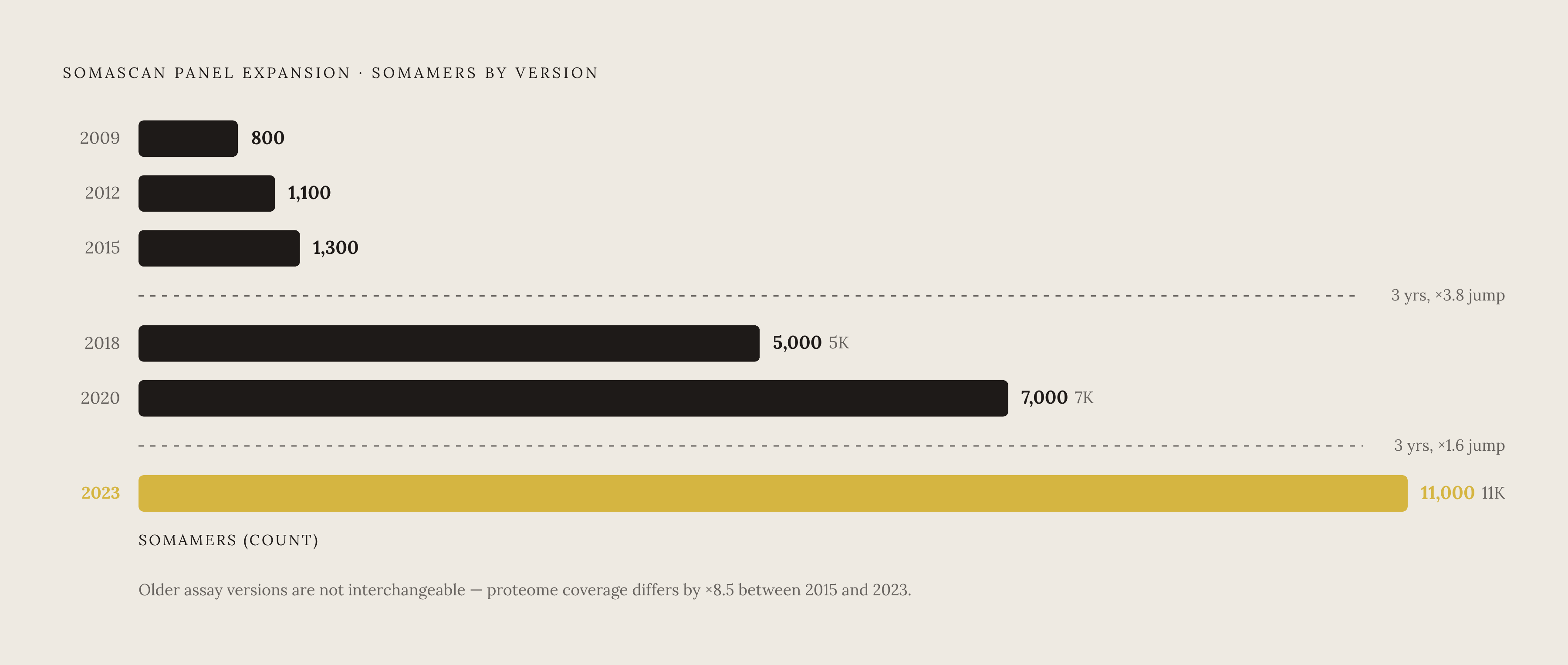
The version history tells the growth story on its own. SomaScan launched around 2009 with about 800 SOMAmers. By 2012 that had climbed to roughly 1,100, then 1,300 by 2015. The panel jumped to about 5,000 proteins in 2018 (the 5K), then 7,000 in 2020 (the 7K). Late 2023 brought the current 11K assay, covering 11,000 total measurements and about 10,000 unique human proteins, close to half of everything the human genome codes for.
A smaller Select 4K option exists too, built around 3,956 unique proteins picked for diversity and heavily checked by outside labs, for anyone who doesn't need the full 11K. The platform changed hands in a sense as well: following a 2021 partnership with Illumina, the 11K assay now runs under the name Illumina SomaScan Discovery, with an early access program launched in 2024 letting labs read SomaScan data straight on Illumina sequencers.
None of this is trivia, and skipping past it is how people end up misreading a headline. The landmark aging studies covered later in this piece were built on the 5K, 7K, and sometimes a separate 2,897-protein UK Biobank proteomics panel, not the current 11K. Knowing which version underlies a finding tells you how much confidence that finding deserves when applied to today's assay. A result from a 5K study doesn't automatically hold on the 11K, and treating them as interchangeable is a mistake. On the infrastructure side, the CLIA-certified, CAP-accredited lab in Boulder, Colorado runs more than 1,000 clinical samples a day, with results typically back in four to six weeks.
What a proteomic aging clock is and how the score gets built
A proteomic aging clock, or PAC, takes chronological age and regresses it against the levels of hundreds or thousands of proteins in blood plasma. Once the model is trained, it spits out a predicted age for each person. The gap between that predicted age and the person's actual birth-certificate age is the real output, not any single protein reading on its own.
Call someone's proteins "older" than their years and you're describing accelerated biological aging. Call them "younger" and it's the opposite. This age gap is the core currency of the entire field.
Building a useful clock means threading a needle, though, and this is where a lot of panels quietly fail. Train a model purely to guess chronological age and it does that well, but it won't tell you much about disease risk beyond what a birthday already implies. Train it purely on a disease outcome instead, and the result is stuffed with disease-relevant proteins that may say little about aging in general. The clocks that actually matter clinically have to do both at once: track age-driven biological change and predict a specific disease endpoint.
Argentieri and colleagues set the bar here, in a 2024 paper in Nature Medicine. Working from 45,441 UK Biobank participants and a panel of 2,897 plasma proteins, they picked out 204 proteins that predicted chronological age with a Pearson correlation of 0.94. That's about as tight a statistical link between proteins and birthdate as the field has produced, and it stands as a ceiling worth measuring smaller or less-validated panels against.
Machine learning does the heavy lifting in picking which proteins matter. Elastic net regression, a penalized statistical method, is the standard tool for choosing which proteins enter a clock and how much weight each one carries. That detail matters for how you read the output: these aren't hand-picked biomarker panels put together by a committee of experts sitting in a room. They're data-driven, built by an algorithm sorting through thousands of candidates to find the combination that predicts best. The score that comes back is a composite drawn from many signals combined by the algorithm. It's a composite of many signals, which makes it more informative than a single marker, but also more dependent on exactly which platform and protein list generated it in the first place.
The finding that biological aging is not uniform across the body's organs and cell types
Ask whether the whole body ages at the same rate, and the honest answer from recent research is no, and it isn't close. A 2025 Nature Aging study built organ-specific aging clocks, plus one overall organismal clock, using UK Biobank data from 43,616 people. Checked against cohorts in China (3,977 people) and the United States (800 people), the organ clocks held up well, with cross-cohort correlations of 0.98 and 0.93. That's a strong signal that organ-level aging isn't a fluke of one population.
A separate 2025 Nature Medicine study pushed the idea further, estimating biological age across 11 organs using 2,916 plasma proteins from 44,498 UK Biobank participants, tracked for up to 17 years. Organ age moved with lifestyle and medication use, and it predicted the onset of heart failure, type 2 diabetes, Alzheimer's disease, and other major conditions.
Then a 2026 Nature Medicine study went a level deeper still, down to individual cell types. Using more than 7,000 plasma proteins measured across 60,542 people, machine learning models estimated biological age across more than 40 cell types, spanning neurons, immune cells, glial cells, endocrine tissue, epithelial cells, muscle, and bone.
What the researchers found wasn't rare, and this is the part that should reframe how anyone thinks about a single "biological age" number. Somewhere between 20% and 25% of people showed accelerated aging in one specific cell type. And 1% to 3% showed accelerated aging across ten or more cell types at once, a much smaller group, but a genuinely alarming one. These aren't edge cases buried in a footnote. A meaningful share of any ordinary, healthy-looking population is aging faster in some specific tissue, even while looking fine from the outside.
The risk numbers attached to specific findings are the kind that should make anyone sit up. Extreme aging in astrocytes, a type of glial cell, tripled the risk of incident Alzheimer's in people carrying two copies of the APOE4 gene variant. People with extremely aged skeletal muscle cells showed a 12.7-fold higher risk of developing ALS. Among smokers, extreme aging in respiratory epithelial cells came with a 58% higher lung cancer risk stacked on top of smoking itself.
Across the organ-specific models, brain aging showed a particularly strong tie to mortality. Whatever is happening in neurological tissue over time carries outsized consequences for the rest of the body's fate.
A single overall "biological age" score is the wrong tool if the goal is catching this kind of risk early. It averages away exactly the detail that matters most, the one organ or cell type quietly running ahead of schedule while everything else looks normal. Organ- and cell-level scores keep that detail intact, and that's the direction the field is visibly moving, for good reason.
The nonlinear nature of proteomic aging and its biological inflection points
Aging doesn't move at a constant pace, at least not according to the proteins in blood. Research has flagged specific ages as points where proteomic profiles shift in a distinct, measurable way. Rather than a smooth downhill slope, biological aging looks more like a series of waves, and these ages mark where the water gets rough.
Five proteins in particular get named as promising markers around these transitions: CXCL13, DPY30, FURIN, IGFBP4, and SHISA5. Each shows a distinct shift in behavior near one of the three pivotal ages.
Sex differences appear here too, and they argue against treating everyone on one scale. Research suggests that aging trajectories may differ meaningfully between sexes, making a case for sex-specific reference ranges when reading any individual score, rather than one universal yardstick. These sex differences in aging dynamics have implications for how scores should be interpreted across different populations.
So what does nonlinearity actually mean for someone getting tested? A single measurement taken at 38 may say very little about what the same person's proteins are doing at 42, because the transition points aren't spaced evenly across a life. Testing near one of the identified inflection ages likely carries more predictive weight than a one-off snapshot taken at a random point in time, which is worth knowing before booking a test just because it's convenient that month.
This also contains a genuinely hopeful argument. The proteins that signal an approaching transition are visible in plasma before any symptom does. That's exactly the window where intervention, whatever form it takes, has the best shot at bending the trajectory.
How proteomic aging scores predict specific diseases (dementia as the sharpest example)
Dementia is where proteomic aging scores show their clearest teeth. The Dementia SomaSignal Test, or dSST, was built from plasma samples collected from ARIC study participants back at Visit 3, between 1993 and 1995, then followed for 20 years through Visit 5 in 2011 to 2013. That's a large cohort of middle-aged people at the initial blood draw, tracked across two decades.
The test ran on SomaScan Assay v4.0, the roughly 5,000-protein version, and compatibility with newer assay versions is discussed in a 2025 paper by Duggan and colleagues in Alzheimer's & Dementia.
A related body of work built proteomic aging clocks in the same ARIC cohort at midlife (average age 58, 57% female, 11,758 people) and again in late life, using elastic net regression, then checked how well those clocks tracked dementia risk. A clock trained just to predict chronological age does pick up some dementia signal, simply because dementia risk climbs with age anyway. A score trained directly on dementia as the outcome, on the other hand, captures a different and more specific set of dementia-associated proteins, ones not fully explained by aging alone, and that's what gives it predictive value beyond age.
Dementia isn't an isolated case, either. The same 2024 Argentieri study that established the 204-protein age clock also linked proteomic aging to 18 major chronic diseases, including heart, liver, kidney, and lung disease, plus diabetes. Dementia sits at the leading edge of a much wider pattern tying protein-based aging signals to disease across nearly every organ system.
Scale backs this up further. The Global Neurodegeneration Proteomics Consortium published four open-access papers on July 15, 2025, pooling SomaScan 7K data from tens of thousands of plasma, serum, and cerebrospinal fluid samples across Alzheimer's, Parkinson's, frontotemporal dementia, ALS, and healthy aging controls, nearly 300 million individual protein measurements now sitting in open access. Writing in Nature Medicine that August, the consortium called SomaScan one of the broadest discovery platforms available for this kind of work. Inside that dataset, protein signatures relevant to neurodegeneration risk were detectable in the dataset across disease groups and controls.
What these scores can and cannot tell an individual today
SomaScan panels currently carry a research-use-only label. They aren't FDA-cleared diagnostics, which means a result can't anchor an official diagnosis by itself.
There's a real limit built into the science, and it has nothing to do with regulatory status. Clocks trained purely on chronological age track biological aging reasonably well but add only modest independent disease information beyond what age alone already tells you. Disease-specific scores, the dSST being one example, carry more clinical weight precisely because they're built around an actual outcome instead of a birthday. Anyone paying for a panel should know which of these two they're getting, because the difference changes what the number is even good for.
Platform version affects the score directly, since results from one version can't be bridged to another without careful validation work. A score generated on the 5K assay isn't directly comparable to one from the 7K or 11K, since the underlying protein lists differ. Bridging one version's results to another takes careful validation work.
None of this makes the scores useless today. Tracked within the same assay version over time, a person's own age gap moving up or down carries real meaning, even if the absolute number attached to it comes with some uncertainty. The population-level associations, spanning 18 major diseases and extended mortality follow-up in some studies, give genuine prior-probability information, even without promising a specific individual outcome. And organ age estimates respond to lifestyle changes and medication, which means these scores read out something dynamic that can shift across a lifetime.
Cost is its own barrier. Institutional research pricing for the SomaScan 11K runs $950 per sample, and access varies enormously depending on where someone lives. Longevity clinics offering high-plex proteomics show wide differences in approach and pricing across more than 80 clinics operating globally, so what one place charges or measures may look nothing like the next.
Taken together, proteomic aging scores rank among the richest biological age signals built so far. But they sit right at the boundary between research tool and clinical instrument, and treating them as more than that today oversells what the science backs. That makes them genuinely useful for understanding where a body is headed, without yet being reliable enough to steer a specific medical decision on their own.
How to evaluate a proteomic aging score or longevity panel before paying for one
Start with the assay version and protein count, because this is where most marketing quietly cuts corners. A panel built on a few dozen proteins is doing something categorically different from a score built on the 5K, 7K, or 11K SomaScan platform. Coverage isn't a minor spec sheet detail. It determines which aging and disease signals the model even has a chance of catching.
Ask what outcome the clock was actually trained on. Was it built to predict chronological age, or a specific disease like dementia or heart failure? A chronological-age clock and a disease-specific score answer different questions, and a panel that won't say which one it's selling is asking for trust it hasn't earned.
Check whether the underlying research has been published and checked across more than one population. The strongest findings covered here, the organ clocks, the cell-type aging work, the dSST, all came with cross-cohort validation attached, tested in separate groups from separate countries. A score with no published validation, or validation in one small cohort only, deserves real skepticism, not the benefit of the doubt.
Consider how the result gets sold, too, because this is often the clearest tell. Does the report explain that this is a research tool showing trajectory and risk, not a diagnosis? Or does the marketing lean toward a certainty the underlying science doesn't support yet? The honest version of this technology tells someone where they might be heading. It stops well short of claiming to know exactly what's wrong with them today, and any panel that skips past that line should be avoided.
Sources
- The Dementia SomaSignal Test (dSST): A plasma proteomic predictor of 20‐year dementia risk - Duggan - 2025 - Alzheimer's & Dementia - Wiley Online Library
- Plasma proteomic signatures of cellular aging predict human disease | Nature Medicine
- 40K-Sample Neurodegeneration Proteomics Mega Analysis
- Proteomics-based aging clocks in midlife or late-life and their associated risk of dementia - PMC
- somalogic.com
- genengnews.com
- somalogic.com
- pubmed.ncbi.nlm.nih.gov