Supplement Quality and Bioavailability Problems
Fewer than one in four supplements contain what they promise, and even accurate doses may not work.

Supplement quality and bioavailability raise two different questions: whether a bottle has what it promises and whether the body can use it. U.S. supplement law leaves both questions largely unanswered before sale. Shopping smarter means looking beyond the dose on the label to evidence of product quality, the nutrient’s form, and whether it changes the health marker it was bought to improve.
How U.S. supplement law left consumers uncertain about what their bottles contain
The Dietary Supplement Health and Education Act, or DSHEA, established the regulatory framework in 1994. It did not give the FDA the pre-market approval authority that applies to prescription drugs. Most supplements thus go on sale without strict pre-approval checks or thorough tests of their safety. The FDA mostly acts after products go on sale and problems come to light.
Manufacturers bear the cost of rigorous quality testing, while consumers bear the risk when that testing is inadequate. Some manufacturers invest in it anyway, but the system does not make proof of safety and effectiveness a condition of market entry. This is not simply an overlooked loophole or a shortage of inspectors. When proof is not required before purchase, the consumer becomes the quality-control mechanism by default.
What independent testing actually finds on store shelves
ConsumerLab’s March 2026 testing found that nearly one in three popular multivitamins failed quality standards because of inaccurate ingredient levels or excessive dosing. ConsumerLab’s testing across two decades has found roughly a quarter of tested products failed for at least one issue. Those results come from the products tested, which were not drawn at random from all supplements for sale. Even with that limit, they show that failures are not isolated exceptions. Independent laboratory testing has also found that roughly one in four finished herbal supplements do not match their labels.
NOW Foods’ February 2026 testing gives that problem a concrete shape. The company tested 35 oregano oil products purchased from Amazon, with testing verified by ISO 17025-accredited laboratory Eurofins. Nearly two-thirds failed to meet labeled potency for carvacrol. Six contained no detectable carvacrol at all. NOW’s testing of 22 St. John’s Wort products purchased from Amazon in August 2025, with results announced in November 2025, found that all except one failed potency testing. Several also contained synthetic dyes used to disguise low-quality or adulterated products.
A failure can also arise without deliberate deception. Consider the ashwagandha example in which a brand uses a supplier-certified extract to aim for 15 mg of withanolides per capsule, but the finished capsules test 44% below the label claim. The supplier’s certification method was not validated for the finished-capsule matrix, degradation occurred during encapsulation, and the finished product was not tested before shipment. The important distinction is between testing an ingredient and testing the product a customer swallows. Evidence about the first does not automatically establish the quality of the second.
When the contents of the bottle are actively harmful, not just inaccurate
The FDA found over 800 dietary supplements with hidden pharmaceutical ingredients between 2007 and 2021. Those ingredients included sildenafil, anabolic steroids, and sibutramine, a weight-loss drug taken off the market after it was found to raise the risk of heart attack and stroke. This is a different failure from delivering less of a nutrient than promised. An inaccurate dose may fail to help, while an undeclared drug can actively harm someone who has no reason to expect it. Products for sexual enhancement, weight loss, and muscle building have the highest rates of adulteration on record.
A&P Creations recalled biQ-FEL and X10 Natural Enhancement in September 2026 after FDA analysis found undeclared sildenafil and tadalafil. The products were sold through Amazon and Walmart storefronts. These drugs can cause severe hypotension when combined with nitrates, making an undisclosed ingredient a potential drug interaction. Hidden anabolic steroids pose other risks, including liver toxicity, unhealthy blood lipid levels, and a drop in how much testosterone the body makes. Consumers often do not report supplement use to clinicians, which can leave interactions and toxicity unrecognized.
The FDA investigated multiple salmonella outbreaks linked to moringa powder beginning in January 2026 and extending into February 2026. Turmeric supplements have also failed independent testing for lead contamination and adulteration with synthetic yellow dyes. These are separate routes to harm, involving pharmaceutical adulteration, microbes, and heavy metals. A label that correctly names the intended ingredient cannot rule out any of them.
Why the consumer least likely to worry about safety is the most exposed
A published study of recreational supplement users found that fewer than 2% cited safety as a purchasing criterion. A 2026 study in Regulatory Toxicology and Pharmacology found that a large majority of the gym-goers studied used supplements, yet most could not correctly identify the legal definition of a food supplement. Nearly half knew little about how the market is controlled or how regulators oversee it. Users were more likely than non-users to recognize the possibility of undeclared or prohibited substances.
Supplements marketed as “natural” imply safety in a way that can suppress the skepticism people would bring to a pharmaceutical product. Performance, weight-loss, and sexual-enhancement products also pair their documented risks with heavy aspirational marketing. The regulatory gap and the awareness gap therefore reinforce one another. A buyer needs a way to judge the product independently of the promise, but purity and potency are only the first part of that judgment.
The second failure mode: a supplement that passes quality testing can still not work
Bioavailability describes how much of an ingredient the body can absorb and use. A laboratory can establish that a capsule contains its stated dose without establishing that the dose will be useful to the person taking it. The chemical form matters because two forms of the same nutrient can behave differently in the body. That creates a second failure mode, separate from contamination or inaccurate labeling.
Magnesium makes the distinction clear. A 400 mg capsule of magnesium oxide can contain a high proportion of elemental magnesium by weight while delivering only a small absorbed fraction. Soluble organic salts such as citrate substantially outperform oxide. One 60-day randomized trial involving 46 participants found that magnesium oxide showed no significant difference from placebo on absorption markers. Yet oxide is common in inexpensive products, so a large dose and a low price can conceal poor absorption.
Precise percentages widely cited for magnesium glycinate appear to lack a direct human trial, and at least one publication has retracted the highest figures. The evidence supports organic salts over oxide more firmly than it supports a specific glycinate absorption percentage.
Curcumin shows how large the gap can become. Phytosome formulations are nearly 30× more bioavailable than standard curcumin extract. Unenhanced turmeric faces two limits, since curcumin makes up only a small fraction of dried turmeric root and is poorly absorbed in the gut on its own. A accurately labeled turmeric product can therefore deliver little pharmacologically active compound.
The EFSA has concluded that a 2.5× conversion factor reflects calcifediol’s bioavailability relative to vitamin D3 in food supplements. Clinical trial data also show that calcifediol is approximately 3× more effective at raising blood vitamin D above baseline. Folate provides another comparison, with food folate having a median relative bioavailability of roughly 65% compared with supplemental folic acid. These examples show that the ingredient form deserves as much attention as the dose printed beside it.
How to read a supplement label with both failure modes in mind
Start by separating evidence about the bottle from evidence about its usefulness. Third-party certification seals, including USP Verified, NSF Certified for Sport, and Informed Sport, can help address quality concerns. But the seals should not be treated as interchangeable promises about every aspect of a product. What the certifier tests and what its certification covers determine how useful the seal is.
The shared limitation is especially important. Certification can support confidence that a product meets its label claims, but it does not establish that those claims describe a clinically useful dose. A certified product can still contain too little of an ingredient to have the intended effect. Certification can also lapse without the printed bottle changing. Check current status in the certifier’s own database, since the seal may have been printed a year or more before purchase.
Next, read the specific form of each key ingredient alongside the amount. For magnesium, prefer citrate, glycinate, or other organic salts over oxide, without relying on unsupported absorption percentages. For curcumin, look for alternatives to standard extract such as phytosome, phospholipid complex, or piperine-enhanced formulations. Calcifediol raises blood vitamin D levels more than D3 at the same dose, though D3 is easier to find and has been studied more widely. These distinctions help explain why two bottles with similar-looking amounts may not offer the same result.
ConsumerLab membership offers direct value in categories where its published pass/fail testing can help distinguish products, including turmeric, St. John’s Wort, fish oil, probiotics, and sports performance supplements. Those categories do not all carry the same kind of risk, but product choice can materially change what a buyer receives. Manufacturers that fund rigorous third-party testing and publish results transparently have a fair objection to being grouped with poor-quality sellers. Such manufacturers exist, and their investment matters. The purpose of scrutiny is to identify that work.
Why biomarker testing is the only way to confirm a supplement is actually working
Someone taking vitamin D for a deficiency that has been confirmed may assume that taking the capsule has brought their level back up. If the product is underdosed or poorly absorbed, the deficiency can persist without an obvious sign. Testing the relevant marker before and after the intervention is the reliable way to establish whether it moved. That is a narrower claim than proving every promised health benefit, but it answers the practical question the supplement was meant to address.
The measurement must also fit the goal. Blood 25-OH vitamin D measures vitamin D status and shows whether the level rose after a capsule was taken. Magnesium is harder to assess because serum levels are tightly regulated and may not reflect tissue stores. A normal serum result can coexist with a tissue deficit, so whole-blood assessment can be more informative than serum alone. For iron, ferritin is needed to check whether stores have been replenished, because hemoglobin alone cannot show this.
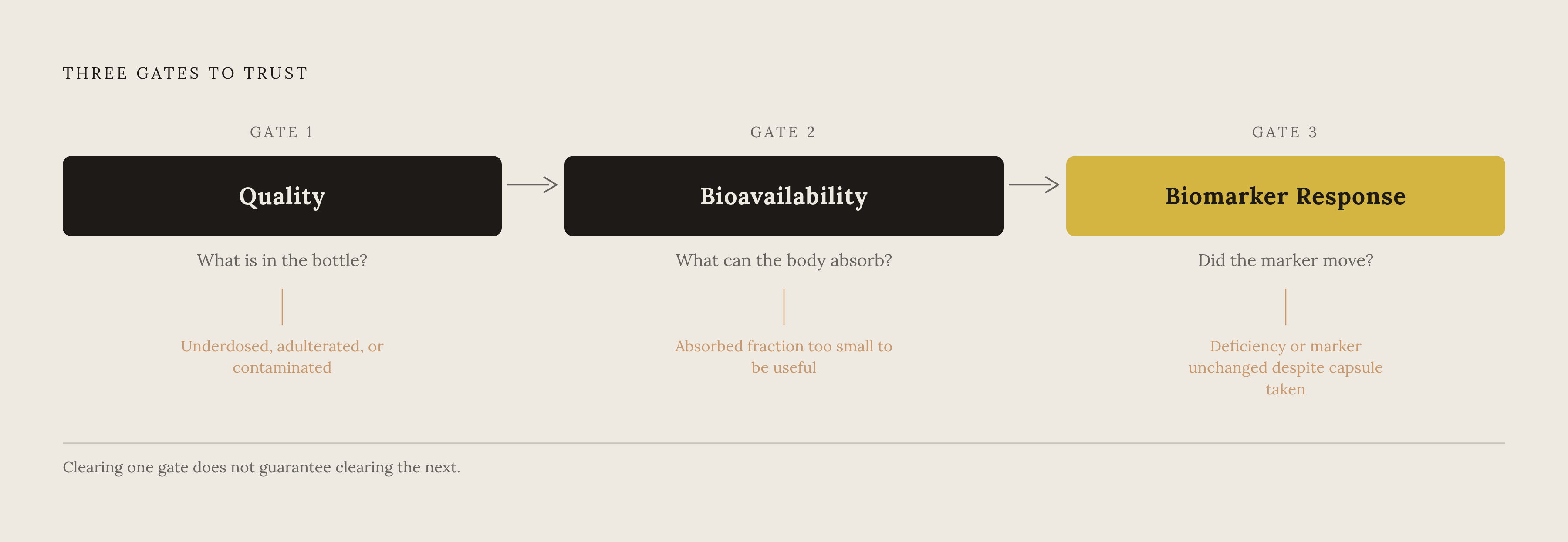
Testing before starting establishes a baseline. Testing afterward, at an interval appropriate to the nutrient’s usual response time, shows whether the chosen product, form, and dose were sufficient to move the target marker. If the marker does not improve, which part failed remains uncertain from that result alone. Quality testing asks what is in the bottle, bioavailability asks what the body can use, and biomarker testing asks whether the intended change actually happened.