Metformin as a Longevity Drug — TAME Trial and Current Evidence
TAME seeks regulatory approval for metformin as an aging drug, but results remain years away.
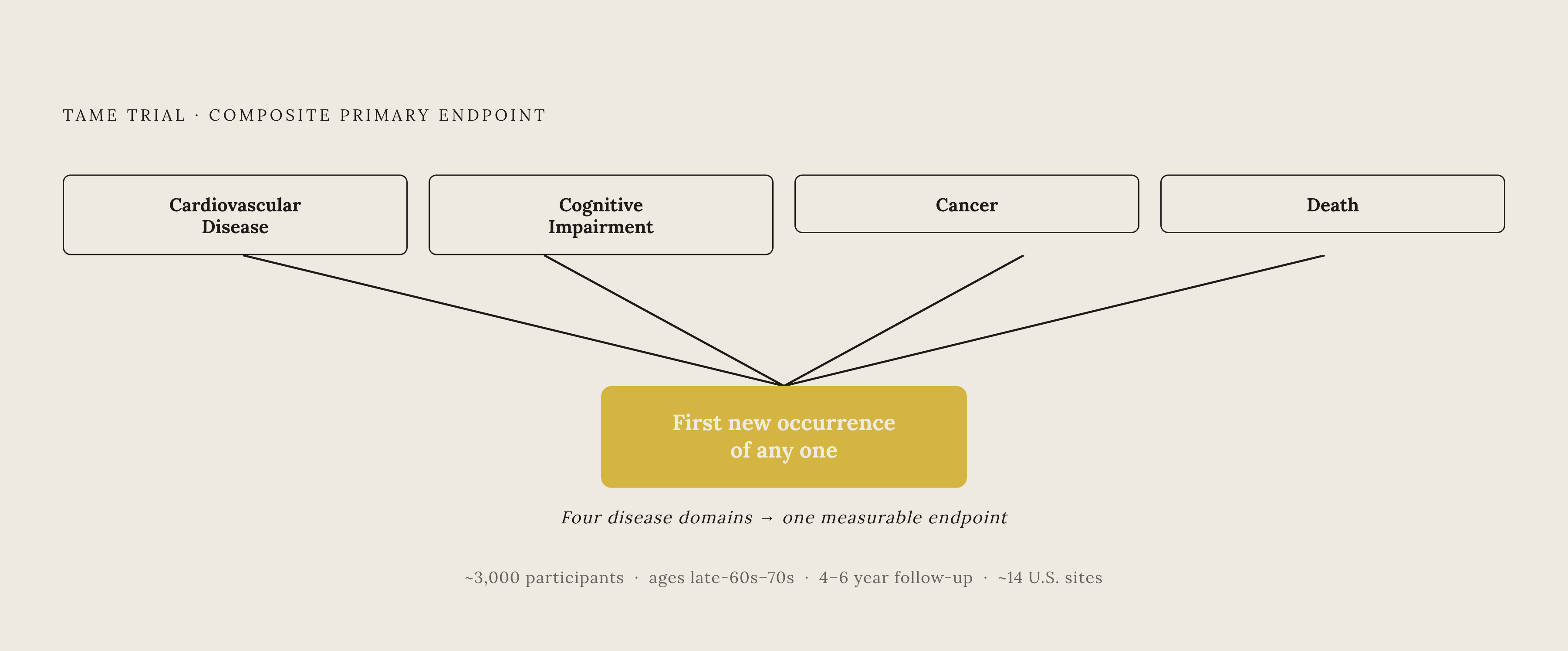
Before the Targeting Aging with Metformin trial, a drug company had no path to run a study "to treat aging." Regulators required a single disease target, full stop on that old rule. TAME broke that template by convincing the FDA to accept a composite endpoint built around aging itself: the first new occurrence of cardiovascular disease, cognitive impairment, cancer, or death, tracked together as one outcome. That design choice affects the trial's results directly, because it mirrors how aging actually makes people sick. Nobody develops heart disease, then recovers fully, then independently develops cancer in some orderly sequence. Aging produces a basket of overlapping risks, and TAME measures a drug against that whole basket at once.
The trial itself is led by Dr. Nir Barzilai at Albert Einstein College of Medicine, with Wake Forest University School of Medicine serving as the coordinating center. The design tests a daily extended-release dose of metformin against placebo in roughly 3,000 non-diabetic adults in their late sixties and seventies, spread across approximately 14 U.S. sites, and follows them for four to six years. That's a large, long, expensive study for a drug that costs pennies a pill. The scale matters because a composite endpoint needs a big enough population and a long enough window to catch signals that smaller, shorter trials would miss.
The regulatory precedent now extends past metformin. ARPA-H, the Advanced Research Projects Agency for Health, built on the DARPA model, has emerged as a potential institutional partner for aging research going forward. That signals something larger than one trial's fate: the federal government may be building a dedicated funding mechanism for longevity science, rather than leaving the field dependent on philanthropy. Separately, reports in 2026 suggest Eli Lilly is planning a GLP-1 trial using the same composite endpoint framework TAME established, though the FDA agreeing to a trial design is not the same as the agency formally approving aging as an indication. Either way, the template now exists. Any company with a drug candidate and the willingness to run a long trial can ask the FDA for the same kind of composite endpoint TAME fought to establish.
Where the trial stands in 2026
TAME has produced no efficacy results as of 2026. That single fact needs stating clearly, because the information circulating about this trial has grown inconsistent enough to mislead a careful reader.
Sources dated early 2026 describe a trial that has not launched. One account from February 2026 states that TAME is not recruiting, that no trial sites appear on ClinicalTrials.gov, and that no interim results exist anywhere. Other early-2026 material describes enrollment as unfunded, with no participants enrolled and no efficacy data published. These accounts agree with each other on the central point: nothing has read out yet.
A source dated March 2026 claims TAME already reported results, including reductions in cardiovascular disease, cancer, cognitive decline, and mortality. That claim conflicts directly with the more detailed, more recently dated accounts confirming no efficacy results exist. The honest way to resolve this conflict is by noticing which sources carry the granular detail, the specific dates, and the absence of any citable trial registry entry showing a completed study, versus which source offers a tidy result summary with none of that supporting texture. If peer-reviewed results haven't appeared in an indexed journal yet, you should treat TAME as ongoing and unresolved. Readers who encounter claims of completed results should ask a simple question: is there a journal citation behind this, or just a confident sentence?
The confusion is understandable. TAME's design has been described in careful, consistent detail for several years now, and the scientific community has spent a lot of that time discussing what the trial is likely to show. That's a reasonable conversation to have. But it creates a slippery slope in secondary coverage, where "this is what the trial is designed to detect" quietly becomes "this is what the trial detected." Those are different sentences, and only one of them is currently true.
Money explains much of the delay. Completing TAME requires approximately $75 million. Metformin is a cheap, off-patent generic, so no pharmaceutical company holds a patent incentive to fund a $75 million trial of it. The funding instead depends on philanthropic contributions through aging-research foundations, government grants, and private donors, a patchwork that moves slower than a single corporate sponsor would. Proposed NIA funding cuts in the 2025-2026 appropriations cycle also put further pressure on federal aging research generally, and that doesn't help a trial already searching for its last dollars.
What should a reader expect, and when? Primary results aren't likely before 2027 or 2028 at the earliest. Before that window, expect interim biomarker sub-studies and mechanistic analyses from individual trial sites, published in journals like Aging Cell, Nature Aging, and the Journals of Gerontology. Those won't answer the big question TAME was built to answer, but they'll still give you real, citable signals along the way.
What the original observational evidence showed
TAME exists because of an anomaly nobody expected to find. People taking metformin for type 2 diabetes appeared to live longer than non-diabetic people taking no medication. Diabetes shortens lifespan on its own. Treated diabetics outlived healthy controls, which suggested metformin was doing something beyond lowering blood sugar, something that touched the aging process more broadly.
That anomaly deserves scrutiny, but also precision about its limits. Observational data of this kind cannot establish that metformin caused the longer lifespans. People who get prescribed metformin interact with the healthcare system more often than people who don't take any medication. They may be healthier in ways the data never measured. The comparison group was never randomized, so the two populations could differ in a dozen ways the study never accounted for. An anomaly is a reason to run a trial. It is not itself the trial's answer.
A 2026 follow-up of the Diabetes Prevention Program cohort, published in JAMA, adds a useful caution here. Among participants with Medicare data, the lifestyle intervention arm from the original study was associated with less long-term multimorbidity decades later. Metformin, by contrast, did not show a statistically significant difference from placebo in that same follow-up. That's an observational follow-up of a randomized cohort, not 21 years of intact experimental conditions, so it carries its own limits. But it tempers the most optimistic reading of the human metformin data before any mechanism gets a chance to make the case sound stronger than the evidence supports.
Animal data complicates the picture further, in a useful way. Martin-Montalvo and colleagues found in 2013 that low-dose metformin extended mean lifespan in two male mouse strains. A tenfold higher dose shortened it. Dose matters enormously here, and that finding should temper any assumption that more metformin simply means more benefit.
Put together, this is the evidential foundation TAME was built to upgrade: an intriguing anomaly in observational human data, a mixed signal from a randomized cohort followed for decades, and a dose-dependent effect in mice that doesn't map cleanly onto a human prescription. TAME is designed to convert that patchwork into randomized, controlled evidence in non-diabetic humans, which is the only kind of evidence that can actually settle the question.
How metformin interacts with the biology of aging at the cellular level
Metformin's relevance to aging research isn't a stretch from its diabetes mechanism. The drug engages several pathways that aging biology has independently identified as central to how cells and tissues decline over time, and that mechanistic case draws significant attention from researchers who study aging.
The core mechanism runs through a cellular energy-sensing enzyme that functions as the body's metabolic master switch. Metformin activates AMPK, shifting cells toward preservation and repair in a way that resembles caloric restriction, without requiring anyone to change their diet. That activation produces enhanced autophagy (the process cells use to clear out damaged components), reduced oxidative stress, and suppressed mTOR signaling. mTOR, short for mechanistic target of rapamycin, drives cell growth, and chronically elevated mTOR signaling is associated with accelerated biological aging. Suppressing it is one of the more consistent threads tying metformin to lifespan research across species.
Metformin also inhibits complex I of the mitochondrial respiratory chain. That sounds like a liability, but the effect creates mild metabolic stress that appears to strengthen cellular resilience over time, a hormetic response where a small stressor leaves cells better equipped to handle larger ones later.
The strongest animal evidence comes from epigenetic aging clocks, measured in non-human primates. A study published in Signal Transduction and Targeted Therapy found that metformin administration decreased protein age in treated monkeys by an average of more than six years. DNA methylation age in the frontal lobe dropped by over six years, with parallel reductions occurring across lung, kidney, liver, and skin tissue. That's animal data, and it doesn't translate directly into a human clinical outcome. But it represents the strongest controlled evidence available that metformin can modify epigenetic age markers in a species close enough to humans to take seriously.
Chronic low-grade inflammation, sometimes called inflammaging, gives the mechanistic case a more measurable angle. Metformin has reduced high-sensitivity CRP, a blood marker anyone can get tested, in clinical trials of patients on glucocorticoids. It has also been shown to stimulate expression of Sirtuin-1, a deacetylase enzyme tied to metabolism and longevity research broadly.
There's a neurological angle too. Metformin decreases Tau protein levels, reduces amyloid-beta accumulation, and reduces hippocampal senescence in studied models, raising the possibility of delayed Alzheimer's onset. That hypothesis connects directly to TAME's cognitive decline endpoint, which is one reason the trial's composite design makes sense: a drug that might touch multiple disease pathways needs an endpoint built to catch more than one of them.
None of this adds up to proof. The mechanisms are plausible, and they line up with what aging biology predicts should matter across multiple organ systems. But a plausible mechanism is not the same as confirmed clinical benefit in humans, and translating effective doses from animal studies into safe, effective human protocols remains unresolved. A dose that helps a mouse or a monkey doesn't automatically scale to a safe, effective human dose, and closing that gap is what a randomized human trial exists to do.
Where the cardiovascular and metabolic evidence is genuinely inconsistent
The mechanistic case for metformin is compelling on paper. The clinical trial record in humans, particularly for cardiovascular outcomes, is a lot messier. Trials including TAYSIDE, GIPS-III, REMOVAL, and GOMET have produced inconsistent results across both clinical and surrogate cardiovascular endpoints. Most of these trials were limited by relatively small sample sizes and short follow-up durations, exactly the limitations TAME was designed to overcome with its roughly 3,000 participants and four-to-six-year follow-up window.
You could argue that inconsistency across small trials just reflects underpowered studies catching noise. That's a fair read, and it's part of why TAME's scale matters so much. But it's also possible the inconsistency reflects something real: that metformin's cardiovascular benefit, if it exists, is modest enough that small trials simply can't detect it reliably. Those two explanations point in opposite directions, and only a trial built at TAME's scale can tell them apart.
Sex differences add another layer: emerging evidence suggests sexual dimorphism in how metformin acts, shaped by hormonal status and pharmacokinetic differences between men and women. In mice, metformin improves healthspan and extends lifespan in males but fails to extend lifespan in females. That's a live research question, not a settled one, and it carries real weight for any woman currently discussing off-label metformin use with a clinician. A mechanism proven in male mice doesn't automatically apply across sexes, in mice or in people.
What does this inconsistency mean for TAME specifically? The trial's composite endpoint and long follow-up are built to detect real effects that shorter cardiovascular trials may have missed simply for lack of statistical power. At the same time, the inconsistent prior record is a reason not to assume TAME will land on a positive result before the data comes in, since inconsistent evidence is evidence of genuine uncertainty, and resolving genuine uncertainty is what a $75 million randomized trial exists to do.
The exercise interference problem, metformin's sharpest practical trade-off
If exercise is the most evidence-backed longevity intervention available, a drug that partially cancels its benefits deserves serious scrutiny. That's the sharpest practical objection to treating metformin as a general longevity drug, and recent research has sharpened it considerably.
Rutgers scientists found that metformin can blunt many of the metabolic and cardiovascular improvements normally produced by exercise. The blunted effects included reduced gains in fitness, reduced improvements in blood vessel function, and reduced gains in glucose control. These are the exact adaptations exercise is supposed to produce, and metformin appears to dull several of them at once.
The mechanism traces back to the same AMPK and mTOR pathways that make metformin interesting for aging research. AMPK activation promotes metabolic health, which is the upside case for metformin. But metformin simultaneously suppresses mTORC1, the precise cellular signaling cascade the body needs to build and maintain skeletal muscle mass. A trial published in the Journal of Applied Physiology found that the metformin group in a resistance-training study gained only about 0.45% in thigh muscle mass, a number that directly conflicts with the hypertrophy goals resistance training is supposed to deliver.
That raises an important question for anyone weighing metformin as a longevity strategy: if muscle mass and cardiorespiratory fitness rank among the strongest predictors of healthspan available, does a drug that blunts both represent a net gain or a trade of one longevity pathway for another? Nobody fully knows yet. The mechanistic case for metformin's benefits runs through the same pathway, AMPK and mTOR signaling, that appears responsible for interfering with exercise adaptation. That overlap isn't a coincidence, and it means the same biological switch metformin flips to promote preservation mode may be the switch that keeps muscle from building the way it would without the drug. Anyone weighing metformin against a serious resistance-training program has a real trade-off to think through, not a hypothetical one.