Rapamycin Use in Healthy Aging Adults
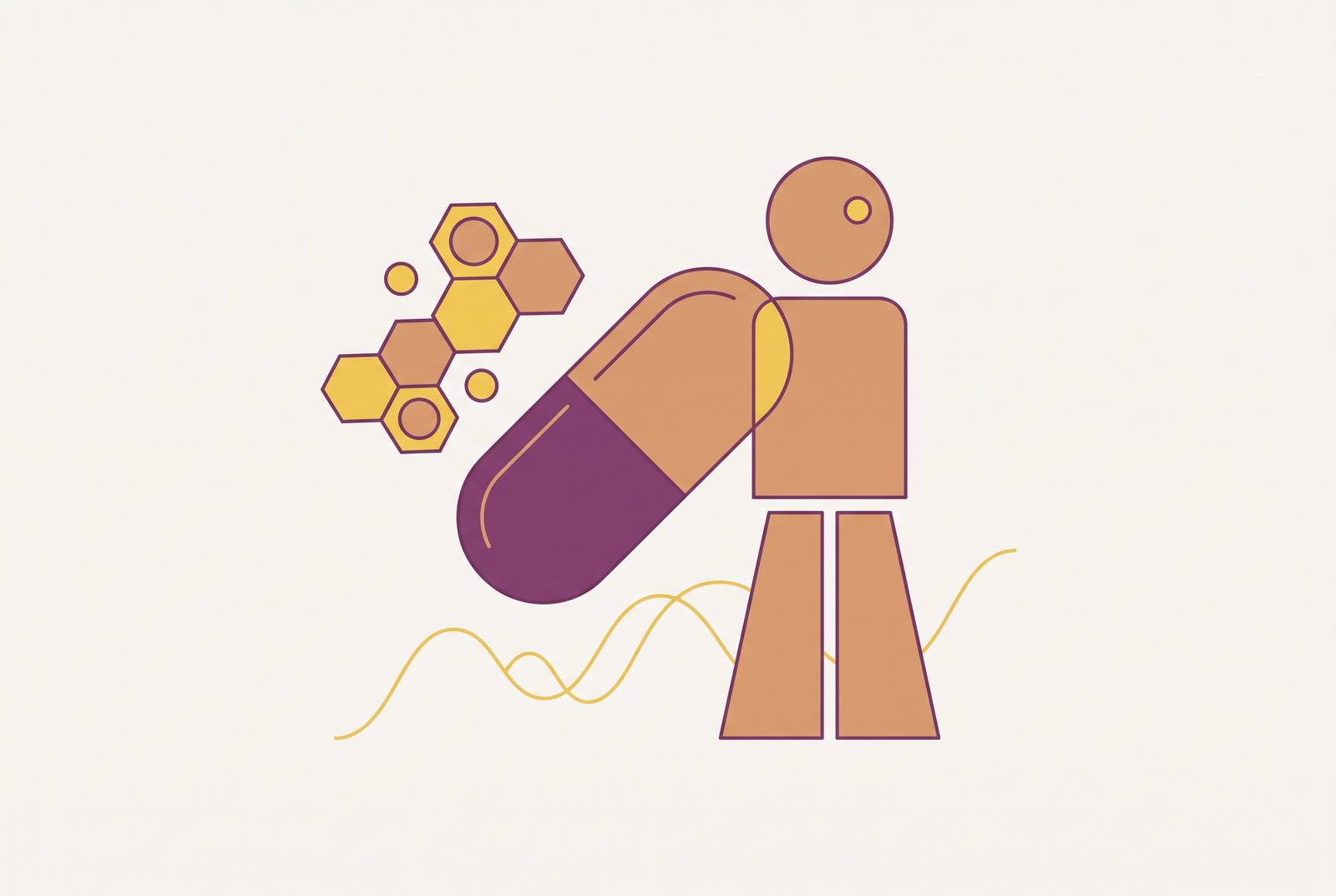
Rapamycin's case for extending human healthspan rests on one molecular switch: mTORC1, a protein kinase that senses nutrient availability and tells cells whether to grow or to clean house. Across middle age and beyond, mTORC1 tends to stay switched on more of the time, and that chronic activity is linked to reduced cellular maintenance and the slow accumulation of damage that marks aging tissue. Rapamycin inhibits mTORC1, and in doing so triggers autophagy, the recycling process cells use to clear out damaged proteins and organelles. Autophagy naturally declines with age, which is part of why reactivating it has drawn so much attention from aging researchers.
The pathway rapamycin targets is the same one that caloric restriction and sustained aerobic exercise, zone 2 cardio in particular, appear to influence. All three converge on mTOR signaling; some researchers view fasting, endurance training, and rapamycin as potentially complementary tools rather than competing strategies for the same outcome. The molecular detail that matters for anyone trying to understand this mechanism beyond the headline involves three downstream substrates: S6K1, 4E-BP1, and Ulk1. Whether these get phosphorylated or not determines, at the cellular level, whether a cell proceeds with growth and protein synthesis or shifts into maintenance and cleanup mode.
The mechanism has gained a new layer recently. A 2026 study published in Aging Cell identified a fourth pathway beyond autophagy: low-dose rapamycin reduced p21, a marker of cellular senescence, in immune cells drawn from older adults. That finding suggests rapamycin might help immune cells resist a particular kind of molecular wear associated with senescence. p21 is one piece of a much larger senescence picture, though, and it has not been validated as an epigenetic endpoint researchers can rely on to track aging itself. The biology here is genuinely interesting on its own terms. What it does not yet do is prove that manipulating this pathway in a living, aging human produces the outcome anyone taking the drug actually wants: a longer, healthier life.
The mTORC1/mTORC2 distinction that makes dosing the entire debate
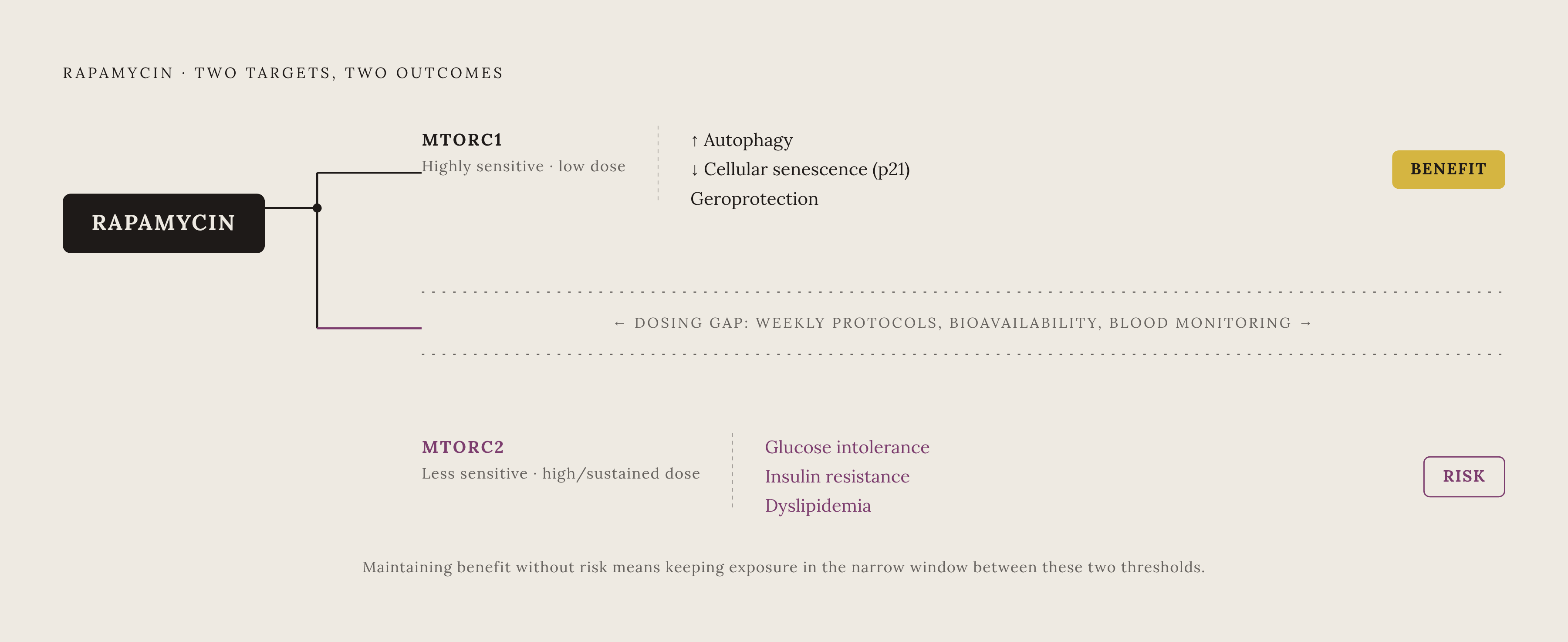
Rapamycin's safety profile hinges on a distinction that separates two related protein complexes that share a name but behave very differently when the drug arrives. mTORC1 is acutely sensitive to rapamycin, responding quickly and directly to the drug at relatively low exposure. mTORC2 is far less sensitive, and most of rapamycin's downside, the side effects visible in clinical monitoring, traces back to mTORC2 getting inhibited. That impairment drives glucose intolerance, one of the drug's most clinically significant and well-documented side effects.
This distinction turns dosing schedule from a convenience question into a pharmacological hypothesis. The PEARL trial and other longevity studies built their once-weekly protocols on this reasoning. Substantial amounts remain active in the body well into the following week, raising the question of how cleanly any "intermittent" protocol actually separates mTORC1 inhibition from mTORC2 exposure in practice.
Individual variability complicates the picture further. A PMC review notes that rapamycin's oral bioavailability runs low, around 15%, and varies considerably between individuals. "Low-dose rapamycin" Low-dose rapamycin" is a target that depends on frequency, individual absorption, and metabolism, and all three need calibration for any given person rather than being treated as settled by the number on the label. Whether a given protocol delivers a targeted mTORC1 intervention or a slower creep into mTORC2 inhibition, and the metabolic consequences that come with it, depends on these details and on dose together. That dependency is what makes blood monitoring, covered later in this piece, a direct consequence of the pharmacology.
What the animal evidence established
The animal data behind rapamycin are some of the strongest lifespan-extension evidence mammal studies have ever produced. Lifespan extension from rapamycin has been replicated across yeast, worms, flies, and multiple mouse strains. No other compound in aging research carries that breadth of cross-species replication.
The mechanism also appears to combine well with others. A 2025 study in Nature Aging found that pairing rapamycin with trametinib produced additive lifespan and healthspan gains in mice, reducing tumors and inflammation across multiple organs. The Dog Aging Project, co-directed by Dr. Matt Kaeberlein, formerly of the University of Washington, and Dr. Daniel Promislow of the University of Washington, has been testing whether these healthspan benefits carry over into companion animals whose physiology more closely resembles human biology. Early results there look promising, though they remain short of definitive.
None of this settles whether rapamycin works in humans, because mouse and human biology diverge in ways that can flip a drug's apparent benefit into a liability. Mice are not small humans. Drug classes have failed to translate from rodent longevity trials into human benefit repeatedly, across multiple mechanisms, not just this one. What the animal data establish is that mTOR inhibition produces a real, potent, and reproducible biological effect across many species. What they do not establish is that this effect produces the same outcome in humans, who live decades longer than mice, face different causes of death, and carry different patterns of age-related disease. The August 2025 PMC review states this directly: "the data in humans have yet to establish that rapamycin, or its analogues, is a proven seno-therapeutic that can delay aging in healthy older adults." Taking that sentence seriously is what separates an informed read of this drug from an enthusiastic one.
What the human trials tested, found, and left unresolved
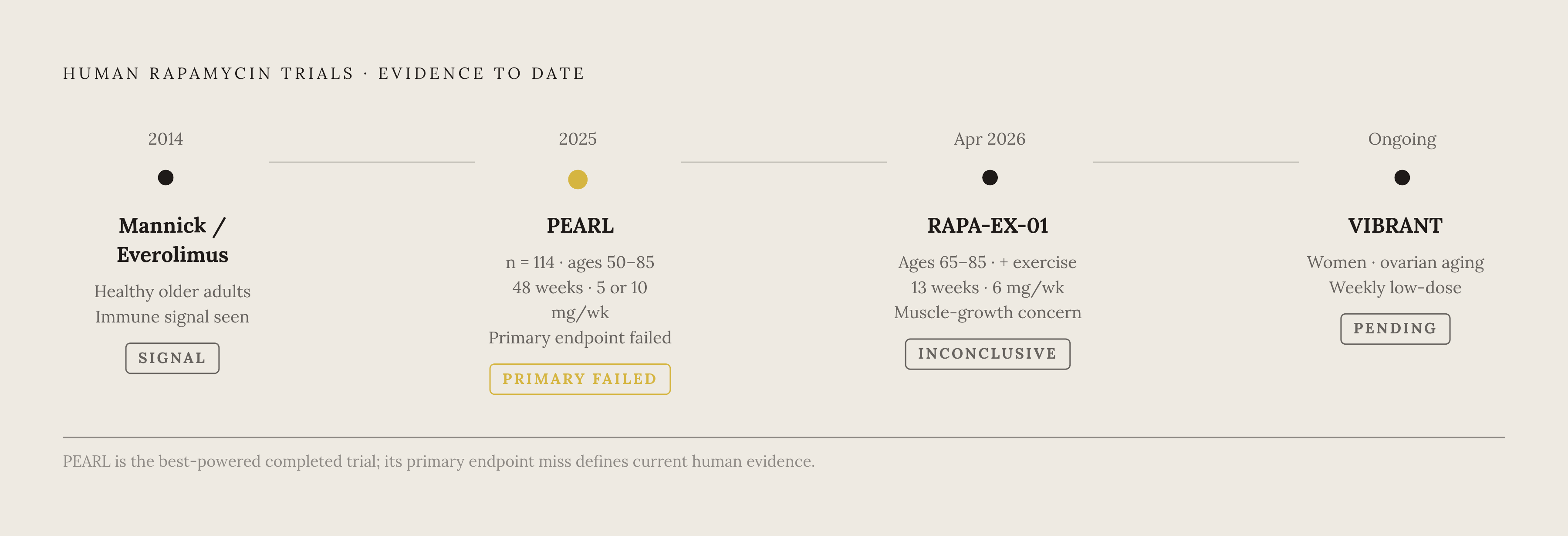
Human evidence on rapamycin remains sparse by any standard. The PMC review from August 2025 counts fewer than a dozen known trials that have tested rapamycin or its analogues in healthy participants across any range of biomarkers. That is the backdrop against which every individual study below needs to be read.
Mannick and colleagues gave the earliest signal in 2014: they tested everolimus, a rapamycin analogue, in healthy older adults, and it improved their immune response to influenza vaccination. In a follow-on study from the same research group, infection rates dropped by a statistically significant margin. Together, these findings offer a meaningful healthspan signal, but the trials were small, industry-funded, and measured immune markers.
The PEARL trial, published in 2025, is the best-powered human longevity RCT completed to date, so it anchors this discussion. Randomized, double-blind, and placebo-controlled, it tested compounded 5 mg and 10 mg weekly doses of rapamycin in 114 healthy adults aged 50 to 85 over 48 weeks. Adverse and serious adverse events looked similar across all groups. Lean tissue mass and self-reported pain improved significantly for women taking the 10 mg dose. Self-reported emotional well-being and general health improved for those on the 5 mg dose. The trial's primary biomarker endpoint, visceral adiposity, showed no significant change. PEARL also recorded a mild, statistically significant rise in HbA1c, consistent with the mTORC2 mechanism described earlier, without a significant increase in systolic blood pressure. Read in full, PEARL works as a green light for larger trials, not as proof that rapamycin slows aging. Its primary endpoint failed, and its secondary improvements, real as they are, remain hypothesis-generating.
RAPA-EX-01, published in April 2026 in the Journal of Cachexia, Sarcopenia and Muscle, pushed the question in a different direction by combining weekly rapamycin with exercise for the first time in older adults. The trial enrolled sedentary adults aged 65 to 85, with roughly equal representation of women, randomizing them to once-weekly 6 mg oral rapamycin or placebo for 13 weeks, testing what researchers call the cycling hypothesis: that dosing timed away from workouts would let muscle growth proceed unimpaired. The pharmacokinetics undercut that hypothesis before the trial even started. The trial raised a real possibility that rapamycin may impair muscle growth under certain dosing and training conditions, a signal that feeds directly into the paradox the next section explores. It also left significant methodological gaps. The trial raised its central question without the tools to answer it.
A fourth study worth watching sits further out. The VIBRANT Study, running at Columbia University and co-led by Dr. Yousin Suh and Dr. Zev Williams, is a prospective, randomized, double-blind, placebo-controlled trial testing whether once-weekly, low-dose oral rapamycin can slow ovarian aging and delay menopause. The reasoning behind it: postponing menopause might reduce downstream cardiovascular, dementia, and mortality risk. It remains ongoing, and its results aren't yet available.
Lined up together, these trials do not climb toward proof. They form a map of what the field still does not know: whether rapamycin changes a hard clinical outcome in healthy humans, whether its muscle effects help or hurt over time, and whether the metabolic signals seen in PEARL grow or stay flat with longer exposure.
The mTOR paradox: why the same pathway rapamycin suppresses for longevity also builds the muscle that predicts it
The sharpest unresolved tension in rapamycin's case for healthy aging is one fact: mTORC1, the very target rapamycin inhibits for its proposed geroprotective effect, is also the master regulator of muscle protein synthesis. Muscle mass itself ranks among the strongest predictors of how long a person lives. A drug built to suppress the pathway that builds and maintains muscle is, on its face, working against one of the best-established levers for a longer healthspan.
This is not a theoretical worry. Any drug that interferes with that process on a sustained basis is working against the very outcome it claims to extend.
The intermittent dosing hypothesis was supposed to resolve this conflict. Some researchers push back against the apparent conflict itself. The level of mTORC1 suppression needed to produce a geroprotective effect might be considerably lower than the level that blunts muscle protein synthesis, so the two effects could, in principle, be decoupled by dose. That is a dose-response question, though, and no completed human trial has been powered to answer it.
Longevity researcher Stanfield, quoted on lifespan.io, put the honest version of this directly: there is "real biological tension" between mTORC1's role as the master regulator of muscle protein synthesis and the sustained mTORC1 inhibition that likely underlies rapamycin's geroprotective effect. That tension has not been resolved by any completed human trial. Anyone weighing rapamycin against the goal of preserving muscle into old age has to weigh two outcomes the current evidence cannot fully reconcile; clever timing has not solved this as an engineering problem.
The biomarkers that must be tracked before and during any rapamycin protocol
Because rapamycin touches several organ systems through genuinely different mechanisms, no single number can tell someone whether a protocol is working or causing harm. A full panel is necessary, and each marker in it traces back to biology already established above.
Lipids come first. Rapamycin reduces LDL receptor expression on liver cells, which slows how quickly LDL gets cleared from the blood. ApoB works better than standard LDL-C as the cardiovascular risk marker in this context, because it counts every atherogenic particle in circulation. That distinction matters here specifically because rapamycin tends to raise triglycerides at the same time, and elevated triglycerides can skew calculated LDL-C downward, producing a falsely reassuring number on a standard lipid panel.
You need to track glucose and HbA1c regularly, for reasons that trace directly back to the mTORC2 mechanism covered earlier. Fasting glucose and HbA1c belong at every monitoring visit, not only at the start of treatment.
Inflammation deserves its own line through high-sensitivity CRP testing. Part of rapamycin's proposed benefit for healthspan is anti-inflammatory, yet PEARL's inflammatory biomarker results came back mixed. A CRP that climbs on treatment calls for a second look at the protocol, not a shrug.
Sirolimus trough levels close the list, and they matter because of the low, variable oral bioavailability raised earlier. Rounding out the panel: complete blood count, given rapamycin's immunosuppressive mechanism and its effect on immune cell counts, along with liver function and kidney function tests, both standard components of a careful baseline and follow-up workup.
The off-label reality: who is using rapamycin, the clinical risks in practice, and who should not use it
Rapamycin remains unapproved for longevity use as of 2026. Nothing about its regulatory status has changed, and no regulator anywhere has approved the drug, or any related compound, to slow aging in healthy people. Despite that, more and more physically active adults are taking it off-label to extend healthspan, often sourcing it through specialty practitioners or compounding pharmacies.
Rapamycin is an immunosuppressant, even at low, intermittent doses. Metabolic disruption carries real weight too: prolonged treatment brings dose-dependent risks of glucose intolerance, insulin resistance, and dyslipidemia, risks grounded directly in the mTORC2 mechanism covered earlier and visible even in PEARL, the most safety-favorable trial in the human record. Stomatitis and other GI effects, mouth sores, diarrhea, nausea, show up as the most commonly reported side effects in the retrospective data, generally mild at longevity doses but a genuine quality-of-life consideration for anyone on long-term treatment. Drug interactions add another layer of complexity: rapamycin gets metabolized through CYP3A4 and affected by P-glycoprotein, a combination that touches an unusually wide range of common medications. That interaction profile calls for an actual clinical conversation.
Certain situations rule rapamycin out under current evidence: pregnancy, breastfeeding, and active attempts at conception for either partner. The AgelessRx retrospective from 2023 offers a useful safety baseline, with serious adverse events rare at longevity doses, but its retrospective design cannot rule out selection bias. The healthiest, most closely monitored patients are the ones most likely to show up in any voluntary registry.
The field's own institutions seem to agree the evidence isn't there yet. VITAL-H, a Phase 3 trial backed by $38 million in funding, is built around that exact premise: current evidence isn't sufficient to guide clinical use at scale, and only a well-powered trial can close that gap. That is itself a statement about where things stand in 2026. A reader who walks away from rapamycin holding that full picture, rather than a simple yes or no, is the one best equipped to make a decision about it.