VO2max as a Longevity Predictor and Training Target
Higher aerobic fitness predicts longevity better than smoking status.

VO2max is the maximum rate at which the body can consume oxygen during intense exercise, and it can only be high if the heart, lungs, blood vessels, and muscles and mitochondria are all working right and cooperating to produce that number. Four systems have to cooperate to produce that number: the heart, which pumps blood; the lungs, where gas exchange happens; the blood vessels, which carry oxygen to tissue; and the muscles and mitochondria, which pull that oxygen out and turn it into usable energy. VO2max equals cardiac output multiplied by the arteriovenous oxygen difference, so a weak link anywhere in that chain drags the whole total down.
That's what separates VO2max from most biomarkers people track. Cholesterol flags one pathway. Fasting glucose flags another. Each is useful, but each is also blind to everything happening outside its own lane. VO2max doesn't work that way. Cardiovascular, pulmonary, and metabolic function all appear together in a single figure, a readout of the entire system operating together.
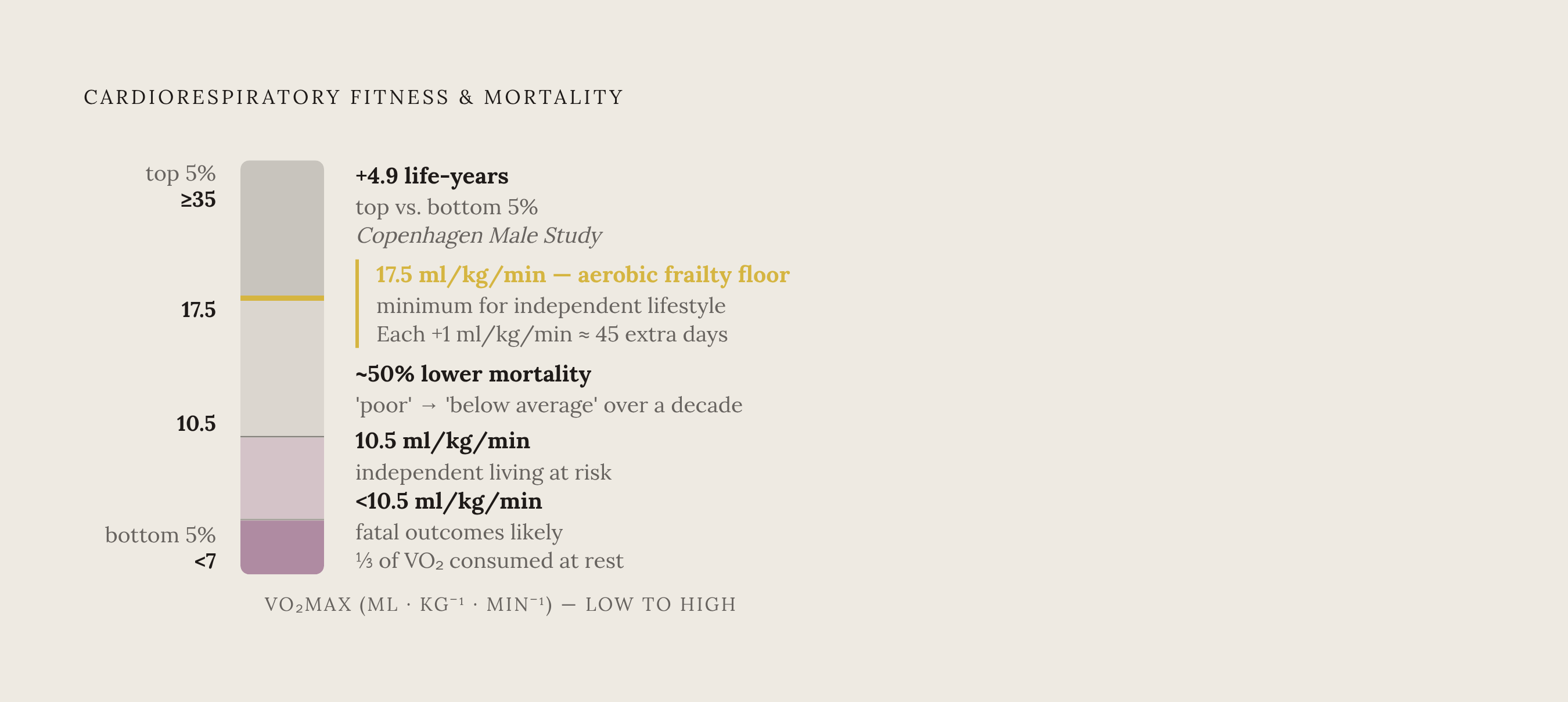
Why does that matter outside a lab? Because there's a hard floor beneath which daily life gets physically difficult. Strasser and Burtscher put that floor at 17.5 ml/kg/min, the level of aerobic capacity needed to sustain an independent lifestyle. Drop below it, and ordinary tasks (climbing stairs, carrying groceries, walking briskly to catch a bus) start eating up whatever aerobic reserve is left. Below 10.5 ml/kg/min, roughly a third of oxygen uptake goes just to keeping the body idling at rest, and outcomes at that point can turn fatal.
So this is a number that applies far beyond athletes chasing a personal best. It's a number that describes whether the body can keep up with the demands of everyday living, this year and in the decades still ahead.
How strongly VO2max predicts mortality: the evidence at scale
The link between VO2max and how long someone lives isn't a single study that got lucky. A 2024 overview in the British Journal of Sports Medicine pulled together meta-analyses covering more than 20.9 million observations, making it one of the largest evidence bases behind any fitness metric in existence PLOS ONE, 2025.
The individual studies inside that pile are striking on their own. A Cleveland Clinic analysis of 122,007 adults found that the least fit group carried roughly five times the risk of death compared to the fittest group, an effect size that outweighs smoking, diabetes, or coronary artery disease. Fitness level outpredicted smoking status. That's not a small claim.
The dose-response relationship holds up too. Each 1 MET increase in fitness, about 3.5 ml/kg/min, tracks with a 13% drop in all-cause mortality risk and a 15% drop in cardiovascular event risk, according to a JAMA analysis; Strasser and Burtscher separately land on a similar 15% reduction in cardiovascular risk. A more recent Scientific Reports model from 2026 takes a more conservative angle, estimating a 3.7% mortality reduction per 1 ml/kg/min gain, but even that smaller number stays clinically meaningful across a population FitCraft. Heart failure risk specifically drops by 21% for every 1 MET increment in cardiorespiratory fitness.
The longest-running data point comes from the Copenhagen Male Study, which followed 5,107 men with an average age of 48.8 at enrollment for 46 years. Compared against the bottom 5% for cardiorespiratory fitness, men with low-normal fitness gained 2.1 extra years of life, high-normal fitness bought 2.9 years, and the top 5% gained 4.9 years JACC study. Broken down further, each 1 ml/kg/min increase in VO2max tracked with roughly 45 extra days of life JACC study.
Why does VO2max keep beating single-pathway risk factors? Because it's measuring several things at once. It's the accumulated output of cardiovascular, metabolic, and muscular health, all captured in one test at once. As longevity specialist Dr. Elie Abirached has put it, many longevity clinics still overlook VO2 testing despite its unmatched ability to reflect whole-system biological function.
Most of this evidence comes from observational cohorts, which shows association but not airtight proof of causation JACC study. Reverse causation was largely ruled out, as results were essentially unchanged when deaths in the first 10 years were excluded.
How VO2max declines with age and where the critical thresholds sit
Fitness erodes with age, roughly 1% a year on average, and the numbers over a lifetime are sobering: men's median VO2max slides from about 42.5 ml/kg/min in their 20s down to around 22 ml/kg/min by 80, cutting the starting value nearly in half.
That decline doesn't move in a straight line. It's gradual through the middle decades, then it steepens, and the part most people don't see coming is how much faster the drop accelerates after 60. Strasser and Burtscher put a number on the pace: roughly 7 to 10% lost per decade, and they describe counteracting that slide through training as essential to avoid falling below the aerobic frailty threshold.
That threshold, 17.5 ml/kg/min, is the point below which independent living becomes physiologically marginal, and a 70-year-old who coasts without training is measurably approaching this line. A 70-year-old who's stopped training isn't just getting older in the abstract; they're measurably drifting closer to a line where independent living stops being a given. But what if someone's already below average, not near the bottom? The data on that group is arguably the most encouraging part of the whole picture: moving from "poor" fitness to just "below average" cuts mortality risk by roughly 50% over a decade. The biggest gains sit at the bottom of the fitness curve, not the top.
Age doesn't erase the benefit of staying active, either. Dr. Andrew Sellars notes that consistent training, along with decent sleep and managing recovery, can dramatically slow metabolic decline even in later decades, and highly trained athletes can sustain impressive scores into their 70s. The biological slope of decline is largely fixed. Where someone starts each decade, though, is not, and that starting point is what training actually controls.
What counts as a good number at your age and why population norms are a limited benchmark
For men, the "excellent" cutoffs run above 49 ml/kg/min in the 30s, above 45 in the 40s, and above 41 in the 50s. For women, "excellent" sits above 41 ml/kg/min in the 30s, above 38 in the 40s, and above 35 in the 50s.
Where should someone actually aim? One useful target, borrowed from the "Centenarian Decathlon" framing of training, is the 75th percentile for age and sex, which is roughly at the lower edge of "excellent" on the ACSM table. The logic behind that target rests on preserving function in your 70s and 80s rather than on performance in your 40s or 50s. It's about preserving the physical margin needed to still do the things that matter in your 70s and 80s: carrying luggage up a flight of stairs, getting off the floor without help, keeping up on a hike.
Any percentile table has a catch, though. It only tells you where you rank against everyone else tested, and that population's average fitness is itself pretty unimpressive by clinical standards. Sitting in the middle of a group that isn't very fit to begin with is not the same as sitting at low mortality risk. The mortality curve doesn't check percentile rank; it tracks absolute VO2max numbers regardless of who else got tested that year. A 50-year-old sitting in the top quartile for their age is, cardiovascularly speaking, functioning decades younger than a 50-year-old stuck in the bottom quartile.
Check the ACSM table to see where you stand today, then use the mortality dose-response, that roughly 45-day longevity gain per 1 ml/kg/min improvement, to understand why moving up from that starting point is worth the sweat. The VO2 Master score ranges, per Dr. Sellars (2025), are: 60–70 ml/kg/min for excellent (trained amateurs/competitive athletes); 50–60 for good (recreational athletes); 40–50 for average (moderately active adults); 20–40 for low (sedentary, aging, or recovering); and below 20 for very low (high-risk/frailty).
How to get an accurate measurement: lab tests, fitness venues, and the limits of smartwatch estimates
It works by strapping on a mask that captures oxygen consumed and carbon dioxide produced breath by breath, while an ECG tracks heart rhythm and the workload ramps up progressively until maximum effort. The whole test typically runs 12 to 20 minutes.
It isn't perfect. Someone can quit before actually reaching true VO2max, whether from discomfort or simply running out of will to keep pushing, and when that happens a supramaximal exercise test can confirm whether the number recorded really was the ceiling. Clinical metabolic cart systems such as the COSMED Quark CPET, MGC Diagnostics Ultima, Vyaire Medical Vyntus, and Jaeger Oxycon Pro cost $40,000–$80,000 or more, which explains why full CPET testing is confined to hospitals, universities, and specialty clinics rather than the local gym.
Pricing for 2026 varies quite a bit depending on where the test happens FitCraft. University or sports-science labs tend to cost around $150 ICT&health. A clinical CPET with physician interpretation costs $300–$600+ and may be covered by insurance if ordered for a clinical indication (unexplained dyspnea, cardiac rehab, or pre-surgical clearance), but fitness testing is almost never covered. Life Time is rolling out SpiroFit VO2max testing nationally in 2026, a sign this kind of testing is spreading into mainstream fitness spaces, even though quality and standardization across venues still varies.
What about the watch on your wrist? A 2025 study published in PLOS ONE tested the Apple Watch Series 9 and Ultra 2 against lab-measured VO2max in 28 participants and found a mean absolute error of 6.92 ml/min/kg, with 95% limits of agreement spanning more than 24 ml/kg/min PLOS ONE, 2025. In practical terms, that means an individual reading could run six points too high or eighteen points too low PLOS ONE, 2025. That's a massive range when the difference between "average" and "excellent" on the ACSM table can be a matter of single digits.
Among highly trained athletes specifically, Garmin's error rate can climb to between 9.4% and 10.4%. Dr. Sellars points out that wearable readings fluctuate day to day, which is itself a tell that these are estimates built on algorithms, not direct physiological measurements, even though many wearable makers validated those algorithms using portable gas analyzers during development.
Research is pushing toward something more sophisticated. A UCSF-linked study is exploring whether VO2max can be estimated from accelerometer and EKG signals gathered passively during daily life, using machine learning to fill the gaps, though that approach hasn't been validated for clinical use yet. For now, anyone who wants a genuine baseline number, one that actually means something against the mortality curves discussed earlier, needs a mask-based lab test. The wearable is fine for watching trend lines move over months. It's not the tool for knowing where you actually stand. The gold standard is CPET (cardiopulmonary exercise test). Here is where to get tested and what to expect to pay, in 2026 pricing. A fitness/body-composition studio, such as DexaFit, costs $99–$175. A dedicated performance or longevity clinic in a major city costs up to $175–$400, with a clinical CPET with physician interpretation costing $300–$600+. Apple Watch and Garmin both use heart rate and pace with population-based algorithms, Garmin via Firstbeat, and the direction of error differs, with Garmin tending to overestimate trained athletes while Apple Watch tended to underestimate a high-fitness sample.
What moves VO2max: the training methods with meaningful evidence behind them
VO2max responds, directly and reliably, to training. Genetics and accumulated damage explain a lot of variance in other biomarkers. This one bends to what someone actually does on a weekly basis.
Training produces that improvement through physiological changes that are well mapped. Training raises cardiac output, expands blood volume, drives new capillary growth into working muscle, increases the volume and function of mitochondria, and shifts muscle fiber composition toward more oxidative, endurance-suited fibers. Every one of those changes plugs directly into the Fick equation from earlier: more cardiac output, better oxygen delivery, better oxygen extraction. That's the whole formula, improving on every front at once.
High-intensity interval training produces the largest VO2max gains for the amount of time invested. The classic version is the Norwegian 4x4 protocol: four rounds of four minutes at roughly 90 to 95% of max heart rate, separated by three minutes of easier active recovery, one of the most extensively studied interval formats in the research literature. It doesn't have to be that structured to work, though. That's a substantial jump. That's the difference between sitting in "low" and climbing into "average" on Dr. Sellars's scale, in a matter of months.
Zone 2 training fills a different role PLOS ONE, 2025. This is the low-intensity aerobic work, walking at a brisk pace, easy cycling, a jog slow enough that a full conversation is still comfortable. It builds better fat oxidation, denser mitochondria, and a stronger stroke volume from the heart, forming the aerobic base for everything else, all without hammering the joints the way repeated high-intensity efforts can. Which raises the obvious next question: does one replace the other? It doesn't replace the other. Training only for the extremes, all sprinting or all shuffling, leaves gains on the table that a mix of both intensities would capture.
The bigger point standing behind all of this is that VO2max stays malleable through training well beyond whatever trait you were handed at birth. It's a moving target, one of the few numbers tied this closely to mortality risk that responds to a training plan inside a matter of weeks. Knowing the number is the easy part. What happens next, whether someone trains toward the aerobic frailty threshold or away from it, is the part actually worth building a plan around. Even simpler intervals of 2 minutes fast and 2 minutes easy produce significant cardiovascular benefits, per Dr. Sellars (VO2 Master, 2025). HIIT-induced gains are supported by research showing improvements in the range of 15–20% in previously sedentary or moderately active adults, according to ICT&health. This is an essential complement to high-intensity work, not a replacement, involving the ratio of Zone.
Sources
- VO2 Max & Longevity: Insights from Dr. Abirached & Dr. Sellars - VO2 Master
- Midlife Cardiorespiratory Fitness and the Long-Term Risk of Mortality: 46 Years of Follow-Up | JACC
- 1505 Survival of the fittest: VO2max, a key predictor of longevity?
- VO2 Max and Longevity: What the Research Shows | FitCraft
- VO2max from a smartwatch. Is it a new longevity biomarker? | ICT&health
- UCSF Cardiopulmonary Trial → Supporting Validation of VO2Max Estimation Methods Using Results in Patients Receiving Standard of Care Cardiopulmonary Exercise Tests (CPET)
- Benchmark Body Metrics - VO2 Max and Longevity: What Studies Show
- VO2max ageing and all cause mortality in a global cohort of multi marathoners | Scientific Reports