Caloric Restriction Evidence in Humans From CALERIE
Moderate calorie restriction slowed aging markers in healthy adults over two years.

Cut calories and yeast lives longer. Same with worms, flies, and mice. That result has held up for decades in the lab, and it's part of why caloric restriction became one of the most discussed levers in aging science. But every one of those results came from an organism that isn't human, and for just as long, nobody had run the actual experiment on people.
What existed instead was suggestive. Okinawan populations who ate less and lived long lives. The Biosphere 2 crew, who ended up in a forced calorie deficit and showed metabolic changes afterward. Interesting, but observational. No control group, no randomization, no way to separate caloric intake from genetics, culture, or the dozen other variables tangled up in each story. So the field had a real gap: strong animal data, suggestive human anecdotes, and nothing that met the bar of a randomized controlled trial in healthy, non-obese adults.
That's the gap CALERIE was built to close. The National Institute on Aging, part of the US National Institutes of Health, started the program in 2001 for exactly this reason. Phase 2 ran as a multicenter, randomized controlled trial across three clinical centers in the US, which is about as rigorous as a lifestyle study gets. Participants were split 2:1 between a calorie-restricted group and an ad libitum control group, and followed for 24 months. So what did two years of sustained restriction actually do to a healthy human body? That's where the data starts getting interesting. CALERIE's population comprised 218 participants aged 21–50 with a BMI of 22.0–27.9 kg/m², a healthy, non-obese, young-to-middle-aged cohort deliberately chosen rather than a patient population.
Participant tasks and achievements
The prescription cut caloric intake by 25% from baseline. In practice, people landed closer to 11.9%, on average, about half the original target.
That's not a failure of the trial. It might be the single most useful number to come out of it. A 25% reduction in caloric intake from baseline was the prescribed target. An 11.9% cut, on the other hand, is something a normal, motivated adult can hold onto over the long run, especially with the right support system in place. And CALERIE participants did have that support: structured dietary education throughout the trial. A study in the American Journal of Clinical Nutrition (Racette et al.) found that CR participants improved their diet quality while restricting, and kept nutrition adequate the whole time. It wasn't people just eating less of whatever they normally ate. It was structured coaching that made moderate, sustained restriction workable. Take away that scaffolding and the number likely drifts.
What did the reduction buy them? Weight loss in the CR group beat the control group by a wide margin, and importantly, the tissue that came off was mostly fat. Lean tissue made up only a small share of what participants lost. So the body composition changes point the right direction: fat down, muscle largely preserved.
What the primary outcomes revealed
Before getting into the biomarkers that made headlines, here is what CALERIE was actually designed to test first. The trial had two pre-specified primary outcomes: core body temperature and resting metabolic rate. These weren't picked at random.
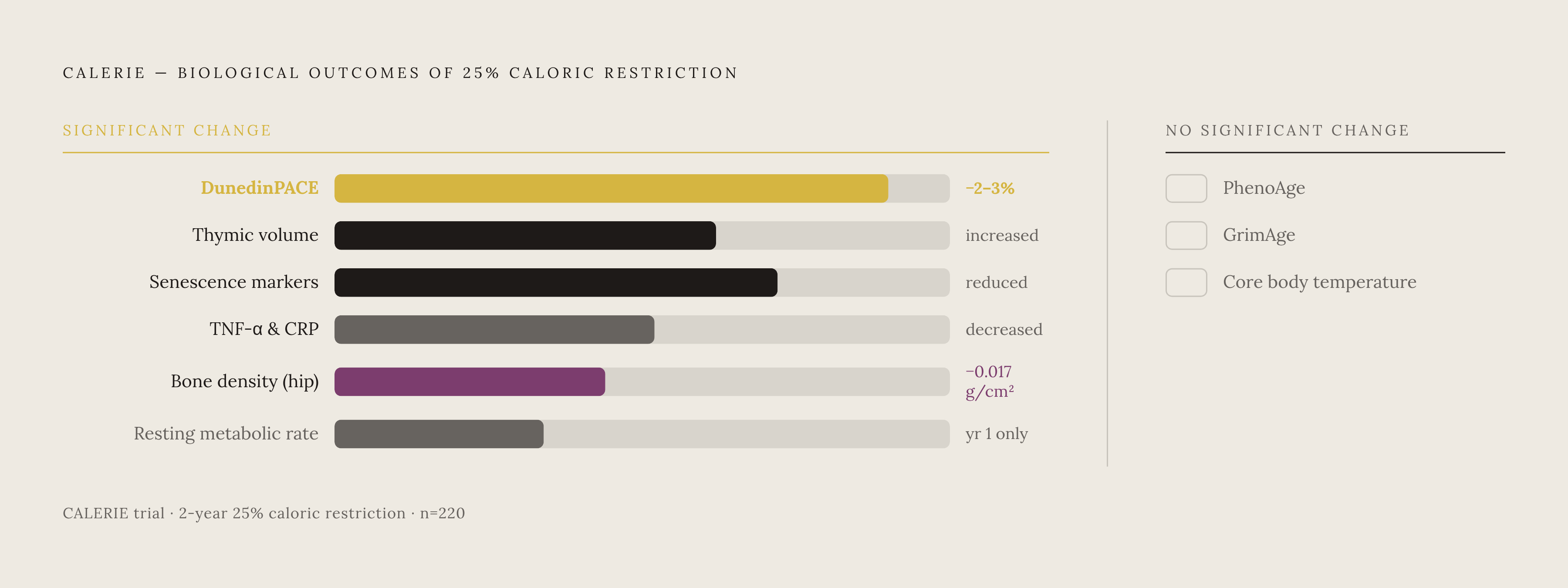
The honest part is this. Core temperature didn't move in any statistically meaningful way. Resting metabolic rate did drop, but only during the first year, and that effect faded out by month 24.
Is that disappointing? Only if the goal was to confirm the animal story point for point. Read differently, it's a sign the trial was rigorous enough to say "this specific pathway didn't hold up," instead of forcing a positive spin onto a null result. A study that only ever finds what it expects to find isn't teaching anyone anything new. CALERIE's real value lies in the outcomes nobody had pre-registered as primary, but which turned out to carry the most weight. In animal models, reduced core temperature and sustained metabolic slowing are proposed mechanisms linking caloric restriction to longevity, but neither replicated cleanly over 24 months in humans.
The cardiometabolic biomarker improvements that did emerge
The cardiometabolic analysis, published in The Lancet Diabetes & Endocrinology, covered a wide exploratory panel: blood pressure, plasma lipids, high-sensitivity C-reactive protein, metabolic syndrome score, fasting insulin, glucose, and insulin resistance. This is where two years of moderate restriction started to look genuinely useful. Blood pressure came down. Cholesterol came down. And inflammatory markers, including CRP and TNF-α, dropped too.
TNF-α deserves a second look, because of what it represents. It's a pro-inflammatory cytokine tied to "inflammaging," the slow-burn, chronic inflammation that's thought to drive a lot of what people call biological aging. Seeing it drop in healthy adults under moderate CR is a meaningful signal, not just a lab curiosity.
The hormone panel tells a similarly coherent story. The CR group saw bigger increases in vitamin D, cortisol, and adiponectin, alongside decreases in leptin and insulin, compared to controls. Adiponectin and leptin move together in this story. Higher adiponectin tracks with better insulin sensitivity. Lower leptin means less fat-driven inflammatory signaling. Both point the same direction, toward better metabolic health, not just less body fat on a scale.
Then there's T3, and this is the one readers watching their own labs should actually understand before panicking. T3 dropped more in the CR group at both 12 and 24 months. But TSH, T4, and free T4 stayed put. Why does that matter? Because it tells you where the change is happening. If the thyroid gland itself were struggling, TSH would climb as the body tried to compensate. TSH didn't climb as the body tried to compensate. What's more likely is that less T4 got converted into T3 out in the tissues, a peripheral adjustment rather than a glandular problem. So a lower T3 number on a CR diet isn't hypothyroidism. The thyroid is working exactly as it should. And there's evidence pointing the other way entirely: lower T3 has been linked to longer lifespan and lower risk of age-related disease. Counterintuitive, maybe, but a lower number is not automatically bad news.
DNA methylation clocks and the pace of aging
This is the section that tends to generate headlines, so the mechanics come before the result. A post-hoc analysis pulled blood samples from 220 CALERIE participants and ran them through three DNA methylation clocks: DunedinPACE, PhenoAge, and GrimAge.
DunedinPACE was built differently from the other two, since prior human evidence on caloric restriction was observational, drawn from Okinawan studies and Biosphere 2 participants, and no randomized controlled trial had tested CR prospectively in healthy, non-obese adults before CALERIE. Researchers first tracked 19 biomarkers over 20 years of follow-up in a long-running cohort, built a composite measure called "Pace of Aging" from how fast those biomarkers changed, then used machine learning to compress that into a single blood test. The output is a rate: biological years aged per calendar year. Below that, and the body is aging slower than the calendar.
In the CR group, DunedinPACE showed a slowing of the pace of aging, somewhere in the range of 2 to 3%. That number has been compared elsewhere to the kind of benefit seen from quitting smoking, but that comparison is an analogy drawn from outside literature, not a hard endpoint CALERIE itself measured. That comparison should not be repeated as fact.
PhenoAge and GrimAge, on the other hand, didn't move in any significant way. Is that a contradiction? Not really, once you know what those two clocks were built to do. Both were developed to predict mortality risk at a single point in time, mostly in older, mixed-age populations, essentially summing up a lifetime of accumulated risk into one number. DunedinPACE, built around rate of change rather than accumulated risk, is simply more sensitive to catching a two-year intervention in a cohort that was young to middle-aged to begin with. One was built to catch exactly this kind of signal. The other two weren't, and it shows.
Evidence that CR reduced cellular senescence and inflammaging
The DunedinPACE result raises an obvious question: cellular senescence, the buildup of damaged cells that stop dividing but refuse to die and instead sit there secreting inflammatory signals into surrounding tissue, is one of the leading candidate mechanisms behind the change. Cellular senescence is one of the leading candidates. It's the buildup of damaged cells that stop dividing but refuse to die, and instead sit there secreting inflammatory signals into surrounding tissue. Most researchers treat it as one of the core drivers of aging and age-related disease.
The evidence has come in waves, each one adding detail to the last. In 2024, a team working with plasma from CALERIE Phase 2 (Aversa, White, Heeren et al., published in Aging Cell) found that CR significantly reduced concentrations of several senescence biomarkers at both 12 and 24 months compared to controls. Then in 2025, researchers applied a panel of 130 inflammation-related epigenetic scores across the full CALERIE cohort of 594 participants, checking how well those scores lined up over time with actual serum markers like CRP, IL-6, TNF-α, oxidative stress indicators, and immune cell counts. It's one of the most detailed inflammaging analyses run on any CR trial to date.
Then, in 2026, a Nature Aging paper pushed the mechanism further still, applying proteomics to plasma samples collected over time from CALERIE participants. It traced the effect to a specific complement protein, C3a. The C3a/C3 ratio dropped significantly under CR, cutting inflammation coming from three separate complement pathways. In aged mice, fat tissue macrophages produce C3a, and blocking C3a directly blocks inflammaging. Three papers, three years apart, all drawing from the same trial, each one narrowing in on a more specific piece of the puzzle. That's a dataset still paying dividends years after the intervention ended.
What happened to immune function, and the thymus finding
Cut calories for two years and a reasonable person might worry about immune function taking a hit. Less fuel, less capacity to fight things off, goes the intuition. CALERIE's data runs the opposite way.
Sustained moderate CR over 24 months did not reduce immune function, and was associated with improved adipose tissue metabolism, decreased inflammation, and reduced thymic lipoatrophy. The thymus is where T cells mature, and it's one of the organs that tends to age faster than the rest of the body. In the CR group, MRI scans showed an increase in total thymic volume.
There's a second marker backing this up: sjTRECs, short for signal-joint T cell receptor excision circles. These are markers of freshly made T cells, and a good proxy for how well the thymus is functioning. The control group showed no change at all. So the thymus wasn't just holding steady under caloric restriction. It looked like it was making more new immune cells than before.
Low levels of an enzyme called PLA2G7 (platelet activating factor acetyl hydrolase) tracked with the immune and metabolic benefits seen under CR, and appears connected to both lower inflammation and longer lifespan in healthy, mid-aged adults. The full biochemistry is still being worked out, but it's a concrete lead pointing at how the thymus effect might actually happen at a molecular level.
What CALERIE showed about telomere length
Telomeres get more public attention than almost any other aging biomarker, and for good reason: they're the protective caps on the ends of chromosomes, and they shorten a little with each cell division. Shorter telomeres, in general, track with faster aging and higher disease risk. Naturally, once CALERIE data was collected, telomere length was going to get measured.
The analysis was published in Aging Cell in 2024, run by a large team including Hastings, Ye, Wolf, Ryan, Das, Huffman, Kobor, Kraus, MacIsaac, Martin, Racette, Redman, Belsky, and Shalev. What does it add to the overall picture? Mostly, it's a data point sitting alongside the DunedinPACE result, the senescence findings, and the epigenetic clock work, part of a broader, multi-measure attempt to capture biological aging from several angles at once. No single marker, telomeres included, tells the whole story on its own. That's arguably the more honest takeaway than any single dramatic number: aging runs on several dials at once. It's several dials, and CALERIE checked more than one.
The real safety signals (bone density, lean mass, and nutritional adequacy)
None of this comes free, and CALERIE didn't hide that. The figures on femoral neck bone density loss come from Villareal et al., published in the Journal of Bone and Mineral Research.
Is that a red flag or an expected consequence? The bone loss tracked in line with the amount of weight lost, so it wasn't wildly out of proportion. Still, it deserves ongoing monitoring, especially for women and anyone who already has borderline bone density.
Lean mass told a gentler story. At roughly 12% CR sustained over two years, participants lost a small amount of leg lean mass, but muscle strength didn't budge. Out of all the tissue lost, only 17.5% was lean mass, the rest was fat. Underneath that, at the gene expression level, muscle tissue in CR participants showed changes across a wide set of pathways: proteostasis, circadian rhythm regulation, DNA repair, mitochondrial biogenesis, mRNA processing and splicing, FOXO3 metabolism, apoptosis, and inflammation. Taken together, that pattern suggests moderate, attainable CR may improve the quality of skeletal muscle even as the quantity dips slightly. At the total hip, the CR group declined by −0.017 ± 0.002 g/cm² compared with 0.001 ± 0.003 g/cm² in controls (p < 0.001). At the femoral neck, the CR group declined by −0.015 ± 0.003 g/cm² compared with −0.005 ± 0.004 g/cm² in controls (p = 0.03).
Nutritional adequacy was the quiet precondition for all of this. CALERIE participants managed to restrict calories while keeping nutrition adequate, but that outcome leaned entirely on the structured dietary education built into the trial. It wasn't self-directed guesswork. A study (Dugan, Das et al., Journal of Nutrition) specifically called out iron status as something worth monitoring clinically during sustained CR. That's a fitting note to end on: moderate caloric restriction produced real, measurable benefits across inflammation, thymic function, and the pace of aging itself, but it worked because it was structured, monitored, and supported, not because someone simply decided to eat less and hoped for the best. Caloric restriction produced real, measurable declines in bone mineral density over 24 months. At the lumbar spine, the CR group declined by −0.013 ± 0.003 g/cm² compared with 0.007 ± 0.004 g/cm² in controls (p < 0.001).
Sources
- CALERIE: Comprehensive Assessment of Long-Term Effects of Reducing Intake of Energy
- Effect of long‐term caloric restriction on telomere length in healthy adults: CALERIE™ 2 trial analysis - Hastings - 2024 - Aging Cell - Wiley Online Library
- Calorie restriction reduces biomarkers of cellular senescence in humans - PMC
- 2 years of calorie restriction and cardiometabolic risk (CALERIE): exploratory outcomes of a multicentre, phase 2, randomised controlled trial - The Lancet Diabetes & Endocrinology
- Effect of long-term caloric restriction on DNA methylation measures of biological aging in healthy adults from the CALERIE trial | Nature Aging
- Effects of caloric restriction on human physiological, psychological, and behavioral outcomes: highlights from CALERIE phase 2 - PMC
- A 2-Year Randomized Controlled Trial of Human Caloric Restriction: Feasibility and Effects on Predictors of Health Span and Longevity - PMC
- Effect of Long-Term Caloric Restriction on Epigenetic Proxies of Inflammaging: CALERIE™ 2 Trial Analysis