ApoB as a Longevity Biomarker Beyond LDL
Particle count matters more than cholesterol mass for predicting cardiovascular risk.

Picture two delivery trucks on the same route. One measurement tells you how much cargo is packed inside a particular kind of truck. The other tells you how many trucks are actually on the road. That's the gap between LDL-C and ApoB, and it's the foundation everything else in this piece rests on.
LDL-C reports the total mass of cholesterol packed inside LDL particles. It's a cargo measurement, nothing more. ApoB counts something different: the number of atherogenic particles circulating in the blood, each one carrying a single copy of the surface structural protein that marks it as atherogenic. One particle, one ApoB molecule, one countable unit. That one-to-one relationship makes ApoB a direct particle count.
The amount of cholesterol packed into any given LDL particle varies a lot from person to person, and even within the same person over time. Two people can post identical LDL-C numbers on a lab report while one of them carries that cholesterol in far more individual particles than the other. A 2024 analysis of 293,876 adults in the UK Biobank found ApoB varied substantially even among people who shared the same LDL-C reading. More particles mean more chances for that cargo to interact with the artery wall and get stuck there, regardless of how much cholesterol each truck happens to be hauling.
A scientifically reviewed overview on lipid testing makes a related point: measuring LDL alone leaves out other pro-atherogenic lipoproteins that also carry a single copy of that same surface protein each, including other cholesterol-carrying remnant particles. ApoB captures all of them in one number. LDL-C only accounts for the cholesterol riding in LDL specifically. That's a narrower window onto the same traffic.
How ApoB drives atherosclerosis physically, not just chemically
Particle count determines the degree of arterial damage because each particle, regardless of cholesterol content, can be retained in the artery wall and trigger inflammation. The answer sits in how these particles behave once they leave the bloodstream and enter the artery wall.
ApoB100 is the structural protein that sits on the surface of every atherogenic lipoprotein. It binds to proteoglycans in the subendothelial space, retaining the particle inside the artery wall instead of letting it pass through, and that retention makes it an active agent. Retention is the step that starts everything else: once a particle is stuck, it contributes to plaque formation and sets off inflammatory cascades, including activation of the NLRP3 inflammasome.
Consider what that means for two particles with different cargo. A cholesterol-rich particle and a cholesterol-depleted particle both carry one copy of that same surface structural protein. Either can bind proteoglycans. Both can get retained. Both can trigger the same inflammatory response. The cholesterol-poor particle isn't a lesser threat just because it's hauling less. It counts as one atherogenic event, same as the cholesterol-rich one.
That's the mechanistic case for treating particle number as the variable closer to the actual cause of harm. Cholesterol content is cargo. Retention and inflammation are what hurt the artery, and those are driven by how many particles show up, not how much they're carrying.
LDL-C versus ApoB discordance
If particle count is what matters physically, the next question writes itself: how often does LDL-C fail to reflect it? More often than a lot of people assume, and not randomly. LDL-C and ApoB diverge in predictable populations: people with metabolic syndrome, type 2 diabetes, elevated triglycerides, or low HDL. These are exactly the groups most likely to produce small, dense, cholesterol-depleted LDL particles, the kind that inflate particle count without raising LDL-C proportionally.
Think about why that happens. A small, dense particle carries less cholesterol than a larger one. So someone whose metabolism is shifting more of their LDL into that smaller, denser form can have a perfectly reasonable LDL-C number while their actual particle count, their ApoB, sits elevated. The lab report looks controlled. The underlying exposure doesn't match.
A 2025 systematic review in Diabetes, Obesity and Metabolism, covering nine studies, found significant discordance between LDL-C and ApoB in people with metabolic syndrome or type 2 diabetes, with these individuals often hitting optimal LDL-C while their ApoB concentrations stayed elevated. Using a cutoff of ApoB ≥100 mg/dL, the same review found a meaningful share of participants carried isolated high ApoB with no sign of trouble on a traditional lipid panel. Their cholesterol numbers looked fine. Their particle burden didn't.
Men, smokers, and people with higher body mass index or hypertension show this same pattern disproportionately: discordantly high ApoB relative to what their LDL-C would suggest. For anyone in these groups, a standard lipid panel can hand back a falsely reassuring result. For a given person, the discordance is a reason to ask what else the panel might be missing.
ApoB and LDL-C as predictors, compared
Discordance is a pattern. What happens when researchers test whether that pattern actually predicts outcomes? This is where the case for ApoB stops being theoretical.
A pooled cohort analysis in Lipids in Health and Disease examined more than 68,000 statin-treated patients with established coronary artery disease, the most counterintuitive finding among them. Researchers calculated "excess ApoB," the gap between a patient's measured ApoB and the ApoB predicted from their LDL-C. Patients in the highest quartile of excess ApoB had significantly worse survival, and that held true across every achieved LDL-C stratum, including patients who had already hit their LDL-C targets. Hitting your number on a standard panel did not mean your particle-level risk was gone.
That finding lines up with earlier prospective evidence. The ATTICA Study followed a large Greek cohort of adults free of cardiovascular disease from 2002 to 2022, twenty years of data. Elevated ApoB independently predicted increased ASCVD risk over that period beyond what LDL-C, non-HDL-C, and Lp(a) could capture on their own. A discordance analysis within that same cohort confirmed elevated ApoB predicted risk regardless of a person's non-HDL-C or Lp(a) status.
The ODYSSEY-Outcomes Trial adds a smaller but pointed piece of evidence: achieved LDL-C and achieved non-HDL-C stopped predicting major adverse cardiovascular events once achieved ApoB was factored in. LDL-C's apparent predictive power in that trial was absorbed by ApoB.
Put those findings next to a systematic review in the Journal of Clinical Lipidology covering discordance studies broadly: ApoB outperformed LDL-C in all nine direct comparisons it examined, and beat non-HDL-C in most of the studies where both were tested. The review's conclusion was blunt. Neither LDL-C nor non-HDL-C serve as adequate clinical surrogates for ApoB. The statin-treated cohort result challenges a specific and common assumption, that reaching your LDL-C target means the job is done, and the evidence says residual particle-level risk can persist underneath a number that looks perfectly fine.
ApoB as a longevity signal, not just a cardiovascular one
So far, the case for ApoB has been built on heart disease. But does the story stop at the artery wall? Growing evidence says no, and that's what turns ApoB from a cardiovascular marker into something closer to a longevity marker.
Mendelian randomization studies, which use genetic variation to test causal relationships rather than just correlations, show higher ApoB levels shorten healthspan in humans. A study published in Communications Biology went further: multivariable Mendelian randomization comparing ApoB and LDL directly found ApoB, not LDL itself, was the predominant trait driving that relationship. That's an important distinction. It suggests particle count carries the causal weight, with cholesterol mass along for the ride.
The same genetic research ties elevated ApoB to higher risk of heart attacks, strokes, and type 2 diabetes, three conditions that don't just shorten life but erode the quality of the years before death. And preliminary evidence links elevated ApoB to Alzheimer's disease risk, adding a brain-health angle to a marker most people file under "cardiovascular" and nothing else.
That accumulation is the argument for testing early, before symptoms appear. A heart attack or a stroke is a late-stage event sitting on top of years, often decades, of particle retention and arterial inflammation that builds quietly underneath. Measuring ApoB early gives a read on that buildup while there's still time to change its trajectory, rather than waiting for the arterial wall to announce the damage on its own schedule.
2026 ACC/AHA guidelines on ApoB testing and targets
The evidence above is what makes ApoB matter. What makes 2026 a notable year is that U.S. clinical guidelines finally caught up to it. The 2026 ACC/AHA guidelines formally incorporate ApoB into cardiovascular risk management for the first time, part of the first comprehensive U.S. guideline update in eight years. The recommendations are selective rather than universal, first-line testing for everyone, sitting at lower recommendation classes, but they come with specific testing guidance and real numerical targets attached.
Co-authored by the ACC and AHA along with nine other leading medical organizations, the guidelines recommend ApoB testing for people already on lipid-lowering therapy who have reached their LDL-C and non-HDL-C goals, particularly those with ASCVD, CKM syndrome, type 2 diabetes, or elevated triglycerides. They also recommend it selectively for adults not yet on therapy, as a way to sharpen risk assessment before treatment even starts. Once LDL-C is being treated and looks controlled, ApoB is the number that can reveal whether particle-level risk is actually still sitting there underneath it.
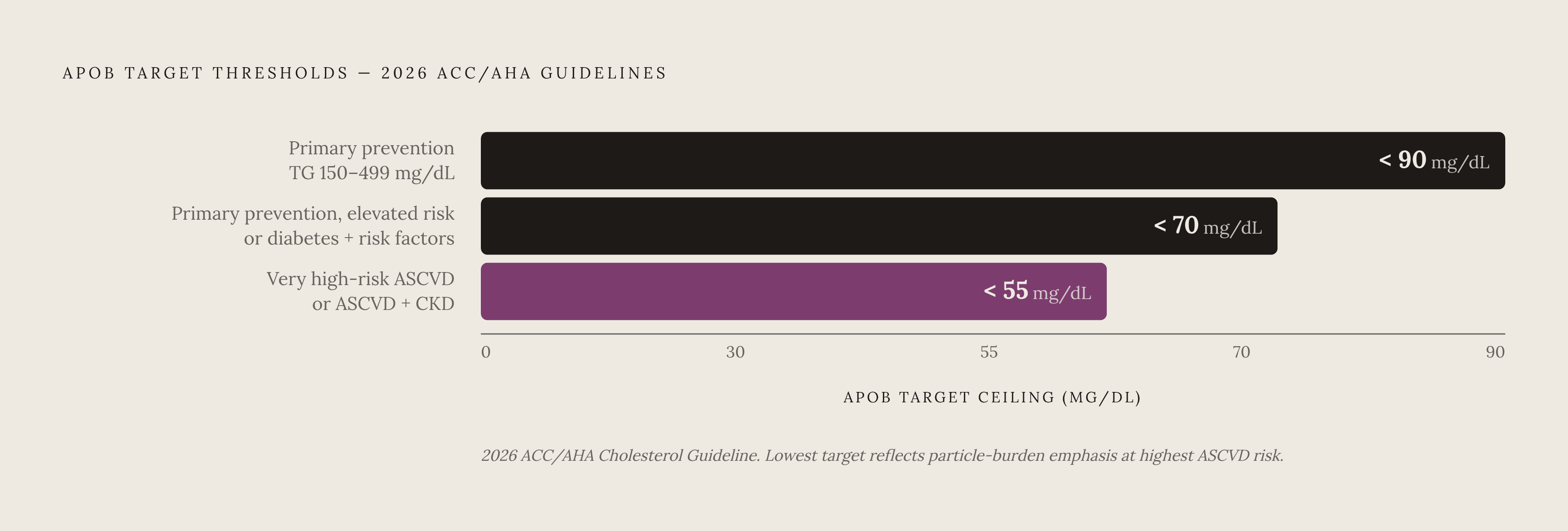
The guidelines lay out tiered ApoB targets for different risk groups. For primary prevention patients at lower PREVENT-ASCVD risk, with triglycerides between 150 and 499 mg/dL, the goal is under 90 mg/dL. For primary prevention patients at elevated risk, or those with diabetes and additional risk factors, the goal tightens to under 70 mg/dL. For very high-risk ASCVD, or clinical ASCVD with chronic kidney disease, the target drops to under 55 mg/dL. People with subclinical atherosclerosis and a high coronary artery calcium score are managed as very-high-risk ASCVD equivalents with an LDL-C goal under 55 mg/dL, though the guideline doesn't list a separate formal ApoB target for that specific subgroup.
The same update formally brings Lp(a) into the picture too, recommending it be measured as a risk-enhancing factor to personalize ASCVD risk assessment through the new PREVENT-ASCVD calculator. The guidelines note that statins don't lower Lp(a) and may even raise it modestly, a detail that matters for anyone whose elevated particle burden includes a substantial Lp(a) component. None of this changes why ApoB matters. It confirms that the clinical establishment has caught up to what the research has been showing. It gives anyone getting an ApoB number back from a lab something concrete to measure it against, a tier, a target, a direction to move in.
What moves ApoB, and by how much
A target is only useful paired with a way to move toward it. ApoB responds to both lifestyle changes and medication, and the better option for a given person depends on the mechanism driving their number up.
On the lifestyle side, a few levers have real evidence behind them. Losing a meaningful fraction of body weight lowers ApoB by reducing visceral fat and improving how the liver handles metabolism. Cutting saturated fat and replacing it with unsaturated fat can lower ApoB meaningfully in most people who make that swap consistently. One of the more specific, approachable interventions is oat beta-glucan: a review of 58 trials found a daily average of 3.5 grams lowered ApoB within five weeks, a change simple enough to fold into a normal diet without a prescription.
Medication is a conversation for a clinician, not a self-directed project, but it helps to understand what each option is actually doing. Statins work by inhibiting cholesterol synthesis in the liver, which forces the liver to pull more LDL receptors to its surface and clear more particles from the blood. They're effective at lowering ApoB substantially. Bempedoic acid achieves similar LDL reductions through a different pathway and suits people who can't tolerate statins, though it carries a risk of gout worth discussing directly with a clinician. Ezetimibe blocks cholesterol absorption in the intestine, is inexpensive, and tends to be well tolerated. PCSK9 inhibitors push receptor expression even further and are typically reserved for high-risk patients or those who don't respond adequately to first-line options.
Is the liver overproducing ApoB particles, or is the body failing to clear them fast enough through LDL receptors? Both overproduction and inadequate clearance tend to respond to statins or PCSK9 inhibitors, which is part of why those remain the backbone of medical treatment, but figuring out which mechanism dominates in a given person is a clinician's job, not a guessing game to run alone.
The payoff for getting this right isn't abstract. A JAMA modeling study found that using ApoB as a treatment target, rather than LDL alone, produced more quality-adjusted life-years, and it did so at a cost well below standard cost-effectiveness thresholds. The benefit of targeting the right number is measurable.
Why particle size alone does not
It's tempting to assume that if particle count matters, particle size must matter just as much, that small, dense LDL is the real villain and large, buoyant LDL gets a pass. The mechanism doesn't support treating size as the deciding factor. Every atherogenic particle, large or small, cholesterol-rich or cholesterol-depleted, carries the same single surface structural protein that mediates retention in the artery wall. Retention is what starts plaque formation and inflammation, and that step depends on the presence of ApoB, not on how much cargo the particle happens to be hauling. A small, dense particle and a large, buoyant one both count as one atherogenic event once they're lodged in the subendothelium. Size shapes which populations are more likely to show discordance between LDL-C and ApoB, since small dense particles carry less cholesterol per particle and can inflate particle count without moving LDL-C much. But size itself isn't the variable driving harm. Count is. That's the reasoning that keeps leading back to ApoB as the number worth tracking, ahead of cholesterol mass and ahead of particle size, because it measures the thing closest to the actual mechanism of disease.
Sources
- Apolipoprotein B outperforms low density lipoprotein particle number as a marker of cardiovascular risk in the UK Biobank - PubMed
- Lipid Biomarkers and Cardiometabolic Diseases: Critical Knowledge Gaps and Future Research Directions
- Concordance‐discordance between apolipoprotein B and lipid biomarkers in predicting 20‐year atherosclerotic cardiovascular disease risk: The ATTICA study (2002–2022)
- ApoB vs. LDL-C for ASCVD Risk: Treatment Reclassification and Outcomes — Systematic Review - ScienceDirect
- Excess apolipoprotein B predicts long-term survival in statin-treated CAD irrespective of achieved LDL-C levels: a pooled cohort analysis
- Mendelian randomization reveals apolipoprotein B shortens healthspan and possibly increases risk for Alzheimer’s disease
- APOLIPOPROTEIN B: Bridging the gap between evidence and clinical practice - PMC