Inflammaging and Chronic Low-Grade Inflammation
Understanding inflammaging reveals why chronic low-grade inflammation damages aging bodies.

Chronic low-grade inflammation builds up in the body with age, quietly, with no infection or injury to set it off. Researchers call this inflammaging, a term coined by immunologist Claudio Franceschi and revisited in recent research that has returned to his original framework. Understanding the machinery behind it gives people a concrete way to slow biological aging before the damage turns permanent.
Acute inflammation and inflammaging are not the same animal. Acute inflammation appears in response to injury, does its job, and leaves: a sprained ankle swells, then heals. Inflammaging never resolves. It sits at a low simmer for years and eventually starts damaging the tissues it was supposed to protect. Immunologists call this antagonistic pleiotropy: the same immune hyperactivation that kept a 25-year-old alive through a serious infection turns into a liability at 65, when there's no infection to fight and the inflammatory signal keeps firing anyway. Useful early, harmful late.
A June 2026 review in Current Issues in Molecular Biology, led by Tero-Vescan and colleagues, pushes the idea further: inflammaging is dynamic and driven by specific molecules, with specific downstream consequences. That distinction changes which biomarkers actually tell you something useful, which diseases inflammaging feeds, and which interventions have a real shot at slowing it.
The biological machinery that produces chronic low-grade inflammation with age
A small set of molecular hubs drives nearly every trigger of inflammaging. The 2026 Tero-Vescan review names five: NF-κB, the NLRP3 inflammasome, cGAS-STING, JAK/STAT, and p38 MAPK. Almost every upstream driver of aging-related inflammation eventually runs through one of these five.
Four things feed into them, mainly.
Cellular senescence comes first. Senescent cells stop dividing but don't die off the way they're supposed to. Instead they stick around and keep pumping out inflammatory molecules, a pattern called the senescence-associated secretory phenotype, or SASP. Think of a smoke detector that never shuts off, years after the fire's out, still signaling danger long after the danger is gone. That's what one senescent cell does to the tissue around it, signal after signal, for years.
Mitochondrial dysfunction comes second. Damaged mitochondria leak molecular debris, things like damage-associated molecular patterns (DAMPs) and stray fragments of mitochondrial DNA, into the cell's interior. The innate immune system reads those fragments as a threat and mounts a response, even with no actual pathogen anywhere nearby.
Immunosenescence is third, and it's the cruelest twist of the four. As the immune system ages, it gets louder on the inflammatory side and weaker on the defensive side, at the same time. More background noise, less actual ability to clear a new infection or catch a cancerous cell early.
Gut microbiome dysbiosis is fourth, and it earns its own section further down, since it's one of the more actionable levers in the whole system.
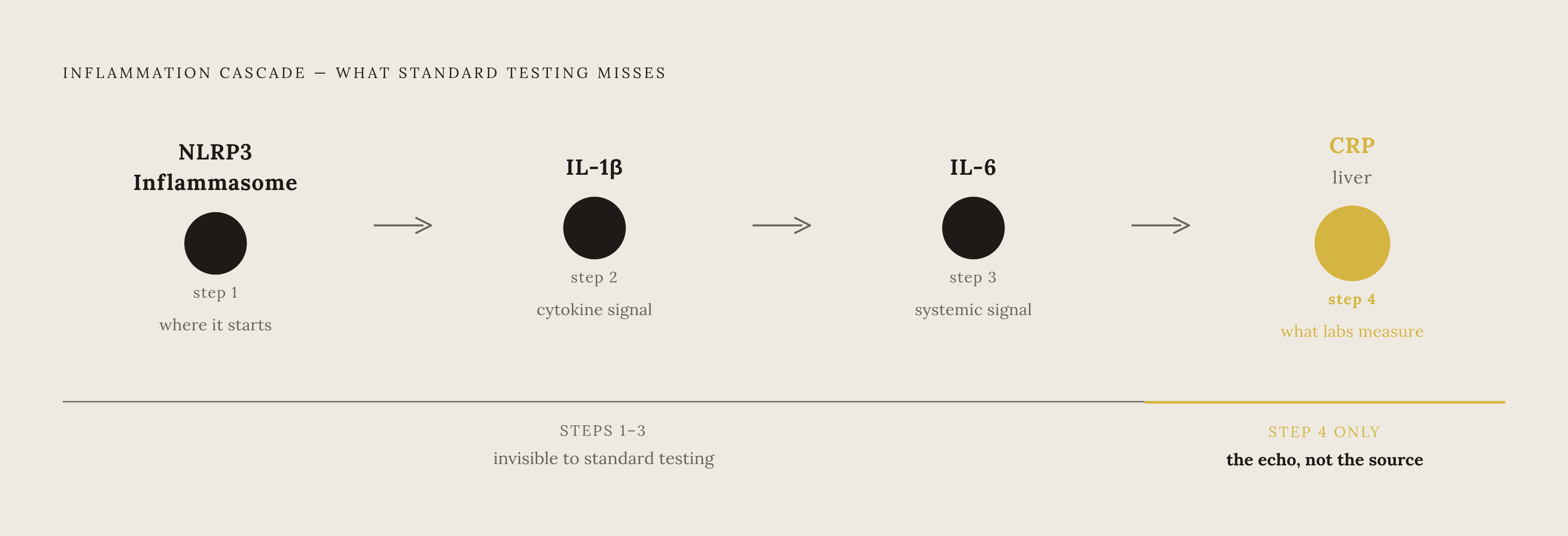
The NLRP3 inflammasome deserves a slower look, because it explains something that trips up a lot of people reading their own labs. NLRP3 activates and triggers release of IL-1β. IL-1β stimulates IL-6. IL-6 then drives the liver to produce CRP, the marker most people actually get tested for. CRP sits at the very end of that chain. That distinction affects how lab reports are interpreted, since it is an echo of inflammation, not the inflammation itself.
The cGAS-STING pathway gets a lot of attention in current research, and for good reason, but it comes with a real catch. Blocking STING with drugs has suppressed inflammatory activity in senescent human cells and tissue samples, and in mice it dialed down aging-related inflammation across several organs, including the brain. Promising, sure. But no cGAS or STING inhibitor has entered clinical trials for aging or neurodegeneration as of this research, and there's a structural reason to move carefully: this same pathway is essential for fighting off viruses and suppressing tumors. Blocking it is a real trade-off, not a small one, and anyone waiting on a STING drug to hit the market anytime soon is waiting on the wrong timeline.
Large-scale proteomic studies, the kind that measure thousands of proteins across big, varied groups of people, keep landing on the same pattern. Age-related shifts in the proteome cluster around inflammatory, innate immune, complement, and senescence pathways, over and over, across different groups. That consistency is the tell. Chronic low-grade inflammation is a core molecular signature of the aging process itself.
Inflammaging is not inevitable, it varies by lifestyle and population
The picture turns hopeful. A 2025 Nature Aging study led by Franck and colleagues looked at inflammatory markers across different human populations and found something that upends the assumption that inflammaging is universal. It isn't, because populations vary too much in how the pattern appears. The study describes what the authors call the "nonuniversality of inflammaging," with the pattern appearing strongest in societies with what researchers term a Western lifestyle. Populations living differently, eating differently, moving differently, follow different trajectories.
Centenarians sharpen the point further. People who live past 100 are less likely to carry the same proinflammatory profile that appears in typical aging. Some long-lived populations carry higher plasma levels of several anti-inflammatory cytokines, which points to a finely tuned immune system rather than a lucky genetic draw. Longevity looks less like the absence of an aging immune system and more like an immune system that stayed regulated the whole way through.
That splits inflammaging into two buckets. One is external: diet, pollutant exposure, chronic infections, psychosocial stress. The other is internal: metabolic rate, microbiome makeup, oxidative stress. The internal side is hard to touch directly. Diet is where the real leverage sits, and it isn't close, a point the last section makes with numbers.
If two people turn 60 on the same calendar day, they're probably not standing anywhere near the same biological place. One spent three decades eating mostly whole food and moving daily. The other carried excess visceral fat and dealt with chronic sleep loss the whole time. Same birthday, wildly different inflammatory burden. That gap is why measurement matters: without data, there's no way to know which side of it someone is standing on.
What the standard inflammatory biomarkers measure, and where they fall short
hs-CRP is the marker most people will actually run into, since it's cheap, accessible, and the one major cardiovascular guidelines lean on. Standard CRP tests are built to catch acute inflammation, usually flagging anything above 10 mg/L. High-sensitivity CRP (hs-CRP) measures down to 0.1 mg/L, which is what makes it useful for catching the low-grade chronic version instead.
Current cardiovascular guidelines treat hs-CRP as a meaningful risk marker, with established bands distinguishing low, intermediate, and elevated cardiovascular risk across that range. NHANES population data from 2021 through 2023 shows the age drift: median hs-CRP runs at 1.31 mg/L for adults 18 to 29, and climbs to 1.8 mg/L for adults 70 and older. Both numbers technically fall in "normal" territory, and that's exactly the problem. Inflammaging creeps upward well within what a lab report calls unremarkable.
One caveat overrides the rest. Any hs-CRP reading above 10 mg/L almost never reflects a baseline inflammaging signal; it's acute illness or injury talking instead. Anyone testing after a cold, flu, or injury should wait at least two weeks after symptoms clear before retesting, or the number ends up measuring the wrong thing.
The 2026 ACC/AHA update treats hs-CRP as a risk enhancer, one that earns the most weight when someone's ten-year cardiovascular risk estimate sits close to a decision threshold. In those borderline cases, hs-CRP can swing the estimate meaningfully in either direction. An analysis in Frontiers in Cardiovascular Medicine found that 38% of people in secondary cardiovascular prevention still had elevated hs-CRP even after hitting their LDL cholesterol targets. That group showed higher rates of heart attack, stroke, and death within a year. Cholesterol looked fine on paper. The inflammation never left, and that's the whole argument for testing it.
IL-6 sits one step upstream of CRP, so it flags trouble earlier. It gets released directly in response to cellular stress and SASP activity, then drives the liver to make CRP afterward. In one prospective cohort study, high IL-6 measured at hospital admission carried more than a threefold increase in 30-day mortality risk (adjusted hazard ratio 3.5, 95% CI 1.95 to 6.28, p < 0.001), and that elevated risk was still present at follow-up points as far out as five years. IL-6 isn't part of routine screening in most clinics, though. The relevant skill is knowing when it's the test that actually matters, rather than ordering it out of habit.
TNF-α matters biologically without translating into a clean screening number. It's central to neuroinflammation: microglial activation in Alzheimer's and Parkinson's runs on ongoing TNF-α release. But unlike IL-6, TNF-α is less consistently tied to clinical outcomes in prospective data, and it's less consistently actionable in a clinical monitoring panel. TNF-α belongs more to research labs studying mechanism than to any individual's monitoring panel.
No single number covers the whole picture, and treating one lab value as a verdict misses the point: these markers are a window into the process, not the process itself. Tracking hs-CRP alongside ApoB, Lp(a), homocysteine, and IGF-1 builds a far more complete read on biological aging than any marker taken alone. Even that fuller panel has a ceiling. The 2026 Tero-Vescan review makes the point directly: traditional biomarkers, even stacked together, don't say which tissues are involved or how the underlying chain of cause and effect actually runs.
The organ systems inflammaging damages over time
Persistently elevated CRP and IL-6 wear on blood vessel walls over time, damaging the endothelium and encouraging lipid buildup, which speeds up atherosclerosis. That 38% figure from earlier, people in secondary prevention with persistently elevated hs-CRP, is this exact pathway occurring in real patients. Not a theoretical concern.
In neurodegeneration, inflammaging keeps microglial cells (the brain's resident immune cells) switched on longer than they should stay on, and the resulting TNF-α release adds to neuronal damage in a loop that feeds itself over time. The cGAS-STING mouse studies mentioned earlier, where blocking the pathway calmed inflammatory activity in brain tissue specifically, offer an early mechanistic look at this same process from a different angle.
Cancer connects to inflammaging through chronic NF-κB activation, which encourages uncontrolled cell growth and shapes the inflammatory environment tumors develop within. The inflammatory environment around a tumor isn't passive scenery. It actively pushes the tumor toward more aggressive behavior.
Frailty and sarcopenia carry a similar fingerprint. A European Journal of Immunology review, led by Cossarizza, found that elevated IL-6, TNF, and CRP predict frailty, sarcopenia, cognitive decline, and cardiovascular events, independent of the traditional risk factors doctors usually screen for. The inflammatory markers do that predictive work on their own, without needing the usual checklist to back them up.
One newer area, gaining attention through 2026, is the bone-brain axis. Emerging research points to an epidemiological link between osteoporosis and cognitive impairment. A shared inflammatory mechanism is biologically plausible, though it isn't fully mapped yet. Osteoporosis and cognitive decline still get treated in separate specialties, by separate doctors, using separate frameworks, even though the underlying biology may run a lot closer together than the clinical system currently admits.
Inflammaging is too much inflammatory signal. Immunosenescence is too little immune effectiveness. They aren't sequential, and they don't take turns. They run at the same time, in the same aging body, pulling the same immune system in opposite directions.
How the gut microbiome feeds and amplifies inflammaging
Start with the mechanism, since it's more concrete than "gut health" usually sounds. When the gut microbiome falls out of balance, a state called dysbiosis, the intestinal barrier weakens. Bacterial components, including lipopolysaccharide (LPS), leak into systemic circulation and trigger the innate immune system directly. That's a real, named, traceable path running from what someone eats to the inflammatory markers that appear in their bloodstream days or weeks later.
Beneficial gut bacteria also make short-chain fatty acids, which actively suppress inflammatory signaling elsewhere in the body. Dysbiosis strips that production away, and with it goes an anti-inflammatory brake the body was counting on.
There's also a developing gut-thyroid link. Some emerging evidence, summarized in some emerging evidence suggests dysbiosis and LPS translocation may disrupt thyroid hormone metabolism. The gut microbiome may also influence the availability of minerals the thyroid depends on. This piece is still hypothesis-stage, especially for anyone trying to pin persistent thyroid symptoms on gut health alone. The biology is plausible. It isn't settled yet.
Diet research backs up the bigger pattern. Studies of long-lived regional populations show these eating patterns tracking with better inflammatory profiles. Part of that link runs through measurable improvements in inflammatory biomarkers, and the gut microbiome is one plausible connector between the two. The gut sits right at the intersection of diet, immune tone, and metabolic health, which makes it both a major driver of inflammaging and one of the more accessible places to actually do something about it.
Lifestyle and evidence-based interventions that measurably lower inflammaging burden
Diet carries the strongest evidence of any single lever here, and it isn't close. Diets built around fruit, vegetables, legumes, nuts, whole grains, and omega-3-rich foods (the Mediterranean pattern is the most studied version) consistently line up with lower inflammatory markers. Ultra-processed food intake, on the other hand, is a confirmed driver of elevated CRP and soluble TNF receptors. For most people, food is the single most accessible entry point into managing inflammaging: more legumes and fatty fish, less packaged and reconstituted food. Specific swaps, not vague advice to "eat healthier."
Movement affects inflammation through channels beyond calorie burning. Sedentary behavior is a confirmed driver of inflammatory biomarkers, while exercise works against inflammation through several separate channels. It reduces adipose tissue, and it triggers anti-inflammatory signaling through mechanisms that remain an active area of research.
Body composition ties directly back into the mechanisms covered earlier. Visceral fat is associated with heightened inflammatory signaling, the same inflammasome pathway sitting at the center of the whole inflammaging cascade. Same machinery, just triggered by a different upstream input this time.
Sleep disruption is a confirmed, modifiable driver of inflammaging as well, though the exact size of its contribution is harder to pin down than diet's. Psychosocial stress appears explicitly in the research as an external driver too, genuinely modifiable, even if it's a lot harder to fix than swapping out a meal.
Then there's the frontier end of the field: senotherapeutics. Senolytics work by clearing out senescent cells selectively. Senomorphics take the gentler route, suppressing the SASP signal without killing the cell. Both classes get coverage in the 2026 Cossarizza review in European Journal of Immunology. Metabolic drugs like metformin and rapamycin also show anti-inflammatory effects in preclinical work and early clinical settings. Early-phase trials in frail older adults have shown these approaches are feasible and safe, with some early signs of lower circulating inflammatory markers and better physical function. "Early-phase" is doing real work in that sentence. These are not established treatments, and they aren't sitting on a shelf as consumer products, no matter how the supplement aisle likes to frame it.
The 2026 Tero-Vescan review frames all of this under what researchers are now calling "druggable inflammaging," the idea that core mechanistic hubs like NF-κB, NLRP3, cGAS-STING, and JAK/STAT might become real drug targets that change aging biology directly, rather than just producing a number on a lab report that tracks it from a distance. Genuinely exciting territory. But the same safety trade-off that comes up with cGAS-STING blockade applies broadly here: these pathways don't just drive unwanted inflammation, they also defend against infection and cancer. Turning down the volume on aging-related inflammation without disabling defenses the body still needs is the real engineering problem, and nobody has solved it yet. Anyone selling a shortcut around that problem right now is selling something ahead of the science.
Sources
- Inflammaging Beyond Biomarkers: Molecular Mechanisms and Therapeutic Opportunities
- Inflammaging: Experimental Insights and Translational Advances
- Inflammaging: Experimental Insights and Translational Advances - Cossarizza - 2026 - European Journal of Immunology - Wiley Online Library
- frontiersin.org
- Frontiers | Chronic low-grade inflammation drives skeletal aging and neurocognitive decline: inflammaging as a central hub coupling bone–brain aging
- news.ucsb.edu
- nature.com
- acc.org