GrimAge and DunedinPACE as Mortality Predictors
Two epigenetic clocks predict mortality risk in different ways.

Two people born in the same year can carry entirely different odds of dying in the next decade. Birth year says nothing about the biological wear each person has actually accumulated: the blood sugar spikes, the blood pressure trending up for a decade, the cumulative hit of smoking, poor sleep, and stress on the systems that keep a body running. A calendar can't register any of that. It just counts years, and years alone don't explain why one 55-year-old is training for a marathon while another is managing early heart disease. That gap between the number on a birth certificate and the actual condition of a person's biology is the reason researchers built epigenetic clocks in the first place, and it's why the specific clock someone chooses to read that condition matters enormously. Asking "how old is this person" turns out to be the wrong question. The better one is "what, specifically, do you want to know about their risk," and that question is what separates the two tools at the center of this piece.
DNA methylation as a readable signal of biological age
Every cell in the body carries the same DNA, but not every gene in that DNA stays switched on. One of the ways cells control that switching is methylation: small chemical tags, methyl groups, attached to cytosine bases at specific spots on the genome called CpG sites. Methylation doesn't touch the genetic code itself. It changes which genes get read and which stay quiet, so a methylation pattern is really a record of regulatory activity built up over a lifetime, not a readout of inherited identity.
That record changes in fairly predictable ways as people age. Some CpG sites gain methylation over time, often silencing genes that would otherwise protect cells from damage. Others lose methylation, often switching on genes tied to inflammation. An epigenetic clock is, at its core, a statistical model trained to read hundreds or thousands of these sites and convert the pattern into a number. A 2026 review in Biogerontology confirms that these multi-CpG models achieve strong predictive accuracy: different clocks pick different CpG sites because they were built to predict different things. Some were trained to guess chronological age. Others were trained to predict death. Others were trained to measure how fast someone is changing right now. Same biological material, different question, different set of sites.
Research that introduces what's called the GIA framework found that the CpG sites used in these clocks are enriched for inherited genetic variants, specifically blood methylation quantitative trait loci, compared to CpG sites the clocks don't use. A variant at the FHL2 locus, for instance, is predicted to increase chromatin accessibility in blood cells and appears repeatedly across multiple clocks. That means part of what a clock reads reflects where a person started genetically, not only what has happened to their body since. This means a single baseline score should be read as a starting point for tracking change over time, not as a fixed verdict on a person's biology. Most clocks are also built and validated on blood or saliva samples, so their reach across other tissue types stays limited. The number a clock returns is a risk signal, not a precise biological fact, and that distinction matters for everything that follows.
GrimAge and the mortality-prediction benchmark
GrimAge was built for one specific job: predicting death. It wasn't trained to guess how old someone looks or feels. It was trained directly on time-to-death data, combined with methylation-based surrogates for a set of plasma proteins tied to mortality and disease risk, plus a methylation-derived estimate of smoking pack-years.
The protein surrogates built into GrimAge are markers that any clinician would recognize on sight. Cystatin C tracks kidney function and cardiovascular risk. Leptin reflects metabolic signaling. TIMP1 relates to tissue remodeling. Adrenomedullin, known as ADM, signals vascular and cardiac stress. Beta-2-microglobulin, B2M, reflects immune and renal status. GDF-15 tracks cellular stress and inflammation. PAI-1 relates to clotting and fibrinolysis. Add in the smoking pack-years estimate, and GrimAge becomes a composite instrument built entirely from mortality-relevant biology. GrimAge v2 extended that list further, adding methylation surrogates for hs-CRP and HbA1c, two markers already central to cardiometabolic testing. So GrimAge v2 reads directly from the same inflammatory and glycemic data that standard blood panels already track.
The evidence backing GrimAge as a mortality predictor is substantial. A 2025 retrospective cohort study in Epigenetics, analyzing 1,942 NHANES participants, found that GrimAge acceleration and GrimAge2 acceleration were the only clock measures to show roughly linear, positive associations across all three mortality outcomes studied: all-cause, cancer-specific, and cardiac. Both were significantly tied to increased death risk, and that association held across most subgroups in the cohort. The number that matters here is GrimAge acceleration, the gap between a person's GrimAge score and their actual chronological age. If the gap is positive, the molecular risk profile is running ahead of the calendar; if it's negative, it's running behind. Research has also tied GrimAge acceleration to lifelong trauma, with elevated readings observed in post-traumatic stress disorder and major depressive disorder, linking psychiatric health to the same mortality signal that cardiometabolic markers feed into. A 2026 explainer on epigenetic clock generations places GrimAge and GrimAge v2, alongside PhenoAge, as the canonical second-generation clocks built specifically around health outcomes and mortality risk, a step up in clinical relevance from first-generation age estimators like the original Horvath clock.
GrimAge answers a long-horizon question. It places your molecular risk profile along a mortality trajectory built from population-level data, much like an actuarial table places your risk without naming your individual date of death. That makes it a strong instrument for assessing where someone stands. It says less about whether something a person changed last month actually moved the needle, which is exactly the gap the next clock was built to close.
What DunedinPACE measures
DunedinPACE doesn't ask where someone sits on a risk curve. It asks how fast they're currently moving along it. A score above 1.0 means a person's biological systems are deteriorating faster than one calendar year per year lived. A score below 1.0 means the opposite: biological aging is running slower than the clock on the wall.
That framing comes directly from how the tool was built. DunedinPACE was developed using longitudinal data from the Dunedin Study, which followed the same group of individuals across decades of their lives. It captures trajectory across repeated measurements in the same people rather than a single population-wide snapshot, a structurally different design from GrimAge's time-to-death training approach. The algorithm itself uses Elastic Net regression on 173 CpG sites, chosen specifically for high test-retest reliability. If a site bounces around between two separate blood draws on the same unchanged person, it isn't useful for tracking real biological movement, so researchers built the model around sites that hold steady unless something in the body actually changes.
That design pays off in prospective research. A study published in Innovation in Aging in 2024, using data from the Berlin Aging Study II (BASE-II), found that baseline DunedinPACE significantly predicted who would go on to develop metabolic syndrome over an average follow-up of 7.4 years. Horvath and GrimAge age acceleration, measured in the same cohort, didn't reach significance in that same prospective analysis. DunedinPACE picked up a forward-looking signal that two established clocks missed, which says something concrete about what it's built to detect: near-term biological momentum, the direction a person's physiology is heading before disease shows up on a standard panel.
None of this makes DunedinPACE a better clock than GrimAge in general terms. It makes it a better instrument for a specific job: tracking whether something changed recently. GrimAge stays the stronger tool for assessing long-term mortality risk. The two were built around different questions, trained on different data structures, and validated against different outcomes, so expecting them to move in lockstep misunderstands what each one is for.
What drives both clocks higher
The factors that push GrimAge and DunedinPACE higher are the same cardiometabolic factors that standard blood testing has tracked for decades, so epigenetic clocks sit downstream of familiar biomarker data rather than off in some separate category of measurement.
An editorial in eBioMedicine cites a longitudinal multi-cohort study showing that smoking, higher BMI, elevated glucose, and poor blood pressure control all accelerate aging as measured by epigenetic tools including DunedinPACE. Physical activity and a healthier diet move the same clocks in the other direction. Avoiding nicotine and managing glucose showed stronger effects in male participants, while physical activity, glucose control, and healthy BMI carried the most weight in female participants. That split matters for anyone trying to prioritize which input to tackle first, because the same lifestyle change doesn't carry identical weight for everyone.
Because it embeds methylation surrogates for hs-CRP and HbA1c directly alongside its original protein panel, improving inflammatory markers or glycemic control should, by the model's own architecture, show up as a lower GrimAge reading over time. The clock and the cardiometabolic panel aren't two separate systems reporting on the same person from different angles. One is built directly from proxies of the other.
The inputs run wider than diet and exercise alone. Genetics, psychosocial stress, nutritional deficiencies, and toxin exposure all appear in the literature as documented drivers of methylation change. Part of any single reading, including the GIA research on inherited variants like the one at FHL2, reflects a person's genetic starting point. The modifiable half, though, smoking status, glucose regulation, blood pressure, activity level, chronic stress, is the part a person can actually act on, and it's also the part both clocks are architecturally built to register.
The CALERIE trial and the GrimAge-DunedinPACE split
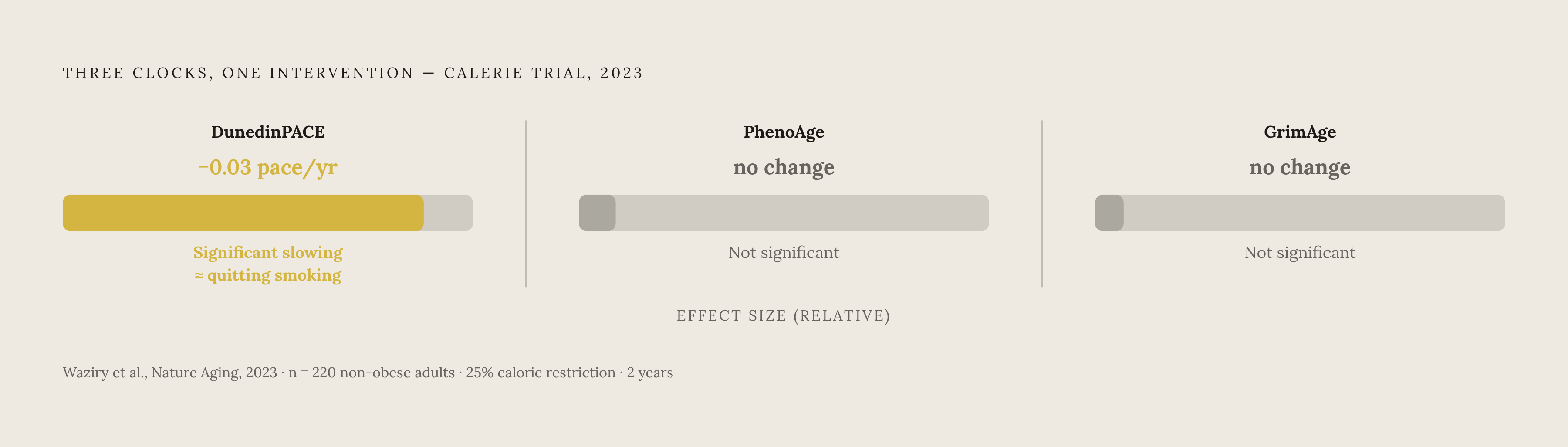
The clearest randomized evidence on how these two clocks diverge comes from the CALERIE trial, published by Waziry and colleagues in Nature Aging in 2023. Researchers ran a post-hoc analysis on 220 non-obese adults randomized to either 25 percent caloric restriction or an ad libitum control diet over two years. Caloric restriction slowed the pace of aging as measured by DunedinPACE. It produced no significant change in biological age as measured by either PhenoAge or GrimAge.
Caloric restriction changed something measurable in the body's rate of biological change over a two-year window, a signal DunedinPACE was built to catch. But it didn't shift the longer-horizon mortality risk profile that GrimAge reads, at least not within that timeframe. The size of the DunedinPACE effect was modest, but researchers have tied that same magnitude of slowing, in independent studies of older adults, to a meaningfully lower risk of death. The CALERIE authors compare that effect size to quitting smoking, so you can see why a small number on a pace-of-aging score carries real weight.
The CALERIE authors are careful about where the evidence stops. You'll need trials built specifically to follow hard outcomes over many years before you get a conclusive answer on whether DunedinPACE change actually lowers chronic disease incidence and mortality over the long run. The mechanism linking a slower pace of aging to lower disease risk is plausible and consistent with the data available so far. No one has closed the causal chain connecting a two-year shift in DunedinPACE to a measurable drop in disease decades later. That's the field's most honest open question right now: when an intervention moves DunedinPACE but leaves GrimAge unchanged, does it lower long-term mortality risk? The current answer sits at probably yes, not yet proven at the level of hard outcomes, and that qualifier matters more than it might seem.
More recent work adds a useful layer to that picture. A study in Nature Medicine, looking at how epigenetic biomarkers respond to longevity interventions across multiple trials, found that second-generation biomarkers, including DunedinPACE and a related measure called PCGrimAge, showed the strongest and most consistent responsiveness overall. DunedinPACE produced the largest effect sizes across lifestyle interventions like diet and exercise programs. PCGrimAge produced the most statistically significant results across the same body of trials. For drug-based interventions, GrimAge v2 reported the highest number of significant decreases among all the clocks analyzed. That pattern suggests a practical division of labor: DunedinPACE appears to be the more sensitive instrument for tracking lifestyle changes, while GrimAge v2 appears better suited to catching molecular responses to pharmacological treatment. Two clocks, two distinct jobs, and evidence now pointing at which one to reach for depending on what kind of change is actually being tested.
Sources
- GIA: Germline-Informed Aging with AlphaGenome Finds Genetically Regulated CpGs
- EPIGENETIC PACE OF AGING (DUNEDINPACE) PREDICTS INCIDENT METABOLIC SYNDROME IN THE BERLIN AGING STUDY II (BASE-II)
- From the lab to lifestyle: epigenetic clocks in personalized aging and health
- Epigenetic clocks: advancing biological age measures towards meaningful clinical use
- GrimAge and GrimAge2 Age Acceleration effectively predict mortality risk: a retrospective cohort study
- DunedinPACE, a DNA methylation biomarker of the pace of aging
- EFFECT OF LONG-TERM CALORIC RESTRICTION ON THE PACE OF BIOLOGICAL AGING IN HEALTHY ADULTS FROM THE CALERIE TRIAL