Coronary Artery Calcium Scoring for Asymptomatic Adults
The scan reveals hidden plaque to clarify uncertain prevention decisions.
For adults without symptoms, coronary artery calcium scoring can turn hidden coronary plaque into a concrete prevention decision. A CAC scan is most useful when standard risk assessment leaves treatment uncertain, and when its result is read together with blood markers, medical history, and the test’s limits.
What a CAC score actually measures and what the Agatston number represents
CAC scoring is a non-invasive CT technique that measures calcified atherosclerotic plaque deposited inside coronary artery walls. It shows disease that is already there, even before symptoms appear. This is not a blood test or a calculation based on age and cholesterol. The result, called the Agatston score, shows how much plaque has built up, while current inflammation is outside what it measures.
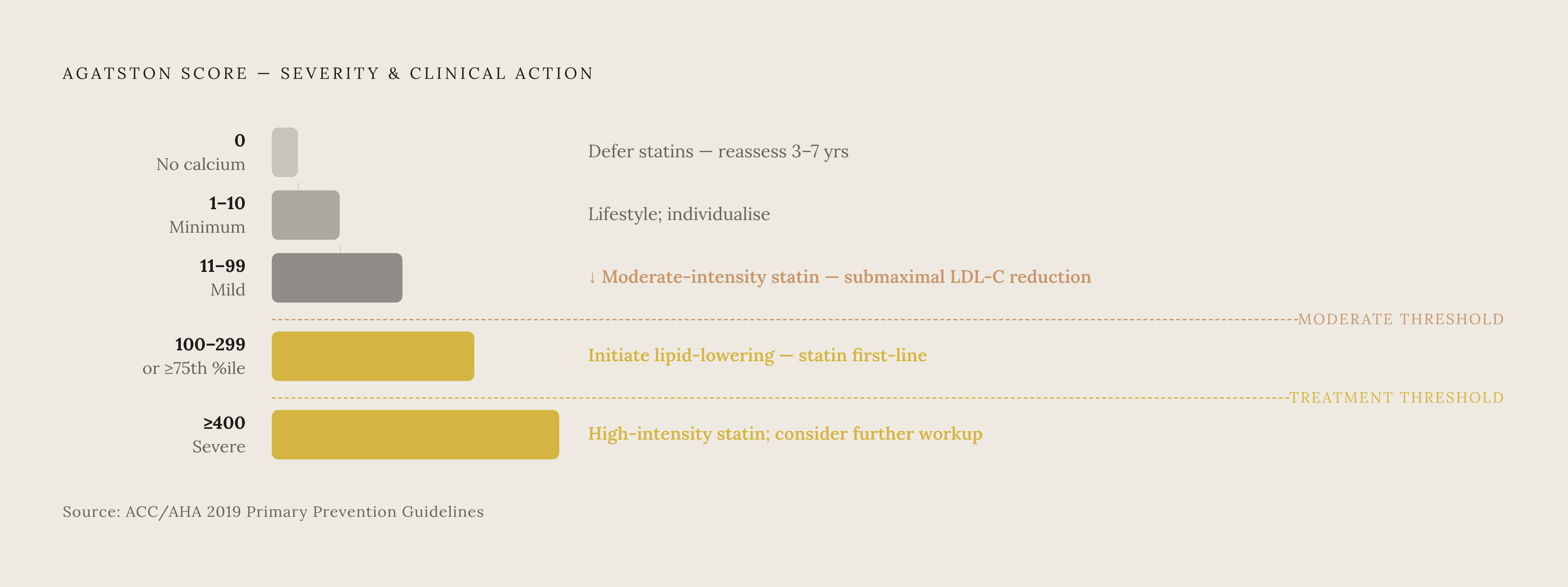
The score describes a graded amount of detectable calcium. Zero means no detectable coronary calcium, 1–10 is minimum, 11–100 is mild, 101–400 is moderate, and above 400 is severe. The scan is also coronary-specific, with stronger predictive value for coronary events than for stroke.
There is one crucial limit to this picture. CAC detects only calcified plaque, leaving non-calcified, or “soft,” plaque invisible. Because soft plaque can also rupture and cause a heart attack, the absence of calcium cannot establish the absence of coronary disease.
Why traditional risk calculators leave a specific group underserved
The Framingham Risk Score and pooled cohort equations estimate cardiovascular risk from demographic and clinical variables. They provide a useful starting point for prevention, but can overestimate or underestimate risk in certain populations. The uncertainty is sharpest among adults classified as low-to-intermediate risk. Their estimated risk may not make the case for preventive medication clear, yet it does not settle the case against treatment either.
What if plaque is already present despite that uncertainty? MESA found that roughly half of adults aged 45–84 had detectable plaque on a CAC scan before symptoms appeared. Calculators still have a use, and scans are needed only for some people in that age range. It shows the difference between estimating future risk and measuring disease already present.
For someone whose treatment decision remains unresolved, that distinction creates an opening for CAC. Imaging adds evidence that another calculation cannot supply. Its role is to complement the standard assessment, including the clinical history and risk factors that gave the question its context.
How CAC reclassifies risk among adults at low-to-intermediate cardiovascular risk
CAC’s strongest contribution is moving people out of an uncertain risk category into one where prevention decisions become clearer. For adults first classed as intermediate-risk, a high score can show that their risk is greater than conventional factors suggest. A zero score can support a less aggressive approach in selected patients. Both directions are useful, because better risk assessment is not simply a way to prescribe more treatment.
Some prospective cohort studies have reported net reclassification improvement values of approximately 0.25, though this measure was not consistently reported across studies. Higher CAC scores also show a graded association with coronary heart disease events independent of conventional risk factors. The evidence supports targeted use.
The newer PREVENT ASCVD equations sharpen that distinction further. A 2026 study found that adding CAC provided only modest improvement across all risk groups, with the benefit concentrated among adults classified as borderline-risk by PREVENT. As the baseline calculator improves, the extra value of imaging depends more closely on who still faces a genuinely uncertain decision.
What the 2026 ACC/AHA guidelines now say clinicians should do with the score
The 2026 ACC/AHA Dyslipidemia Guideline upgraded CAC for risk stratification beyond PREVENT scores from Class 2a to Class 1. The wording moves from “reasonable to consider” to “recommended.” This applies to adults at intermediate risk and selected adults at borderline risk who are still unsure about preventive treatment after a clinician-patient discussion. It is not a recommendation to screen every asymptomatic adult.
For CAC 1–99 and below the 75th percentile for age, sex, and ethnicity, it recommends a moderate-intensity statin, targeting a meaningful but submaximal LDL-C reduction. For CAC 100–299, or any score at or above the 75th percentile, it recommends initiating lipid-lowering therapy, with a statin first-line. A result is therefore more than a simple positive or negative test.
The 2018 USPSTF position found insufficient evidence to assess the benefits versus harms of CAC screening and has not been formally reversed. That difference remains part of the policy landscape, even as the cardiology guideline has moved toward more definite use in a defined population.
The "power of zero" finding and its real limits
A zero score offers genuine short-to-intermediate-term reassurance. It predicts very low event rates and can support deferring statins in carefully selected patients. A zero result can still be reassuring for someone with borderline cholesterol or a concerning family history, but those features should stay in the discussion.
Zero does not rule out obstructive coronary artery disease. The soft-plaque limitation is especially relevant in younger adults, women, and people with HIV, in whom non-calcified plaque is more common relative to calcified plaque. For younger symptomatic patients with high clinical suspicion, coronary CT angiography, or CCTA, or functional testing is more appropriate than relying on CAC=0.
Prior treatment creates another interpretive complication. Statins can increase CAC scores over time, so a score obtained during statin use may not accurately represent untreated risk. This complicates the use of repeat calcium measurements as a simple account of whether prevention is working.
How CAC interacts with ApoB, Lp(a), and CRP — and why it does not replace them
Elevated Lp(a) paired with CAC above zero identifies a group at materially higher risk than either marker suggests on its own. Conversely, normal Lp(a) together with zero CAC compounds the reassurance. This is a practical reason to read blood results and imaging together. Neither finding needs to compete with the other for importance.
The tests describe different parts of the process. ApoB tracks atherogenic particle burden, a driver of plaque formation, while CAC shows plaque that has already calcified in artery walls. Lp(a) and CRP likewise show what is still going on in the body and add to what the scan shows. Knowing these markers helps a clinician interpret what the visible plaque means for future prevention.
The DanRisk substudy found at 10-year follow-up that selected blood biomarkers, including CRP, did not independently improve prediction once CAC was included in the model. That finding has a narrower meaning than “blood tests are unnecessary.” CAC can capture the downstream result of processes that biomarkers describe upstream, making some predictive information overlap without making the tests biologically identical.
Who is most likely to benefit from getting a CAC scan, and who is not the right candidate
The best candidate is an asymptomatic adult at borderline or intermediate risk whose statin decision remains unsettled after standard assessment. Risk-enhancing factors, including a strong family history of premature cardiovascular disease, elevated Lp(a), or chronic inflammatory conditions, can make that uncertainty more consequential. The person also needs to be willing to act on the result and have a clinician who can interpret it. Patients and clinicians need to ask whether the scan could change care.
For some adults, the answer is probably no. For those already on statins, treatment makes the score harder to interpret, while people with known cardiovascular disease need care for the disease they have and have no need for primary-prevention screening. Adults whose risk is clearly high or low may also gain little if the result would leave their treatment unchanged. Younger symptomatic adults need a different diagnostic assessment when there is reason to suspect soft plaque.
Exposure from a CAC scan is comparable to that of a mammogram, and cumulative exposure deserves consideration when younger adults contemplate serial scans. The evidence so far is too limited to recommend population-wide CAC screening.
What the evidence does and does not prove about CAC's impact on hard outcomes
Better prediction is not the same as better health. The evidence does not yet conclusively establish that CAC screening of asymptomatic adults reduces all-cause mortality or cardiovascular events. A scan may identify risk accurately without proving that a screening strategy improves those outcomes.
The Australian CAUGHT-CAD randomized trial, reported in 2025, enrolled adults aged 40–70 and tested a CAC-informed strategy that included showing patients their results, statin prescribing, and health coaching. It found that coronary plaque volume grew less over three years with this approach than with usual care. That is encouraging, but plaque progression is not mortality. The CorCal Trial found higher statin adherence with CAC-guided care, yet no difference in major adverse cardiovascular events at early follow-up.
The trials also differ in how much the use of cardiovascular medication changed. Firm conclusions about population-screening are hard to draw because there is little randomized evidence, studies have a moderate-to-high risk of bias, and economic analyses are missing. Even so, the guideline upgrade is a meaningful shift in clinical consensus. It reflects the combined weight of observational evidence, biological reasoning, and intermediate outcomes in the specific population where treatment remains uncertain.
What a CAC scan actually costs, where prices vary most, and how to avoid overpaying
Texas provides a concrete exception to the usual coverage gap. A state law in effect since 2009 requires covered health plans to pay up to $200 for one noninvasive heart screening test every five years, either CAC CT or carotid ultrasound. Eligibility includes men 45–75 and women 55–75 who are diabetic or at intermediate-or-higher Framingham cardiovascular risk.
Cash prices also reward comparison before booking. The listed price for a scan is $49 at Rush University Medical Center in Chicago and Columbus Regional Health in Indiana, $60 at Northwestern Medicine in Chicago, and $150 at Tufts Medicine in Massachusetts. The broader out-of-pocket range is roughly $100–$400, with lower-priced options available. Choosing a freestanding imaging center over a hospital-based radiology department is generally the most reliable way to pay less, though the prices at these hospitals show why it helps to ask for a quote.
Most insurance plans, including original Medicare, do not pay for CAC scanning, even though the guideline recommends it. Some patients have successfully appealed denials with a physician letter establishing clinical appropriateness, while others find direct payment simpler at a low cash price. For a reader considering the scan, comparing prices and asking about coverage are practical next steps.
How to connect a CAC result to a concrete next step
For someone considering CAC, the practical sequence begins with baseline risk assessment using PREVENT or the pooled cohort equations. A clearly low or high result may settle management without imaging. If the estimate falls in the borderline-to-intermediate range, given here as 3–10% ten-year risk, and whether to start a statin remains unresolved, the guideline supports moving to a CAC discussion. Relevant blood markers, particularly Lp(a), ApoB, and hsCRP, should be known before or with the scan.
The Agatston burden category and the guideline’s treatment range answer different questions, so the clinician needs both rather than a vague description such as “a little calcium.” Blood markers and risk enhancers then help place that result in context. The number alone does not choose treatment.
If CAC is zero and risk enhancers are absent, guideline-supported deferral can include reassessment with a repeat scan in 3–7 years. An elevated score leads to a discussion of statin intensity and lifestyle interventions, with consideration of additional imaging such as CCTA when the score is very high. The follow-up conversation should end with a treatment decision and a plan for reassessment.
Sources
- Coronary atherosclerosis screening in asymptomatic adults using coronary artery calcium for cardiovascular prevention: a systematic review of randomised controlled trials and prospective cohorts
- Coronary Artery Calcium Scoring for Risk Reclassification and Prediction of Hard Cardiovascular Events in Asymptomatic Adults at Low-to-Intermediate Cardiovascular Risk: A Systematic Review
- Coronary Artery Calcium Score as a Predictor of Cardiovascular Disease Events and Mortality Among Asymptomatic Working-Age Adults: A Systematic Review
- Role of Coronary Artery Calcium Score CT in Risk Stratification of Asymptomatic Individuals - PMC
- Beyond Traditional Risk Calculators: The Expanding Role of Coronary Artery Calcium Scoring in Preventive Cardiology
- Evolving strategies in cardiovascular disease prevention: 2025 American society for preventive cardiology highlights - ScienceDirect