High-Sensitivity CRP and Cardiovascular Risk Reclassification
Inflammation testing reveals cardiovascular risk that cholesterol scores alone cannot detect.

High-sensitivity CRP can change how cardiovascular risk is classified by revealing inflammation that cholesterol tests miss. Its value is not in replacing traditional risk factors, but in adding a distinct signal of residual inflammatory risk. Understanding the three risk tiers, and knowing when a result is reliable, turns that extra information into a sounder basis for prevention.
Why standard cholesterol panels leave a meaningful risk gap
You can feel well and have “normal” cholesterol while another process continues to drive cardiovascular risk. A lipid panel describes cholesterol levels, but it does not reveal whether chronic low-grade inflammation is also contributing to that risk. The missing layer matters because controlling one cause of cardiovascular disease does not necessarily control another.
The 2025 ACC Scientific Statement describes residual inflammatory risk in patients who still have cardiovascular events even though statin treatment has kept their LDL-C well controlled. In these patients, inflammation remains a source of risk even after cholesterol has been addressed. A normal standard CRP result cannot reliably close that gap because the test is calibrated for larger elevations associated with acute infection and trauma. The high-sensitivity test is needed to pick up the smaller signal that stays over time.
What hsCRP actually measures and why the liver's response to inflammation matters
CRP is an acute-phase protein produced by the liver in response to inflammatory signals, particularly interleukin-6. During chronic low-grade inflammation, that production can remain active at a low but persistent level. The high-sensitivity assay measures the same protein at concentrations below the range that standard CRP tests can reliably resolve. That is why the test name matters when ordering it.
What the result reveals also needs a careful boundary. hsCRP is a downstream signal of inflammation. It can help identify cardiovascular risk without showing how much plaque someone has. New evidence also links the signal to diseases beyond cardiovascular disease, including lung and liver cancer and IBD. Its strongest validation, however, is as a predictor of cardiometabolic risk.
The 2025 ACC Scientific Statement gives hsCRP a distinct place among inflammatory biomarkers. It notes that only hsCRP is recognized by regulatory agencies and has been consistently used in major cardiovascular outcome trials. That record explains why this marker has a clinical role beyond merely showing that inflammation is present.
What your number means: the three-tier threshold system and its limits
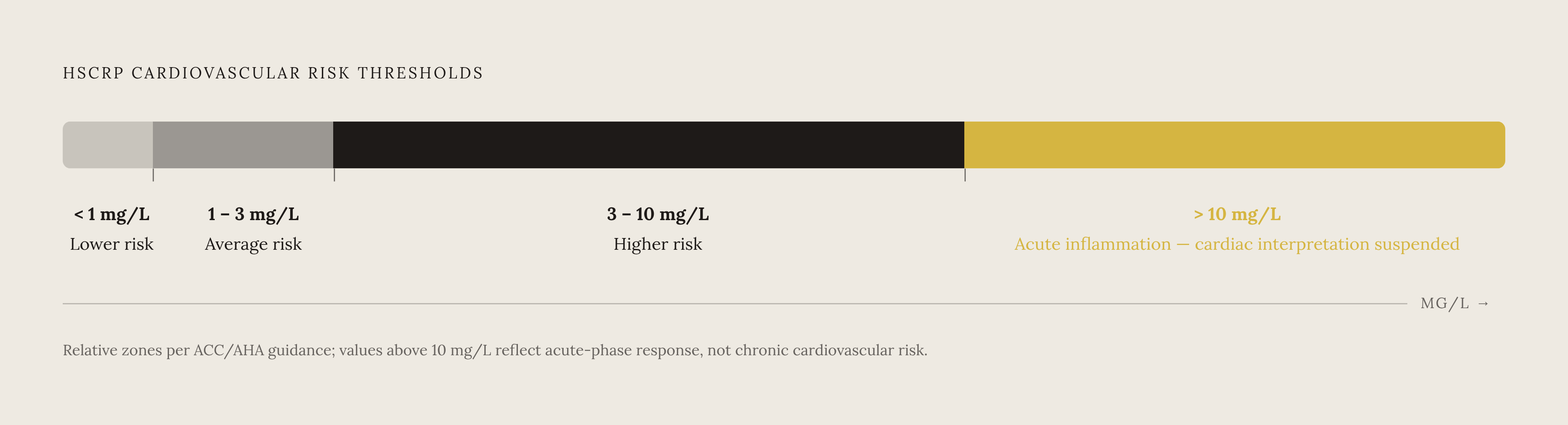
The three-tier system provides a starting point for reading your result. A result below 1 mg/L points to lower relative cardiovascular risk. A result of 1–3 mg/L indicates average relative cardiovascular risk. A result above 3 mg/L points to higher relative cardiovascular risk. These relative categories must be read with traditional risk factors to assess someone’s risk and need for treatment.
A result above 10 mg/L falls outside that chronic cardiovascular interpretation and signals acute inflammation instead. Timing can also distort results at lower levels. Recent infections, injuries, intense workouts, surgery, dental procedures and active autoimmune flares can raise hsCRP for one to two weeks. An elevated reading after one of these events should not be treated as a chronic cardiovascular signal. Repeating the test two to three weeks after recovery helps establish an accurate baseline, and guidelines recommend two readings.
Even when the test is done at the right time, the assay itself can affect the result. INSTAND's longitudinal EQA analysis found that manufacturer-specific differences remained large enough to move a patient across a clinical decision threshold despite improved harmonization. The same blood sample could therefore receive different risk classifications at different labs. These differences matter most when a result is close to the line between tiers. Using the same lab and assay for repeat tests makes it easier to tell whether a change comes from the body or from the platform used to measure it.
What drives hsCRP up — and what that means for who should test
Once a persistent elevation is established, the next issue is what may be driving it. Visceral fat is metabolically active and produces inflammatory cytokines, called adipokines, that stimulate CRP production. Weight loss consistently reduces hsCRP. Insulin resistance and type 2 diabetes are also linked to this inflammatory process as both causes and consequences. Elevated hsCRP is therefore common in people with metabolic syndrome and pre-diabetes, where inflammation and metabolic health are closely connected.
Smoking provides another direct source of chronic vascular inflammation and reliably raises hsCRP, with levels declining after cessation. Other influences need a different interpretation. Oral contraceptives, hormone replacement therapy and strenuous exercise can cause temporary elevations that complicate the cardiovascular reading. A high number is therefore a reason to examine context, rather than assume that every elevation has the same cause. Distinguishing a persistent driver from a confounder makes the result more useful.
Testing can benefit people with these risk factors, people whose standard risk scores fall in an intermediate range, and those monitoring a metabolic condition. For the last group, hsCRP can help show whether inflammation is responding to treatment. Yet none of these uses depends on feeling unwell or having high cholesterol. JUPITER tested whether treatment could help people who had that mix of elevated hsCRP and normal LDL.
How strongly hsCRP predicts cardiovascular events — and what 20 years of follow-up data show
The most consequential use of hsCRP is identifying risk in people whom standard tools would otherwise leave in a lower-risk category. Elevated hsCRP predicts incident coronary heart disease even among people with no standard modifiable risk factors at baseline. Its predictive strength is comparable to systolic blood pressure and appears stronger than conventional lipids. This makes it more than a second description of risk already captured by cholesterol.
The ASCOT Legacy 20-year follow-up, published in eBioMedicine in July 2025, found that adding hsCRP meaningfully improved risk reclassification for non-fatal MI and fatal coronary heart disease. The long follow-up matters because the question is not simply whether inflammation is present today, but whether its measurement helps distinguish future outcomes. Reclassification describes a change in where someone belongs in the risk picture after the extra information is considered. Its clinical value lies in identifying people whose original category understated or overstated their risk.
A 2025 European Heart Journal analysis also found that net reclassification for both events and non-events improved when hsCRP was added to SCORE2. The contribution was therefore not limited to moving people toward higher-risk labels. Establishing that treatment based on better prediction will help requires evidence from a trial in which the newly identified group receives treatment or a comparison.
The JUPITER trial: what happened when hsCRP-selected patients with normal LDL were treated
JUPITER addressed that next question by enrolling people with LDL-C well below treatment thresholds but hsCRP ≥2 mg/L. Conventional guidelines would have left this group untreated on the basis of their cholesterol. The trial compared outcomes with rosuvastatin and placebo in people with that apparently reassuring LDL-C level. Its Data and Safety Monitoring Board stopped it early after detecting a large reduction in the primary endpoint, including major reductions in myocardial infarction and stroke. Selecting patients by their inflammatory signal had identified a group that benefited.
A subset of participants had no standard modifiable risk factor at all, with hsCRP above 2 mg/L as their only elevated marker. This “SMuRFLess but Inflamed” group experienced a 48% reduction in major adverse cardiovascular events on rosuvastatin versus placebo. People who looked low-risk under the usual framework experienced fewer events when treated. It does not establish that every person with an elevated hsCRP needs a statin.
CARE, PROVE-IT TIMI 22, A-to-Z and REVERSAL add a related finding from other statin trials. Their lowest event rates consistently occurred in patients who achieved both low LDL-C and hsCRP below 2 mg/L. These results distinguish cholesterol control from an accompanying low-inflammation state. They support assessing both dimensions rather than treating a satisfactory cholesterol result as the whole prevention goal.
What the 2025 ACC Scientific Statement changes about routine clinical practice
The 2025 ACC Scientific Statement names hsCRP as part of checking for residual risk and links levels that stay high to choices about treatment. It states that elevated hsCRP should prompt consideration of starting or intensifying statin therapy irrespective of LDL-C. For patients already taking statins, it advises considering higher-intensity dosing if hsCRP remains above 2 mg/L. These prescription decisions require clinical review. The shift is that inflammation has an explicit place in the discussion even when LDL-C is controlled.
Low-dose colchicine has FDA approval for patients who have established atherosclerotic cardiovascular disease or more than one cardiovascular risk factor. In chronic coronary artery disease, it has reduced hsCRP and major cardiovascular events. But other randomized trials found no drop in cardiovascular risk after acute MI or stroke. The statement therefore cautions against extending recommendations for an agent beyond the trial evidence supporting its use.
The statement reports an adoption gap as well, citing a real-world audit in which only 2.1% of patients with elevated hsCRP were taking colchicine at baseline. The audit shows that recognizing inflammation in guidance and addressing it in routine care are different steps. Proactive testing can give a reader information to bring into a clinical conversation without assuming that the absence of prior testing reflects poor care.
How hsCRP fits into a broader residual-risk dashboard alongside Lp(a) and ApoB
The broader framework works because the markers answer different questions. hsCRP addresses ongoing inflammatory risk, Lp(a) captures a distinct and largely genetic atherogenic risk, and LDL-C and ApoB describe lipid burden. Equally, a genetic risk marker does not establish whether inflammation is contributing to someone’s remaining risk. Their combined value lies in the complementary information they provide.
The 2026 ACC/AHA multisociety dyslipidemia guideline gives a Class I recommendation for at least once Lp(a) measurement in all adults. The 2025 ACC Scientific Statement says that using hsCRP and Lp(a) along with LDL-C and ApoB gives key insights into a person’s risk and helps guide the choice of treatment. Under this framework, an unexplained layer of risk can call for a different kind of measurement.
Agents such as semaglutide and tirzepatide consistently reduce hsCRP, making it a useful monitoring target for patients using them for weight or glucose management. In that setting, the marker adds information about inflammatory response to the treatment’s metabolic effects. It remains one part of the overall assessment rather than a replacement for the other measures being followed.
What to do with an elevated result: lifestyle changes and when to involve a clinician
The first task is establishing whether the elevation is persistent, using the timing and assay precautions described earlier. Once a baseline is reliable, later measurements can help show how inflammation responds to changes in health and treatment.
The 2025 ACC Scientific Statement recommends at least 150 minutes per week of moderate activity or a lesser amount of intense exercise, a plant-predominant diet, weight loss and smoking cessation for patients with elevated hsCRP. These recommendations address several of the conditions that drive the signal. Reducing visceral fat lowers adipokine output, while stopping smoking removes a direct cause of vascular inflammation. The practical emphasis is on changing the underlying drivers, with hsCRP serving as a marker of response.
Tracking that response takes tests at more than one point in time, so it matters to know the price of each blood draw and to have access to a clinician’s guidance. Direct access can make testing easier, but testing and guidance are not substitutes for treatment. Persistent elevation despite lifestyle changes warrants clinical review, including consideration of statin initiation or intensification and, in patients with established atherosclerosis, potentially colchicine. People with established cardiovascular disease still need their physician’s assessment of prescription options.
Sources
- Inflammation and Cardiovascular Disease: 2025 ACC Scientific Statement: A Report of the American College of Cardiology
- Longitudinal evaluation of manufacturer-specific differences for high-sensitive CRP EQA results
- The relationship of baseline high-sensitivity C-reactive protein with incident cardiovascular events and all-cause mortality over 20 years - eBioMedicine
- The relationship of baseline high-sensitivity C-reactive protein with incident cardiovascular events and all-cause mortality over 20 years - PMC
- C-reactive protein and cardiovascular risk in the general population