Whole-Body MRI Screening in Asymptomatic Adults
Finding abnormalities on asymptomatic scans doesn't guarantee they need treatment.
Whole-body MRI screening in adults without symptoms is a test that reliably finds things. One review reported a radiologic abnormality in most scans. But finding something is not the same as finding a threat that needs treatment, or saving a life. The decision turns on that gap, including what the scan can establish, what remains uncertain, and what further care its findings may set in motion.
Why WB-MRI is finding its way into consumer health decisions
Whole-body MRI, or WB-MRI, is now marketed directly to consumers as a proactive, radiation-free way to detect disease early. Many private clinics require no physician referral. That appeal fits a common belief in longevity culture, that more health data should help people stay healthier. For someone who feels well but wants to avoid a future illness, the offer is understandable.
Yet scans have become more widely available to buy faster than the evidence for screening has grown. The promise is easier to grasp than the follow-up. A scan can find something unexpected without showing whether it could harm health, needs treatment, or can safely be left alone. That uncertainty is part of the decision to buy the test.
What whole-body MRI actually does inside the scanner
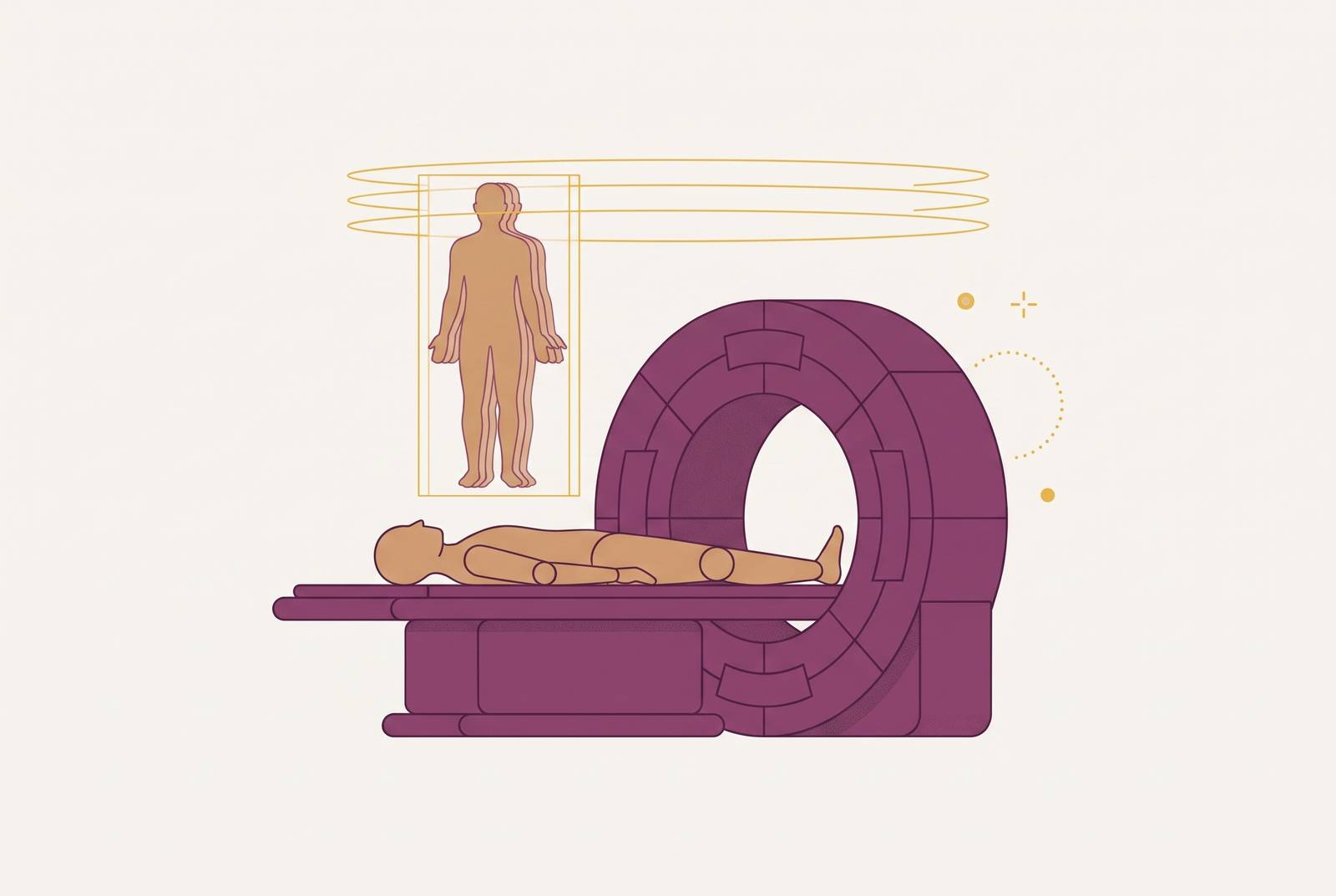
A standard screening protocol runs from the vertex, or top of the head, to mid-thigh on a 1.5T or 3T scanner. It uses T1-weighted, T2-weighted, and diffusion-weighted sequences, usually without intravenous contrast. Scanning usually takes 45 to 90 minutes, depending on the protocol and hardware. Its design favors coverage over depth. Each organ region gets a streamlined look rather than the optimized sequences of a dedicated examination.
Avoiding contrast also means avoiding gadolinium exposure, but some findings visible only on contrast-enhanced sequences will be missed. Small lung nodules, early-stage breast microcalcifications, and small gastrointestinal mucosal lesions are among the blind spots of non-contrast protocols. Even with a broad scan, dedicated tests such as colonoscopy, mammography, or thyroid ultrasound are still needed when appropriate.
There is also no single standardized WB-MRI protocol. Two clinics can use the same name for scans that differ a great deal. Those differences change both what the scan might find and how its price compares with another offer.
What the scan finds — and how often it finds it
Systematic reviews of cohort studies find that most people undergoing WB-MRI have at least one radiologic abnormality. Studies that count all findings find several for each person. Confirmed cancer detection rates across the evidence base fall at roughly one to two per hundred people screened. A meta-analysis of ten studies reported a pooled confirmed cancer rate, with prostate, renal, lung, and thyroid cancers the most commonly detected types.
Other findings can also prompt clinical action. These include complex renal cysts or solid renal masses, hepatic lesions, complex ovarian cysts or tumors, thyroid nodules, and adrenal adenomas. Up to roughly a third of screened individuals require additional investigation in some reviews. Critical and indeterminate findings appear more often than confirmed cancers, while false positives account for a substantial minority in one systematic review.
These studies describe yield. The available data do not establish how many people screened negative and later developed cancer, so sensitivity and specificity cannot be calculated.
Why finding something is not the same as catching something dangerous
What does an abnormal result actually predict? Positive predictive value tells how often a positive test result means the person has the condition the test seeks. That depends partly on how common the condition is in the population being tested. In adults without symptoms and at average risk, a finding is not automatically strong evidence of dangerous disease. An abnormal image is a starting point for interpretation.
Overdiagnosis means finding a real but indolent condition that would never have caused symptoms during the person’s lifetime. It is not a false alarm. Slow-growing kidney and thyroid tumors can fall into this category, yet their discovery can lead to treatment with real risks and costs. Autopsy studies have long shown that people can die of other causes while carrying small cancers.
Timing can also make screening look more beneficial than it is. Lead-time bias occurs when earlier detection lengthens the measured time from diagnosis to death without changing when death occurs. Length bias adds a different distortion. Screening preferentially finds slow-growing tumors that remain detectable during the screening window, while aggressive tumors can arise and progress between scans.
Evidence must connect earlier diagnosis to fewer deaths. That link has not been established for WB-MRI screening in average-risk adults.
The cascade that follows an indeterminate finding
An indeterminate finding is one that the initial scan cannot confidently classify. Resolving it may require targeted imaging, specialist consultations, and sometimes a biopsy. Each step has its own consequences. Biopsies have small but real risks of bleeding and infection, and the tissue sampled is in many cases healthy.
The German cohort study found higher outpatient costs in WB-MRI recipients over two years, driven by specialist consultations and follow-up imaging. Costs were also higher for people in the study who had no reported MRI findings. The overall comparison was between MRI participants and non-participants, however, rather than a separate estimate for the no-findings subgroup. The pattern suggests a broader increase in medical surveillance after scanning.
Uncertainty also has a psychological cost. Being told that something looks abnormal can shift a person’s self-perception from healthy to patient, even when the finding is likely benign. Some people remain anxious after reassuring follow-up. Personality, expectations, and how results are communicated all shape that response. Considering this cascade before scheduling leaves room to decide whether the information is worth its possible consequences.
Where WB-MRI genuinely earns its place — high-risk populations
The calculation changes when baseline cancer risk is high. Li-Fraumeni syndrome, or LFS, is the clearest example. Caused by germline TP53 mutations, it places the vast majority of carriers at risk of cancer over their lifetime. WB-MRI and brain MRI each year are now standard care for adults with LFS.
Dana-Farber Cancer Institute’s prospective cohort study, presented at the 2025 ASCO Annual Meeting as Abstract 10501, reported that, among only the cancers detected by WB-MRI in its cohort of LFS patients, 86% were localized and treated with curative intent. It supports a specific clinical use. It is not evidence that the same results apply to average-risk consumers.
The distinction rests on pretest probability. When that probability is high, true positives make up a larger share of positive results, and cancer yields are substantially higher in hereditary syndrome populations. Whether personal risk justifies the process the technology may start therefore matters more than whether the technology is good or bad. Most people considering consumer screening are not in these high-risk populations.
What the major medical bodies have formally concluded
The American College of Radiology stated in 2023 that evidence was insufficient to recommend total-body screening for people without symptoms, risk factors, or a family history suggesting underlying disease or serious injury. The American Academy of Family Physicians, through Choosing Wisely, states explicitly, “Don't use whole-body scans for early tumor detection in asymptomatic patients”. These positions concern screening people who feel well. They do not rule out the ways MRI can help in clinical care more broadly.
The Canadian Association of Radiologists issued a 2025 policy statement recommending against WB-MRI screening in asymptomatic individuals. The statement contrasts promises of empowerment and peace of mind with the uncertainty, overdiagnosis, and harm screening can produce. It also calls for prevention grounded in evidence and individual risk.
These organizations reached their conclusions because there are no mortality data or randomized trial evidence to support average-risk screening. None offers blanket support for expanding use while gathering evidence.
What the scan costs — and what the cascade adds to that
Cash-pay clinic prices range from roughly $650 to $3,999 as of 2026, depending on the provider, scan duration, anatomy covered, and contrast use. Insurance coverage is almost universally unavailable for asymptomatic screening, with narrow exceptions for specific high-risk genetic syndromes. But the scans sold at those prices use different protocols, so they are not all the same product.
A cheaper package may scan only some regions or use a less extensive protocol than a more costly one. To compare offers meaningfully, consumers should ask for a written description of the anatomy included before booking. When hospital departments charge for diagnostic MRI by region, the total for several regions can be much higher than clinic prices for scans that cover the same areas. HSA and FSA funds are a financing mechanism that may affect the effective out-of-pocket cost at some providers while leaving the service’s price unchanged.
The booking fee also leaves later spending unresolved. The German cohort’s findings show why a budget limited to that fee is incomplete, although they do not predict any one person’s bill. Follow-up needs vary with what is found. The quoted scan price can be right even when the full cost of screening is still unknown. For biomarker-based screening that does not require imaging, the cost picture is generally simpler.
How to think about WB-MRI as one input among several
The decision begins with personal risk and expectations. Someone with a known or suspected hereditary cancer predisposition syndrome should have a genetics consultation before deciding on imaging. A strong family history of multiple cancers, especially at early ages, also changes the probability calculation.
Whether established screening is already complete also matters. Depending on age, sex, and risk, that can include colonoscopy, mammography, or low-dose CT for lung cancer in high-risk smokers. These tests have demonstrated mortality benefit. WB-MRI does not yet have that evidence in average-risk screening, and it cannot stand in for the dedicated examinations its broad design does not replace.
Readiness for the result deserves equal attention. How would an abnormality of uncertain significance affect daily life? A finding may be very unlikely to represent cancer and still require follow-up, with both emotional and financial demands. To make an informed decision, a person needs to accept that possibility and budget for costs beyond the first scan. Reassurance cannot be assumed simply because reassurance was the reason for booking.
For most asymptomatic adults, WB-MRI is not the right first step. A more evidence-supported starting point is assessment of relevant biomarkers, including cardiovascular risk markers, metabolic markers, hormones, and inflammatory markers, with testing and interpretation tied to individual risk. These can provide actionable findings at lower cost and with less cascade risk, though a larger panel is not automatically more useful. WB-MRI may become a reasonable later step for specific risk profiles after foundational questions have been addressed. Being proactive means choosing information that can guide a sound decision.
Sources
- Evaluation of whole-body MRI for cancer early detection in Li-Fraumeni syndrome
- Whole-body magnetic resonance imaging for cancer screening in asymptomatic adults: a multicenter study - PubMed
- Applying ONCO-RADS to whole-body MRI cancer screening in a retrospective cohort of asymptomatic individuals
- Whole-body MRI for preventive health screening: A systematic review of the literature - PubMed
- Brief communication: the clinical opportunities and ongoing challenges with whole-body MRI for screening - ScienceDirect