NAD+ Decline Mechanisms Across the Lifespan
Three separate mechanisms drive NAD+ decline, each worsening the others with age.

NAD+ decline isn't one process. It's a pileup: three separate mechanisms working at once, each one making the other two worse. Understanding those mechanisms, and where they show up in the body, is what separates an informed decision about NAD+ from a marketing pitch built on a blood test that measures the wrong thing.
Start with what NAD+ actually does. It plays two distinct roles in cell biology. As a coenzyme, it shuttles electrons in redox reactions, the basic currency of energy metabolism. As a signaling molecule, it's the fuel that sirtuins, PARPs, and CD38 all draw from to regulate gene expression, DNA repair, and metabolic sensing. Over 500 enzymatic reactions in the body depend on it. That number alone should tell you this isn't a niche molecule tucked into some obscure pathway. It is central to mitochondrial oxidative phosphorylation, DNA repair, inflammation control, and sirtuin activity, and it does so across tissue types that don't always behave the same way: liver, pancreas, skeletal muscle, brain, heart. A global scientific effort, including researchers at the University of Oslo, ties falling NAD+ to cognitive decline, sarcopenia, and metabolic disease. Falling NAD+ is associated with cognitive decline, sarcopenia, and metabolic disease. It's also not the same as saying NAD+ decline causes those conditions outright, or that raising NAD+ reverses them. The mechanism deserves scrutiny before the marketing claim does.
The three interlocking mechanisms behind falling NAD+ levels with age
So what's actually driving the drop? Not one culprit, but three, running in parallel and feeding off each other.
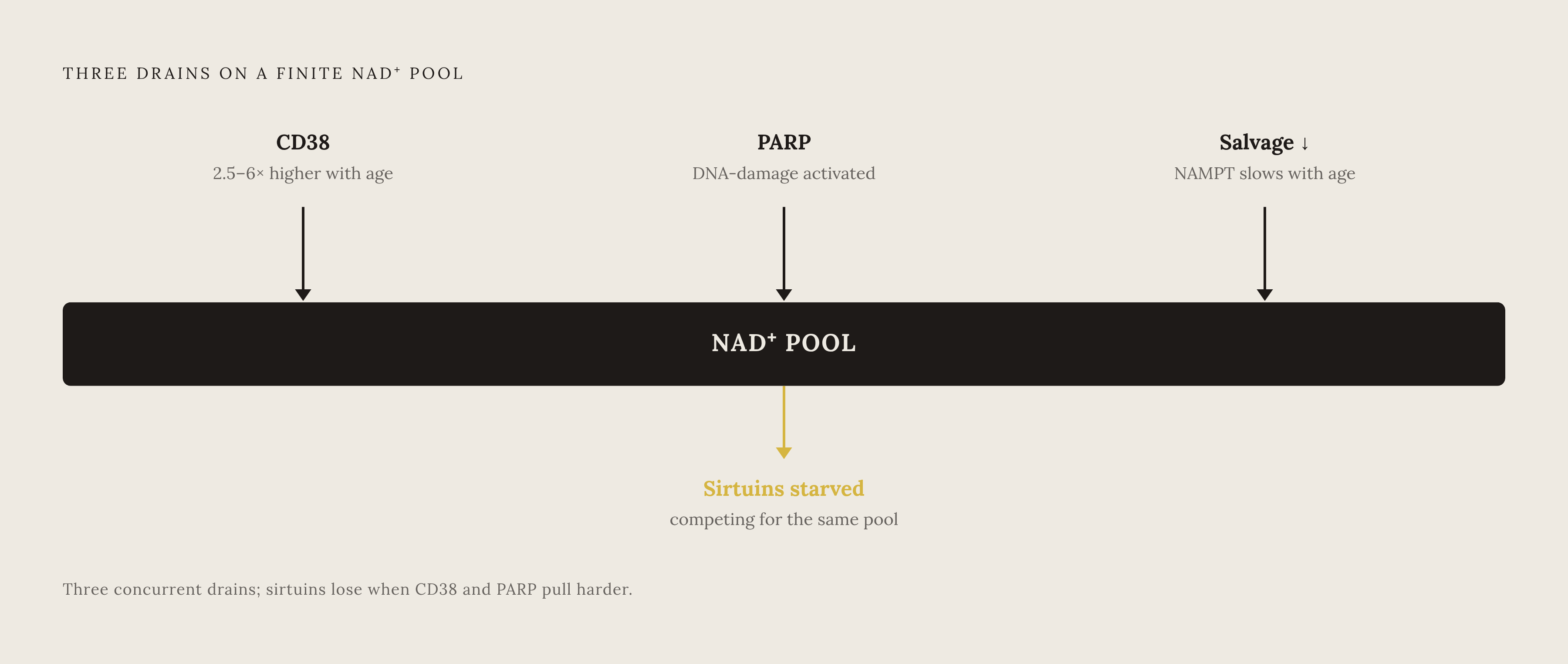
First, CD38, an enzyme that rises with age, chews through NAD+ faster than younger tissue does. Second, PARP enzymes, activated by accumulating DNA damage, draw down whatever NAD+ is left trying to keep up with repairs. Third, the salvage pathway, the body's main system for recycling NAD+ from its breakdown products, gets less efficient with age, so less gets made to begin with.
Newer research, including a paper in Frontiers in Immunology, suggests the consumption side, especially CD38, may matter more than the production side. Older models leaned heavily on the idea that biosynthesis just slows down. That's still true, but it may not be the lead driver. The three processes compete for the same finite pool of NAD+ inside the cell. PARP, CD38, and the sirtuins are all fishing from the same well. When two of them are pulling harder, the third, sirtuin activity, gets starved out. PARP, CD38, and the sirtuins are all fishing from the same well, and when two of them are pulling harder, the third, sirtuin activity, gets starved out.
CD38: the enzyme that rises with age and dismantles NAD+ at scale
CD38 is what's called an NADase. Its main job is breaking NAD+ down through a process called NAD+ glycohydrolysis. It has a couple of smaller side activities too, but the function that breaks down NAD+ is the one that matters here.
And it rises sharply with age. In a study published in Cell Metabolism by Camacho-Pereira and colleagues, CD38 mRNA levels in old mice ran about 2.5 times higher than in young mice across liver, fat, and skeletal muscle, and up to six times higher in the spleen. That's rodent data, and it's foundational to the field, but human tissue confirmation is thinner. Protein-level studies do track in the same direction: a Frontiers in Immunology paper found CD38 levels rising with age in human samples too, correlating with falling NAD+.
The more convincing evidence isn't correlation, it's intervention. When researchers knocked down CD38 or blocked it pharmacologically in aged mice, NAD+ levels held up, and so did mitochondrial function. That's the kind of result that moves CD38 from bystander to driver. CD38 is the primary enzyme that breaks down NMN in the body, so a rising CD38 level doesn't just drain NAD+ directly, it can undercut precursor-based strategies meant to replenish it.
What turns CD38 up? Chronic, low-grade inflammation. Immune cells express more CD38 in an inflamed environment, and senescent cells, which secrete inflammatory signals as part of their normal behavior, help keep that inflammation going. CD38 and inflammation reinforce each other in a loop, and that loop is the bridge into the next mechanism.
PARP activation and DNA damage: the second drain on NAD+ pools
PARP enzymes repair broken strands of DNA, and they use NAD+ to do it. In an acute injury, that's what you want: fast repair powered by NAD+. The trouble starts when the damage never really stops. Aging tissue accumulates low-level DNA damage continuously, which means PARP stays switched on more or less permanently, siphoning NAD+ around the clock instead of in short bursts.
That sets up a loop that feeds itself. Lower NAD+ makes DNA repair less efficient. Less efficient repair leaves more damage unrepaired. More unrepaired damage triggers more PARP activity. More PARP activity drains NAD+ further. Around it goes.
Because PARP, CD38, and sirtuins all draw from the same pool, a rise in PARP activity doesn't just deplete NAD+ in isolation, it crowds out the sirtuins specifically. Sirtuins regulate gene expression, mitochondrial biogenesis, and the cell's stress response, so starving them isn't a minor side effect. It's a second-order consequence of the first two mechanisms colliding.
A computational modeling paper published in Biology in August 2026, a paper involving LUMS and Mayo Clinic among its contributing researchers, put a number on what that shift looks like at the cellular level. As NAD+ declined progressively in the model, the propensity for oxidative phosphorylation dropped from 0.686 to 0.186, while the propensity for glycolysis rose from 0.256 to 0.426. That's a model, not a clinical measurement in living patients, and it should be read that way. But it gives a concrete shape to something that's otherwise just an abstract phrase: "loss of mitochondrial function." It also feeds into a broader question the same paper raises about cancer risk, since a glycolysis-favoring cell state with its NAD+ used up resembles the metabolic profile seen in some cancer cells.
Reduced biosynthesis: how the salvage pathway loses efficiency with age
NAD+ doesn't come from just one factory. The body runs four separate routes: de novo synthesis from tryptophan (the kynurenine pathway), the Preiss-Handler pathway using nicotinic acid and trigonelline, nicotinamide salvage, and nicotinamide riboside salvage.
Of those four, nicotinamide salvage does most of the daily heavy lifting, and its rate-limiting enzyme is NAMPT. Both NAMPT activity and de novo synthesis slow with age, as enzyme efficiency drops and the pathway becomes less productive overall. The de novo route can also be affected by metabolic stress, which may reduce its overall efficiency.
Older models of NAD+ decline put NAMPT loss front and center as the main cause. That's not wrong, exactly, but it's increasingly looking incomplete. The Frontiers in Immunology evidence pointing to CD38-driven consumption as a potentially more dominant mechanism suggests biosynthesis decline is secondary, a contributing factor rather than the lead one.
There's one lifestyle lever that connects directly to this side of the equation, and it's mechanistic rather than just an association. An editorial by Janssens, Houtkooper, and Hoeks in Aging (2022) cited a study where twelve weeks of combined aerobic and resistance training in older adults raised NAMPT levels. That's a specific enzyme responding to a specific intervention, not a vague wellness claim about exercise being good for you.
Cellular senescence as both product and accelerant of NAD+ decline
Senescent cells are cells that have permanently exited the cell cycle but haven't died. They stick around, stay metabolically active, and keep secreting signals into surrounding tissue. Their numbers climb with age, and they sit at both ends of the NAD+ story: they're partly caused by NAD+ depletion, and they go on to cause more of it.
The onset side works like this: when PARP and CD38 crowd out sirtuin activity, DNA repair suffers, mitochondria start malfunctioning, and reactive oxygen species build up. Any one of those pressures can push a cell toward permanent growth arrest, which is senescence.
Once a cell becomes senescent, it makes the NAD+ problem worse for its neighbors, not just itself. Senescent cells show reduced NAD+ biosynthesis and higher consumption from their own stress-response enzymes. More importantly, they secrete inflammatory factors, known collectively as the senescence-associated secretory phenotype, that turn up CD38 expression in nearby immune cells, particularly tissue-resident macrophages. That closes a loop that started back in the CD38 section: rising CD38 depletes NAD+, depleted NAD+ drives mitochondrial dysfunction, dysfunction pushes cells into senescence, and senescent cells turn CD38 up further in the tissue around them. A self-sustaining cycle, not a one-way slide.
The same 2026 computational model cited earlier offers a useful, if speculative, frame here. It describes a hyperproliferative, glycolytic, apoptosis-resistant metabolic state, the kind of profile associated with tumor-permissive conditions, as conditionally reversible if specific signaling nodes are targeted. Could interrupting that particular enzyme-driven senescence loop specifically be a more useful intervention point than trying to flood the system with more NAD+ precursors? The honest answer, based on where the science stands, is that nobody knows yet. This is mechanism, not a treatment plan.
What human tissue data shows versus what blood tests measure
Here's the finding that reframes almost everything above. Researchers analyzing seven independent human cohorts, published in Nature Metabolism in 2026, found that whole-blood NAD+ concentrations stay remarkably stable across age and lifestyle interventions. Not slightly stable. Remarkably stable, measured using ultra-high-performance liquid chromatography coupled with high-resolution mass spectrometry, a rigorous, validated method that puts real weight behind the result.
So why does that matter so much? Because whole blood is dominated by red blood cell NAD+ content, and red blood cells don't have mitochondria. They don't run oxidative phosphorylation, and they aren't subject to the same age-related metabolic wear that appears in the tissues where NAD+-dependent aging actually plays out. Testing blood for NAD+ and expecting it to reflect what's happening in muscle or brain is a bit like checking the water pressure in your garden hose to figure out what's going on in your basement pipes. Related system, wrong compartment.
Tissue-level data tells a different, more consistent story. Direct measurements in skeletal muscle, from work out of Amsterdam UMC (Janssens and Houtkooper) and separately at Maastricht University, show clear age-related NAD+ decline. Skin, brain, and liver studies point the same direction. The muscle data is especially well worked out: physically impaired older adults had lower muscle NAD+ than fit older adults of the same age, exercise-trained older adults showed levels closer to what's seen in young adults, and daily step count correlated directly with muscle NAD+ content, based on skeletal muscle biopsy metabolomics reported in Janssens and Houtkooper's 2022 Aging piece.
Mark Tarnopolsky, at McMaster University, put the implication in commentary reported by NutraIngredients in June 2026: the blood findings don't invalidate tissue-level NAD+ biology, but they do challenge using circulating NAD+ as a stand-in for what's happening downstream in tissue. That's an important distinction, and it doesn't contradict Janssens and Houtkooper's earlier tissue work either. It just draws a hard line between two compartments that got conflated in the marketing conversation around NAD+ testing.
Methods for measuring NAD+ status in practice, and their limits
If tissue is where the real story lives, why does almost every consumer test look at blood? Mostly because blood is easy to draw and tissue biopsies aren't something anyone signs up for casually.
The gold standard for precision is liquid chromatography-mass spectrometry, LC-MS, the method behind the research findings described above. It's not something most people can order as a consumer test; it lives mainly in research labs. Clinical venous blood panels, the kind that measure NAD+, NADH, and the NAD+/NADH ratio, are available through specialty labs, with turnaround times and pricing that vary by provider and should be confirmed directly. Specialized intracellular testing options are also available, with turnaround times and pricing that vary and should be confirmed with individual providers.
Home dried blood spot testing, using a finger-prick sample of 10 to 20 microliters, has held up well analytically. Validation studies report correlation with venous LC-MS at r=0.92 to 0.98, which is a strong analytical match. But strong correlation with venous blood doesn't get around the deeper issue: it's still measuring the blood compartment, and blood is the compartment the 2026 Nature Metabolism data says doesn't move with age. NADMED, a spin-out from the University of Helsinki, offers a lab-based option measuring NAD+ and NADH for cellular health context, an emerging option, particularly in EU markets.
One more wrinkle across every method: reference ranges need to be age-adjusted and sex-specific. Generic population ranges can flatten out meaningful differences and lead someone to misread a normal result as concerning, or vice versa.
There is one place where blood testing earns its keep. A 2026 systematic review covering 33 human intervention studies, 28 of them randomized trials, found that oral NR and NMN supplementation generally does raise blood NAD-related metabolites, even though blood NAD+ doesn't track with age or lifestyle on its own. Improvements in metabolic health, cardiovascular markers, and physical performance across those same studies were inconsistent. So the honest read: blood testing is decent for tracking whether a supplement is doing something measurable in circulation. It's a weaker tool for figuring out where someone stands on the aging curve to begin with.
Proxy biomarkers that track the inputs driving NAD+ decline
If the tissue where NAD+ decline actually matters is hard to test directly, the next best move is testing the upstream processes that drive the decline. Those are accessible through standard panels most labs already run.
Inflammation is at the top of the list, since it's the proximate trigger for CD38 upregulation in tissue-resident macrophages. hsCRP and IL-6 are the standard markers here, and elevated chronic readings point toward exactly the kind of low-grade inflammatory state that keeps CD38 turned up.
Insulin resistance and visceral fat matter too, since visceral adiposity drives both inflammation and insulin resistance, and both accelerate NAD+ decline through the mechanisms already covered. Fasting glucose, fasting insulin, and HOMA-IR capture that dimension reasonably well. Homocysteine reflects one-carbon metabolism and methylation status, since that intersects with how available NAD+ precursors and B-vitamins actually are. Where accessible, markers of oxidative stress and DNA damage tie back to the PARP mechanism specifically.
And then there's the simplest proxy of all: physical activity. The muscle biopsy data from Janssens and Houtkooper showed daily step count correlating directly with muscle NAD+ content. That's not a soft, feel-good substitute for a lab value. It's an objective, trackable proxy with a documented mechanistic link.
None of this is a pitch for a specific product or panel. The value is more structural: even without a direct window into muscle or brain NAD+, tracking the inputs that drive its depletion, inflammation, insulin resistance, oxidative stress, physical activity, gives someone real, actionable information before symptoms appear. That's the underlying logic behind biomarker-driven preventive health more broadly, and NAD+ is one of the clearer illustrations of why it works.
What the current human evidence shows
Pull it together and the picture is consistent, even where the details are still being worked out. Three mechanisms, CD38 upregulation, PARP activation, and reduced biosynthesis, converge to drain NAD+ with age, and current evidence increasingly points to rising consumption, especially through CD38, as the heavier driver relative to falling production. Senescent cells sit inside that cycle as both a downstream effect and an upstream cause, feeding CD38 activity in the tissue around them.
Tissue data, particularly from skeletal muscle, backs up the decline directly. Blood data, at least based on the 2026 Nature Metabolism findings across seven cohorts, does not, because blood measures a compartment that isn't behaving like the tissues where the biology actually happens. That gap between what's testable and what's meaningful is the reason this piece separates mechanism from marketing. Supplementation with NR or NMN does raise blood NAD-related metabolites fairly reliably; whether that translates into meaningful gains in metabolic health, cardiovascular function, or physical performance remains, honestly, an open question, with the 2026 review of 33 human trials showing inconsistent results on those fronts.
None of that makes the underlying mechanisms any less real, or any less worth understanding. It does mean the confident claims stapled onto a lot of NAD+ marketing are running well ahead of what a blood test, or even the current supplementation evidence, can actually support.
Sources
- Age-Associated NAD+ Decline and Mitochondrial Dysfunction Predispose Cells to a Reversible Tumor-Permissive Metabolic State
- NAD+ to assess health in aging humans
- The role of NAD+ metabolism and its modulation of mitochondria in aging and disease | npj Metabolic Health and Disease
- frontiersin.org
- cell.com
- Mechanisms of NAD+ Homeostasis in Aging and Disease | Annual Reviews
- NAD+ precursor supplementation in human ageing: clinical evidence and challenges - PubMed
- nature.com