Telomere Attrition and Healthspan Outcomes
The cells that age fastest reveal what actually slows biological aging.
What a telomere length test reports, and what it cannot
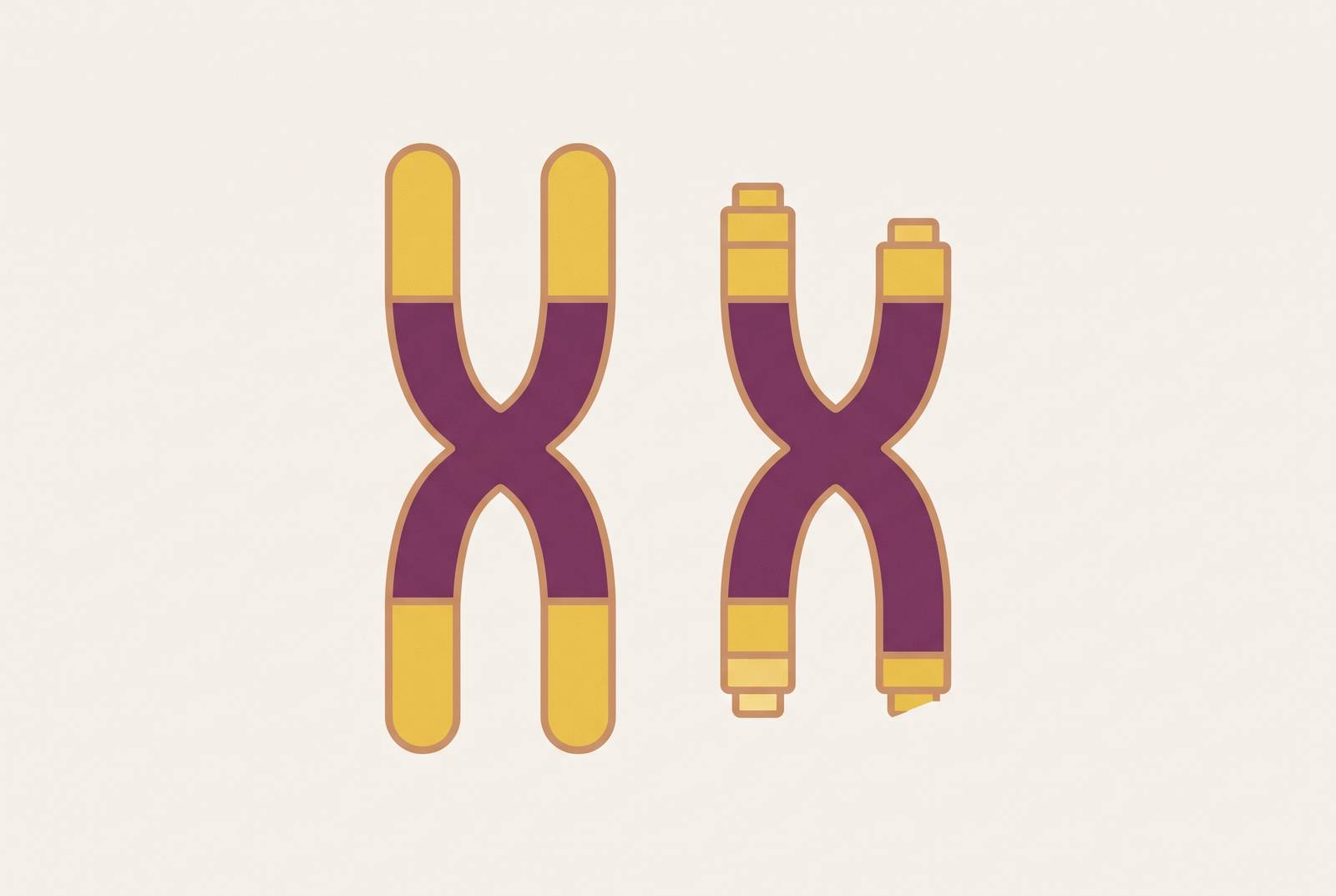
Telomeres sit at the ends of chromosomes like the plastic tips on a shoelace, and every time a cell divides, they get a little shorter. That shortening is called telomere attrition, and it functions as a molecular clock with real consequences for how long tissue keeps working. It is not a poetic stand-in for growing old.
The structure itself is a repeating DNA sequence, TTAGGG, stacked over and over at the chromosome tip and wrapped in protective proteins that keep the ends from fraying or fusing together. Each division costs the cap roughly 50 to 100 base pairs, and oxidative damage can push that rate higher. Once telomeres get short enough, the cell treats it as a red flag: it either stops dividing (senescence) or self-destructs (apoptosis), a safeguard against genetic errors piling up. Multiply that across a lifetime, and enough cells hitting that wall starts to look a lot like tissue aging.
An enzyme called telomerase can rebuild telomere length and slow the whole process, but most adult cells barely have any of it switched on. Declining telomerase alongside shortening telomeres gets treated, increasingly, as a biological signature of aging, sometimes of disease already underway.
Here is where the test itself gets less trustworthy than the marketing around it suggests. Most telomere tests, whether run in a research lab or sold direct to consumers, measure average telomere length in leukocytes, the white blood cells pulled from a standard draw. That single number becomes a stand-in for how "old" the body is at a cellular level, system-wide, which is already a stretch. Results come back as either average length or relative length depending on the lab's method, and interpreting either one gets murky fast. Shorter length reads as elevated risk, sure. But longer length is not automatically good news either: it has been linked to certain cancers and to all-cause cancer mortality in some studies. The real relationship looks more like a range where both ends carry a flag.
Telomere length also varies by age, sex, and ancestry, as well as by differences in laboratory methods and sample processing. Without an age-adjusted reference range validated on that same testing platform, one reading in isolation does not say much. That gap in standardization is exactly where physician opinion splits. Longevity and functional medicine doctors have gotten comfortable folding telomere panels into preventive workups. Conventional internists tend to hold back, and for a defensible reason: there is no universal reference range yet, and clinical guidance on what to actually do with the result stays thin. If a test cannot tell a doctor what to change in a treatment plan, it is fair to ask what it is really being sold for.
The forces that accelerate telomere loss faster than normal aging
Attrition happens to everyone. The rate is not fixed, though, and what compounds it matters as much as time itself passing.
Oxidative stress sits at the center of nearly every accelerant on this list. It damages the TTAGGG repeats directly, and it suppresses telomerase at the same time, so a cell loses its protective cap and its main repair tool in one move. That is a compounding loop, not two separate problems running in parallel, and it is why so many downstream conditions trace back to the same starting point.
Metabolic syndrome shows that loop in action about as clearly as anything in the research. People with metabolic syndrome show shorter telomeres, and the relationship between metabolic dysfunction and accelerated attrition appears to run in both directions. Poor metabolic regulation speeds up attrition, and attrition, in turn, seems to make metabolic regulation harder to hold onto. So which comes first, the dysfunction or the cellular aging? Neither does, really. It is a cycle, not a chain with one starting link, and treating it like a chain is where a lot of intervention advice goes wrong, chasing the wrong end of a loop that has no clean beginning.
Diet feeds directly into this. Ultra-processed food consumption drives faster telomere shortening in the research, likely through oxidative stress, low-grade inflammation, and the nutrient gaps that come with a diet heavy in processed calories. Whether the damage comes from what ultra-processed food adds, additives and refined starches, or what it crowds out, fiber and micronutrients, is still being sorted out. The association itself is consistent enough to take seriously either way, and waiting for the mechanism to get fully mapped before changing what is on the plate is a bad trade.
What the epidemiology shows about shorter telomeres and disease risk
A 17.75-year NHANES cohort of 1,980 people with metabolic syndrome found that shorter telomere length carried a hazard ratio of 1.33 (95% CI 1.11 to 1.6) for all-cause mortality, a figure that held up even after adjusting for other variables. That is a solid, well-supported number. The cardiovascular mortality figure from the same cohort, 1.36 (95% CI 0.96 to 1.93), crosses 1 in its confidence interval. That particular signal reads as suggestive rather than settled. One number stands on firmer ground than the other.
The disease associations do not stop at cardiovascular risk. Type 2 diabetes, neurodegenerative conditions including Alzheimer's, and several cancers all show links to telomere shortening, and in each case the relationship looks bidirectional. Disease speeds up attrition, and shortened telomeres seem to worsen disease progression through cellular senescence, genomic instability, and inflammatory signaling that amplifies rather than settles down over time. Cause and effect do not separate cleanly here, and pretending one is upstream of the other oversimplifies what the data actually shows.
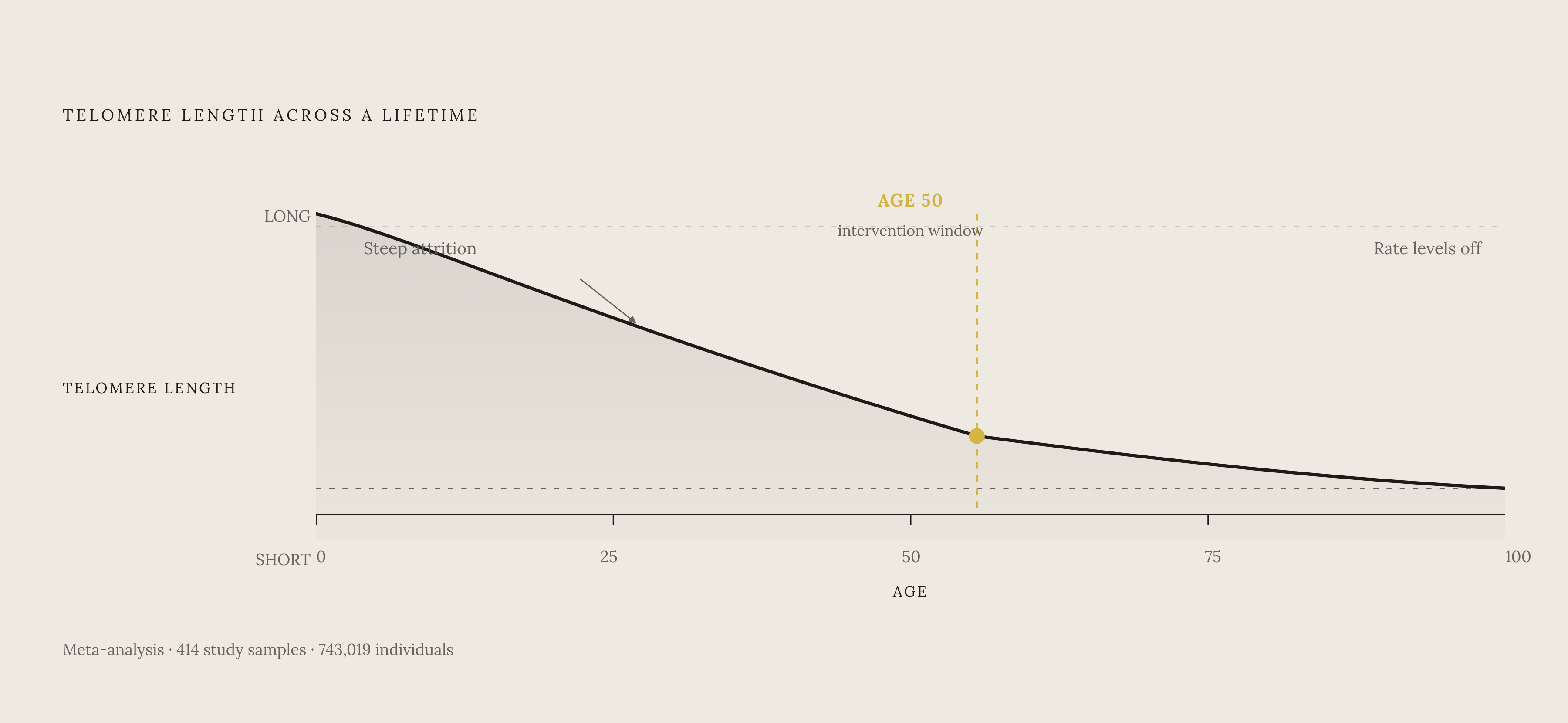
A meta-analysis covering 414 study samples and 743,019 individuals found that the rate of telomere shortening is not constant across a lifetime. It declines gradually up to around age 50, then levels off. That single detail reframes when intervention actually matters: if attrition is steepest before 50 and flattens out after, midlife is the window where changing behavior has the most room to bend the trajectory, not the decades that follow. Waiting until 60 to take any of this seriously misses most of the curve.
There is a genetic thread here too, and it pushes past pure correlation. Certain inherited variants that influence baseline telomere length appear to predict aging-related outcomes independently, suggesting telomere biology is partly set before any measurement is taken. That pattern suggests telomere length is not just riding along as a bystander marker. It may play an actual causal role in some of these outcomes, which is a different and more serious claim than "shorter telomeres correlate with worse health."
What the research supports for slowing attrition
Diet carries the clearest signal in the intervention literature, and it is not close. Plant-based, minimally processed eating patterns line up with better telomere dynamics, and the nutrients that keep appearing across this literature, antioxidants, polyphenols, omega-3 fatty acids, and folate, are linked to reduced oxidative stress and better telomere maintenance. Cutting back on ultra-processed food does more than remove additives from a plate. Cutting back on ultra-processed food does more than remove additives from a plate, and most diet advice skips past subtraction on its way to talking about supplements.
Exercise belongs in the same conversation, but the mechanism deserves more precision than "move more." The effect runs through redox and metabolic pathways, shifting mitochondrial function and oxidative balance rather than working through calories burned. That distinction matters for anyone trying to build an actual protocol instead of just logging steps on a watch.
Sleep might be the strongest single modifiable factor in the data, and it is the one most often brushed off. Sleeping under 6 hours a night ties to attrition rates running noticeably faster than normal, anywhere from moderately faster to roughly double the pace. The leading explanation points to stress-related biological pathways, with chronically disrupted sleep feeding the same oxidative stress loop already driving telomere loss elsewhere. That is a hypothesis more than a settled mechanism, but the size of the effect in the rate data is hard to wave off.
Supplements are where the noise lives: buying a telomerase-activating supplement right now means buying ahead of the evidence, not with it. Early experimental data on telomerase activation has not translated into confirmed human results. Diet, sleep, and exercise all have some human data behind them. Supplements mostly have mouse data and a marketing budget, and those are not the same thing.
How to track telomere-related biology before symptoms appear
Telomere length moves slowly, and one measurement is genuinely hard to read without a second point for comparison months or years out. A more useful focus is what can actually be tracked right now, with established reference ranges and a clear next step attached to the result. That means the metabolic and inflammatory drivers that accelerate attrition in the first place, not the telomeres themselves.
A short list to put on a regular testing schedule:
- Fasting glucose and HbA1c, since metabolic dysregulation drives attrition directly. A basic metabolic panel, which includes glucose, runs roughly $20 to $45 at self-pay labs.
- A lipid panel, given that cardiovascular risk carried the strongest mortality signal in the NHANES cohort. Cash price typically runs $25 to $55.
- A comprehensive metabolic panel covering liver function, relevant given the documented link between liver disease and telomere attrition. Expect $30 to $65.
- A complete blood count, because leukocyte health is the tissue telomere testing actually measures. Usually $15 to $35.
- CRP or another inflammatory marker, since chronic low-grade inflammation drives the whole process, often bundled into standard preventive panels rather than priced on its own.
Adding telomere length testing on top of that runs from around $100 for a basic length measurement up to $298 for a fuller genetic longevity analysis. Whatever the price, the result only means something measured against an age-adjusted reference range built on that same platform, and one reading tells less than two readings taken far enough apart to show a trend.
Pricing deserves a second look before booking anything, because the same basic metabolic panel can vary significantly in price from one facility to the next for the identical test. Ordering direct through a lab's own consumer portal, ordering direct through a lab's consumer portal cuts out the markup that appears when a panel routes through a doctor's office first, with individual test prices varying widely by panel type, though some estimates put the floor closer to $25 to $29. That floor figure is not confirmed by primary sourcing, so treat it as a rough estimate rather than a fixed one.
What the science currently can and cannot promise about telomere intervention
Some of this stands on solid ground. Telomere attrition is measurable, and it counts as a genuine hallmark of biological aging rather than a metaphor borrowed from it. Shorter leukocyte telomere length tracks with meaningfully higher mortality risk at the population level, and the main drivers behind that shortening, oxidative stress, poor metabolic health, chronic sleep deprivation, sustained cortisol elevation, are all things a person can actually change starting this week.
What the science cannot do yet matters just as much. A telomere length reading does not predict any one person's individual lifespan. Nudging that number through a specific diet or supplement has not been shown to improve outcomes in humans. Consumer telomere testing in a healthy adult with no clinical indication does not have established clinical utility yet, whatever the marketing around it implies.
So if the number itself is this hard to act on, what is actually worth spending money on today? Testing the upstream drivers, glucose, lipids, inflammatory markers, already has established clinical utility and a clear path to action, independent of whether telomere length ever gets measured directly. Using the biomarkers available now is the more defensible use of a testing budget right now. A 2025 review in Biogerontology frames aging as less of a fixed, one-way trajectory and more of a modifiable process, and that framing lines up with the evidence on the table: use the biomarkers available now alongside the metabolic levers already known to work, aimed at extending healthspan rather than just adding years at the tail end of life.
Sources
- Reframing Telomere Biology in Exercise Science: From Descriptive Metrics to Redox–Metabolic Mechanisms for Precision Healthy Aging (2000–2025) - PMC
- From telomeres and senescence to integrated longevity medicine: redefining the path to extended healthspan | Biogerontology | Springer Nature Link
- Employing Nutrition to Delay Aging: A Plant-Based Telomere-Friendly Dietary Revolution
- Telomere length and chronological age across the human lifespan: A systematic review and meta-analysis of 414 study samples including 743,019 individuals - ScienceDirect
- labtestmenu.org
- researchgate.net