Continuous Glucose Monitoring in Non-Diabetic Adults
CGM reveals daily glucose patterns standard tests miss, but benefits depend on who you are.

Continuous glucose monitoring can show how metabolism responds through the day in non-diabetic adults in ways that fasting glucose and HbA1c cannot. Its usefulness depends on whether the readings expose a pattern worth acting on, whether that action has evidence behind it, and whether glucose remains one part of the health picture.
Why a fasting glucose test cannot answer the question a CGM is asking
A fasting glucose test measures a single moment, while HbA1c gives a rolling average. Neither shows how glucose changed between those measurements. Two people can have identical results on both tests yet respond very differently after eating the same meal. Their lab results agree, but their daily trajectories diverge. Researchers describe these different response patterns as “glucotypes.”
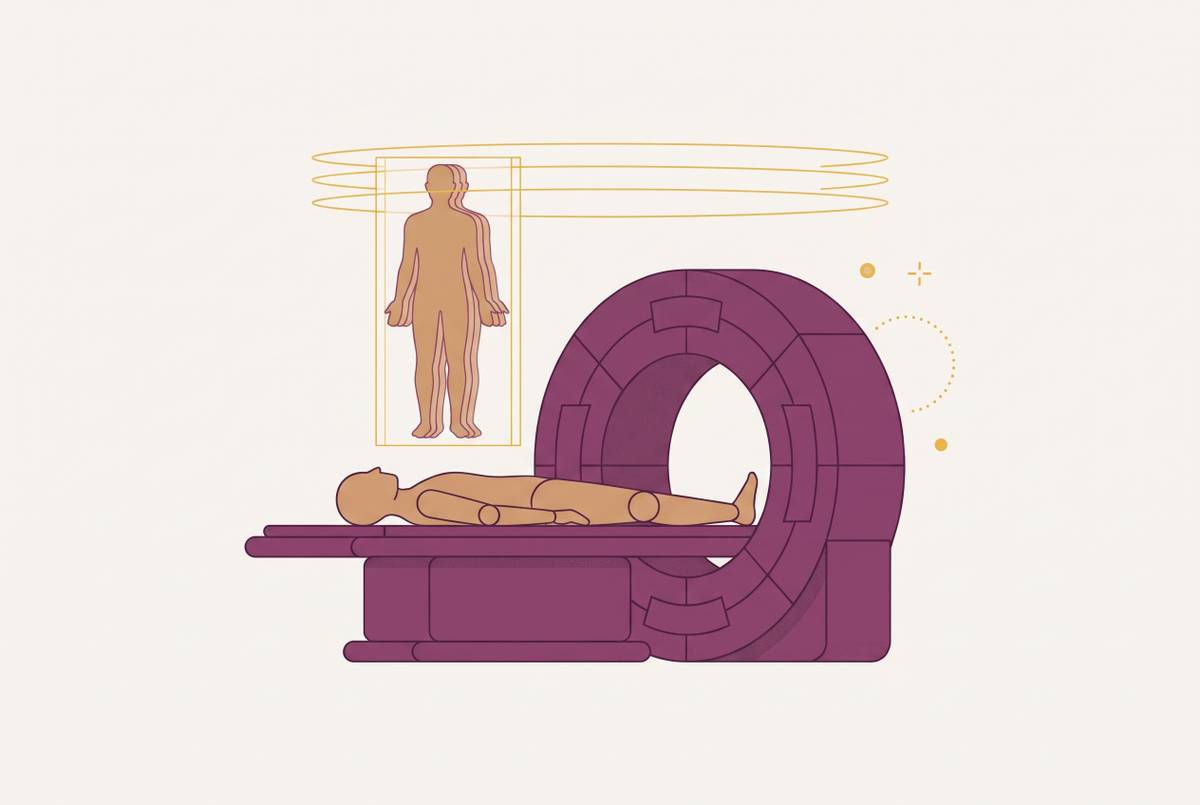
Continuous glucose monitoring, or CGM, uses a sensor placed under the skin to show those changes. It measures glucose in interstitial fluid and sends readings to an app in near real time. The question changes from whether a fasting value or average falls within a normal range to how glucose responds as a person moves through the day.
What happens after a carbohydrate-rich meal, exercise, poor sleep, or a stressful afternoon? Dietary fiber, meal composition, physical activity timing, and psychobiological stress all shape glucose responses, and those responses vary between people without diabetes. CGM makes those differences visible in a way a single blood draw cannot. A normal average and a variable daily pattern can both be accurate descriptions of the same person.
What CGM data from healthy adults actually shows
Even normoglycemic adults, whose fasting glucose and HbA1c fall within normal ranges, show individually variable glucose excursions. A 2025 study in the Journal of the Endocrine Society found that healthy adults ages 60–75 with normal HbA1c had higher mean and minimum daytime glucose than adults ages 20–35. The finding suggests that CGM can pick up small differences linked to age that standard lab results do not show. It does not establish that every difference requires treatment.
Glycemic variability in normoglycemic people correlates with age, BMI, HbA1c, physical activity, fiber intake, and the nutrient composition of breakfast. Observational studies have also identified subclinical dysregulation in menopause and obstructive sleep apnea, including links between higher glucose variability and blood pressure variability. These relationships make the data more than random noise. But a relationship with another risk marker is not the same as a diagnosis.
The measurement itself also needs careful interpretation. CGM reads interstitial fluid glucose, so there is a physiological lag. That lag becomes most consequential during rapid glucose changes, including during or immediately after exercise. A reading is therefore not an exact, instantaneous account of blood glucose. CGM also measures neither muscle glycogen concentrations nor carbohydrate flux, which limits its usefulness as an athletic “fuel sensor.”
What elevated glycemic variability in a healthy person might mean for cardiovascular risk
High glycemic variability may increase protein glycation, oxidative stress, and inflammation, contributing to vascular damage below the point where standard labs raise a flag. Yet a mechanism that could explain the harm does not, on its own, show how much risk a given pattern brings. A stronger test is to see whether CGM measurements track cardiovascular risk in people without diagnosed disease.
The Framingham Heart Study CGM sub-study, published in Diabetes Care, examined 1,356 adults without diabetes or cardiovascular disease. It found that some CGM measures were linked to higher estimated 10-year cardiovascular risk and worse cardiometabolic risk factors, even when fasting plasma glucose and BMI were taken into account. Higher average glucose and more time above 140 mg/dL were also associated with higher odds of hypertension and dyslipidemia.
CGM-based profiling of people with lab-defined prediabetes has likewise reclassified many into patterns of greater dysglycemia, with higher predicted cardiovascular risk and worse lipid and triglyceride-glucose index gradients. This suggests that lab categories alone can understate differences within an at-risk group. However, predicted risk is not an observed heart attack or stroke. Evidence that acting on CGM readings changes those hard outcomes remains limited, and the Framingham findings do not justify clinical intervention on CGM readings alone. They support a narrower conclusion, which is that elevated variability deserves further investigation in the context of other markers, including ApoB, CRP, and lipids.
Where CGM-guided feedback produces measurable behavior change — and where it does not
For CGM feedback to help, it needs to lead to a useful change beyond producing an interesting graph. Intervention studies provide a concrete example in walking timed before an individual’s post-meal glucose peak. That approach significantly reduced postprandial glucose, insulin, and C-peptide levels.
Feedback can also change a person’s readiness to act. Seeing glucose rise after a meal can give someone more reason to be physically active right then than general health advice does. Still, motivation is not the same as a measured health outcome. A 2024 systematic review and meta-analysis found that HbA1c fell and time in range rose more with CGM-based interventions than with interventions without CGM feedback. It found no significant effect on BMI or body weight, so improved glycemic measures should not be presented as evidence that the device independently drives weight loss.
Liao et al.’s 2026 meta-analysis in the European Journal of Medical Research sharpened the distinction between populations. It found that CGM significantly improved mean blood glucose overall, but the improvement was concentrated in people with prediabetes. Healthy normoglycemic populations showed no appreciable glycemic benefit. That is a useful boundary. It suggests that the benefit depends on having a metabolic pattern that can improve. Combining results for non-diabetic adults can hide that difference because people in this group start from quite different points.
Who is most likely to extract genuine signal from a CGM
The strongest case is for adults with prediabetes, where intervention evidence shows clearer benefit. Other groups with a stronger rationale for considering CGM include people with a family history of type 2 diabetes, elevated BMI, or metabolic syndrome components such as elevated triglycerides, low HDL, and elevated blood pressure. Older adults may also have more to learn because subtle glucose dysregulation increases with age. These groups have varying evidence of benefit and more reason to investigate than a low-risk population does.
Someone may have a normal HbA1c yet spend a fair part of each day above 140 mg/dL after meals. CGM can identify that phenotype without establishing, by itself, what treatment it requires. Menopause and obstructive sleep apnea provide other settings in which observational evidence points to otherwise hidden dysregulation. In those cases, the value is in making a possible concern visible for further assessment.
For a healthy, young, normoglycemic adult without metabolic risk factors, the case is much weaker. Evidence does not currently support improved glycemic outcomes in that group, and the behavioral benefit is less certain. The signal-to-noise ratio is low. For anyone considering CGM, the more defensible approach is to read its patterns with fasting glucose, HbA1c, fasting insulin, lipids, and CRP. Those measures give information that a glucose trace cannot, while the trace shows the timing and variability that an ordinary panel leaves out.
What the OTC devices available now actually are and what they cost
The FDA cleared the first over-the-counter continuous glucose monitors in 2024, bringing access beyond prescription-only care. People could buy the devices at pharmacies without a prescription or doctor’s referral. Dexcom Stelo, launched in 2024, was the first FDA-cleared OTC CGM device. It is cleared for adults 18+ who do not use insulin, including people with prediabetes and those seeking metabolic insights. Purchase options include a one-time purchase of two sensors, a monthly subscription, or a quarterly purchase of six sensors.
Signos received FDA clearance as an over-the-counter glucose monitoring system under 510(k) K250106 in March 2025. Its cleared population is adults 18 and older who do not use insulin. The FDA summary says it may help users understand how changes in the way they live and act, including diet and exercise, affect glucose excursions. It also states that it “may be useful in helping users to maintain a healthy weight.” That wording is narrower than proof of weight loss, especially given the intervention findings on body weight.
For wellness use, the choice is not simply better hardware at a higher tier. OTC sensing hardware is comparable to prescription CGMs, with the main differences lying in the companion app and certain display constraints. There is little technical reason to pay for a prescription-tier device solely for wellness use. The expense remains out of pocket because these devices are not covered by insurance for non-diabetic wellness use. Tax savings do not make access free.
The useful cost comparison is between a short learning period and an ongoing service, rather than a dollar estimate unsupported by the available pricing details. Intermittent use changes that calculation substantially. Two weeks of CGM per quarter is the pattern-learning interval suggested by the evidence, and buying sensors outright for that schedule costs substantially less than a subscription coaching platform. Coaching platforms give people access to a dietitian but cost much more. For people who actively engage with their data, evidence does not strongly support ongoing coaching beyond the initial learning period.
The honest case against CGM in healthy adults — and what it actually settles
The Johns Hopkins Bloomberg School of Public Health stated in January 2026 that CGMs have been transformative for people with diabetes but that there is little evidence of benefit for people without the disease. Transient post-meal excursions in healthy normoglycemic people do not automatically indicate pathological glucose regulation. Their long-term health risks are not established, nor is clinical benefit from modifying those responses. A visible rise is therefore not, by itself, evidence that a food needs to be removed from someone’s diet.
There is also a risk in narrowing attention. CGM measures glucose, while cholesterol, triglycerides, blood pressure, ApoB, and CRP describe other important parts of cardiovascular and metabolic health. A compelling graph can receive more attention than those less immediate measurements deserve. The school also notes that tracking readings too closely can create unnecessary anxiety about occasional highs in healthy people. More frequent information can become a burden when its meaning is uncertain.
These objections are decisive against treating CGM as a standalone wellness intervention for healthy normoglycemic adults. They are not decisive against every use in a person without diabetes. Prediabetes, elevated cardiovascular risk markers, and conditions such as menopause and sleep apnea present different questions, with stronger evidence for detecting useful patterns, though not equal proof of improved outcomes. The distinction is between identifying a phenotype and delivering a health benefit. One can be established more clearly than the other.
A genuinely useful CGM practice therefore begins with a question the data can answer and interprets the response within a broader assessment. It does not pursue a perfectly flat graph or treat each excursion as a dietary failure. Its most defensible role is as a dynamic layer added to a comprehensive biomarker picture. That preserves what continuous monitoring uniquely reveals without asking it to replace the conventional measures, or the evidence of clinical benefit, that a sound health decision still requires.
Sources
- Use of Continuous Glucose Monitoring in Non-diabetic Individuals for Cardiovascular Prevention: A Systematic Review of Its Impact on Guiding Lifestyle Interventions
- Is Glucose Monitoring Useful for Non-Diabetics?
- Continuous glucose monitoring in non-diabetic populations
- Personal and Lifestyle Determinants of Glycemic Variability in Healthy Adults Without Diabetes
- Glycemic Variability and Control by CGM in Healthy Older and Young Adults and Their Relationship With Diet
- Continuous Glucose Monitoring for Metabolic Phenotyping and Precision Nutrition: Current Evidence, Clinical Applications and Future Perspectives