mTOR Signaling and Nutrient Sensing in Aging
Blocking this growth switch could slow aging by cutting off the signals that drive cellular decline.
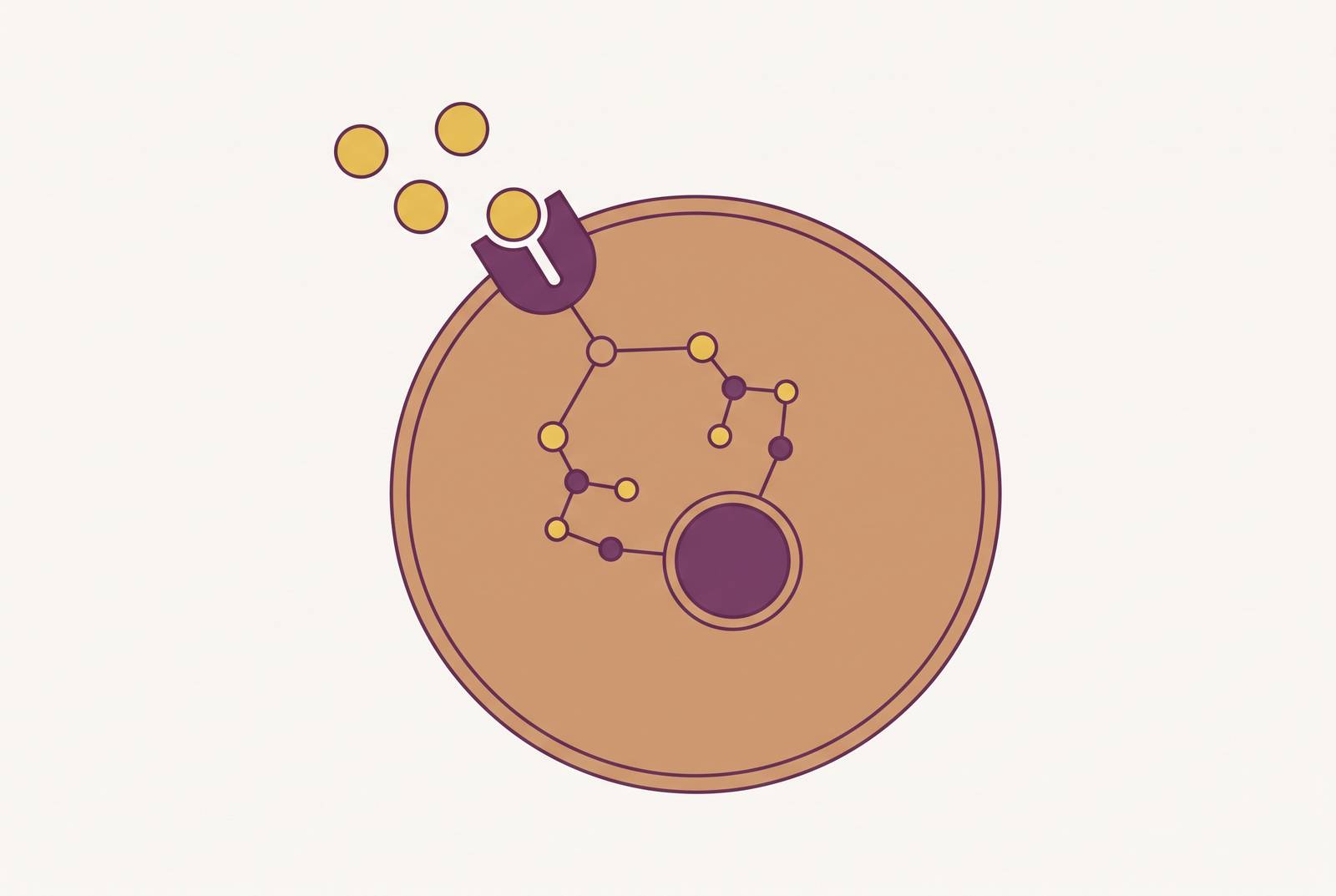
Every cell in the body runs a constant calculation: build, or clean up? A single protein kinase called mTOR makes that call, thousands of times a day, and how it gets made has more to do with how fast a person ages than almost any other switch in human biology. Get the switch stuck in the "build" position, and the body pays for it in ways researchers can now name one by one.
mTOR stands for mechanistic target of rapamycin. It's a serine/threonine protein kinase that acts as the master regulator of cell growth in pretty much every organism with a nucleus, from yeast to humans. Picture a construction foreman on a job site. When materials show up (amino acids, glucose, insulin), the foreman waves the crew forward: pour concrete, frame walls, keep building. When the truck doesn't show, a good foreman calls off new construction and puts the crew on maintenance instead, patching what's there, hauling away debris. That second mode is where autophagy lives, the cell's cleanup system. Chronic overactivation of mTOR is a foreman who never calls off the build, even when the site is already full and badly needs upkeep instead of more concrete.
There isn't one mTOR. There are two distinct complexes, mTORC1 and mTORC2, and lumping them together muddies the whole story. mTORC1 is the one that matters for aging: it drives protein synthesis and cell growth, responds directly to feeding signals, and shuts down autophagy by inhibiting an enzyme called ULK1. mTORC2 runs differently. It handles cell survival, insulin sensitivity, structural scaffolding, and cardiac function, responds less to nutrients, gets only partly blocked by rapamycin, and tends to protect tissue depending on context. Nearly all of the aging-acceleration story traces back to mTORC1, and any argument that treats "mTOR" as one undifferentiated villain is already off track.
What flips mTORC1 on? Amino acids, especially leucine, sensed by a protein called Sestrin2 and signaled through Rag GTPases sitting on the lysosome's surface. Glucose. Insulin, working through the PI3K/Akt pathway, disabling a natural mTOR brake called TSC2. IGF-1, growth factors, inflammatory cytokines. Everything about a full, fed, comfortable state tells mTOR to keep building.
Why evolution built a pathway that accelerates aging
Natural selection doesn't optimize for a long life. It optimizes for surviving long enough to reproduce and raise offspring who survive too. That's the core idea behind life history theory, and it explains why mTOR looks the way it does: a nutrient-sensing system tuned for a world of feast and famine, badly suited to a world of granola bars in every desk drawer.
Think of the anabolic-catabolic axis as the underlying logic. Food shows up, an organism grows and reproduces. Food disappears, an organism shifts into maintenance and, if things get bad enough, dormancy. mTOR sits on the growth side of that axis. AMPK sits on the maintenance side. For millions of years the system worked because scarcity kept showing up on schedule: winters, droughts, failed hunts. The switch flipped back and forth without anyone having to think about it.
That's the setup behind what researchers call the hyperfunction theory of aging. mTOR doesn't break down as an organism gets older. It keeps pushing growth and construction, in an environment that no longer forces it to stop. Three meals a day plus snacks, an office chair, a kitchen stocked around the clock: modern life keeps mTOR biased toward construction for most of a person's waking hours. The feast-famine cycling that used to suppress mTOR on a regular basis has, for most people, all but disappeared. Modern life keeps mTOR biased toward construction for most of a person's waking hours, and the pathway is simply doing what it's built to do. It's doing its job in an environment that never asks it to stop.
How chronic mTOR activation connects to every major hallmark of aging
mTOR touches nearly every process researchers now call a hallmark of aging: nutrient sensing, protein folding, autophagy, mitochondrial health, cellular senescence, stem cell function. That's a long list for one kinase to show up on, but each connection traces back to the same root behavior: mTOR won't stand down.
Start with autophagy, the most direct line. Active mTORC1 phosphorylates and inhibits ULK1, the enzyme that kicks off a cell's internal cleaning crew. When mTOR never powers down, that cleaning crew never gets called in. Damaged proteins pile up instead of getting recycled, a state researchers call loss of proteostasis. Damaged mitochondria, which normally get cleared through a specific form of autophagy called mitophagy, stick around too, leaking reactive oxygen species the whole time. One malfunction feeds the next.
Then there's cellular senescence, the inflammatory half of the story. Cells under chronic mTOR pressure can get pushed into a senescent state: they stop dividing, but they don't die, and they don't go quiet either. They stay metabolically active and pump out inflammatory molecules, a pattern called the senescence-associated secretory phenotype, or SASP. mTOR appears to work with autophagy machinery to drive that secretory behavior, releasing factors that get in the way of normal tissue renewal. A 2024 study in Nature Aging found that a mild, genetically engineered bump in mTORC1 signaling in mice was enough on its own to drive chronic myeloid inflammation, damage multiple organs, and cut lifespan by around 30%. A small, sustained nudge did that. Not a dramatic overdose, not an extreme genetic knockout. A nudge.
Stem cells take a hit too. Growth signals driven by mTOR push quiescent stem cells, the ones sitting in reserve, into premature activity. A stem cell that should be resting, waiting for a real repair job, gets called into action too often and burns out ahead of schedule. Tissue repair capacity declines as that reserve pool empties faster than it should refill.
What tips the mTOR-AMPK seesaw in modern life
AMPK, short for AMP-activated protein kinase, is the cell's energy gauge, and it sits on the opposite side of the seesaw from mTOR. Low energy states, exercise, fasting, cold exposure, all switch AMPK on. Once active, AMPK inhibits mTORC1 and turns on autophagy. The two pathways work against each other: when one climbs, the other tends to drop.
In ancestral conditions, this seesaw moved constantly. A stretch of scarcity or a hard physical effort activated AMPK and suppressed mTOR. Food came back, rest came back, and mTOR came back online for growth and repair. That back-and-forth wasn't an inconvenience to route around. It was the design.
Modern routines tip the seesaw and leave it tipped there. A few reasons why:
- Frequent meals and snacks keep amino acids and insulin elevated across nearly the entire waking day, so mTOR rarely gets the signal to stand down
- Long stretches without physical movement remove one of the main natural triggers for AMPK activation
- Diets heavy in refined carbs and added sugar keep insulin chronically high, which tells mTOR to stay active even when a cell's actual energy stores are fine
- Low-grade chronic inflammation, itself partly a product of mTOR overactivity, piles another layer of growth signaling on top
Aronoff and Trumble's work in evolutionary medicine lays out the mismatch: the feast-famine cycling that once kept mTOR in check has largely vanished for sedentary adults who eat throughout the day. The pathway hasn't changed. The environment around it has changed completely, and the pathway has no way of knowing that.
What the evidence shows about fasting, protein timing, and exercise as mTOR modulators
Researchers increasingly frame the goal as periodic stimulation followed by periodic suppression, a rhythm instead of a permanent state in either direction. That reframes fasting and protein cycling as ways to restore a cycle the body already expects.
Caloric restriction has the strongest evidence base by a wide margin, though nearly all of it comes from animal research, and that gap in human evidence means claims about human longevity benefits remain unproven. Dietary restriction is the most consistently lifespan-extending intervention tested across species, and a good chunk of that effect runs through limiting nutrient uptake and dialing down mTORC1 activity. The pattern holds up across strikingly different organisms: deleting the SCH9 gene, a yeast homologue of a key mTOR pathway component, extends yeast lifespan; suppressing TOR signaling extends lifespan in C. elegans and in fruit flies; rapamycin confirms the same mechanism working across yeast, worms, flies, and mice. That's about as strong a signal for a shared pathway as biology tends to offer. Human data lags behind, though. Long-term studies tying fasting directly to human longevity don't exist yet with anything close to the rigor of the animal work. What's better established is narrower: fasting shifts biomarkers that sit close to mTOR activity, fasting insulin, IGF-1, inflammatory markers, in a favorable direction. That's a real finding. It's not the same as proof that fasting adds years.
Protein timing is where the picture gets more textured, and where a lot of casual advice gets it wrong. Leucine is a particularly strong amino acid activator of mTORC1, and continuous high protein intake all day keeps mTOR running hot around the clock. Concentrating protein into defined windows instead lets suppression happen in the gaps. Leucine-rich sources like whey or branched-chain amino acids produce a pulsed spike in mTOR activity, useful for muscle repair, but the risk sits in overuse: too frequent, too high a dose, and the suppression window never opens. IGF-1 adds another wrinkle, and it's the one that trips people up most. Protein intake shifts IGF-1 levels, and IGF-1 sits just upstream of mTOR, but lower isn't automatically better here. IGF-1 running too high has been associated with adverse health outcomes in some research contexts. IGF-1 running too low raises its own concerns, particularly around maintaining muscle mass in older adults. The target sits in the middle, and the middle moves: it's not the same number for a 30-year-old lifting weights as for an 80-year-old trying to hold onto muscle. Population data from Blue Zones regions, where diets skew lower in protein and heavier in plants, line up with lower IGF-1, lower mTOR markers, and lower mortality in the epidemiological record. Chasing maximum protein intake for decades is very likely the wrong longevity strategy, even if it builds bigger muscles along the way, which is a real point in favor of moderate protein intake for anyone optimizing for lifespan over raw muscle mass.
Exercise might be the cleanest modulator of the three, because it hits both sides of the seesaw on purpose instead of by accident. Resistance training activates mTOR acutely in muscle tissue, which is exactly the anabolic signal muscle needs to repair and grow. Endurance exercise does close to the opposite: it activates AMPK across the whole body, suppresses mTOR, and turns up both autophagy and mitochondrial biogenesis. Combining the two kinds of training makes the pattern start to look like the original feast-famine cycle mTOR evolved around: activation, then suppression, growth, then cleanup. The clearest evidence-backed case for intentionally switching mTOR on is resistance training paired with amino acids right after a workout, targeted and temporary, aimed at muscle resilience, followed by actual recovery instead of another spike an hour later.
Rapamycin: what the pharmacological evidence establishes
Rapamycin turned mTOR from an interesting biochemical pathway into one of the most closely watched targets in aging research, and the reason traces back to a single striking result. Mice given rapamycin starting at 600 days of age, roughly the equivalent of a 60-year-old human, lived 14% longer if female and 9% longer if male. That's not a prevention story. These mice were already well into the back half of life when treatment started, and they still gained measurable time. It was the first pharmacological intervention shown to extend mammalian lifespan when started that late in the game.
Why does that matter mechanistically? Rapamycin works by specifically inhibiting mTORC1, and the fact that it still extends lifespan starting mid-life suggests the pathway stays adjustable well past youth. It isn't a developmental window that slams shut early and locks in whatever damage already happened. The switch can still be moved later on, and moving it still pays off. That's a meaningfully different claim than saying mTOR suppression only works as prevention, and it's the claim that makes rapamycin interesting to researchers who work with adults, not lab mice bred for early intervention.
The result also isn't a one-off. A multi-site testing program ran rapamycin trials in genetically varied male and female mice across three separate testing sites, and the lifespan extension held up at all three. Replication across independent sites and mixed genetic backgrounds rules out a fluke tied to one lab or one mouse strain. The effect isn't confined to mice either. A 2025 meta-analysis pooled 911 effect sizes from 167 separate papers, spanning eight vertebrate species, and found rapamycin produced roughly 24% lifespan extension on average. That figure matches, and in some comparisons beats, what dietary restriction delivers, the intervention long treated as the gold standard for extending lifespan across species.
So what does this actually establish, and what doesn't it? Suppressing mTORC1, through a drug, through fasting, through deliberate exercise patterns, reliably shifts the growth-versus-repair balance back toward repair, across an unusually wide range of organisms and study designs. Whether that shift turns into a specific, prescribable human protocol is still an open question, and anyone claiming otherwise is running ahead of the data. But the mechanism holds up across species that split from each other tens of millions of years ago, and that kind of agreement across such distant biology is not something research stumbles into by chance.
Sources
- F1000Research Article: mTOR as a central regulator of lifespan and aging.
- mTOR: When to turn it off to live longer
- Nutrient sensing of mTORC1 signaling in cancer and aging - ScienceDirect
- Multifaceted role of mTOR (mammalian target of rapamycin) signaling pathway in human health and disease | Signal Transduction and Targeted Therapy
- Twenty-five years of mTOR: Uncovering the link from nutrients to growth | PNAS
- nature.com
- frontiersin.org