Senolytics in Human Clinical Trials
Early trials show senolytics can clear aging cells but not yet whether patients actually benefit.

Human clinical trials of senolytics have begun to test whether clearing senescent cells that persist can improve health as well as change laboratory markers. The early studies show feasibility and biological activity, but those findings are not yet a dependable basis for treatment. Whether that activity produces lasting benefits for patients remains unresolved, and the evidence needs to be read with that distinction in view.
What senescent cells are and why their accumulation drives systemic harm
Cellular senescence is not the same as cell death. A damaged cell permanently stops dividing but stays metabolically active, releasing an inflammatory mixture called the senescence-associated secretory phenotype, or SASP. This mixture includes IL-6, IL-8, TNF-α, matrix metalloproteinases, and dozens of other mediators. Its effects extend beyond the tissue of origin, so senescent cells in one place can contribute to dysfunction elsewhere.
In the short term, senescence serves a protective purpose. It helps keep damaged cells from becoming cancerous and brings in the immune system to clear them. But that clearance becomes less efficient with age, allowing persistent cells and their inflammatory output to accumulate. The aim of senolytics is therefore not to abolish senescence, but to remove cells that have outlasted their usefulness. If those cells help drive age-related disease through the SASP, selectively clearing them should reduce that harm.
How senolytics are designed to work, and which agents have reached human trials
Senolytics target the survival machinery that keeps senescent cells alive. These cells make more use of anti-apoptotic pathways to resist death signals, especially pathways that involve proteins that keep cells alive. Blocking those pathways is intended to trigger apoptosis while sparing normal cells. The leading clinical combination, dasatinib plus quercetin, or D+Q, pairs a BCR-ABL and Src kinase inhibitor used in leukemia with a plant flavonoid that inhibits PI3K/AKT and BCL-2 family proteins. The compounds target different senescent cell types, so together they clear cells that neither clears well on its own.
Dasatinib is an FDA-labeled oncology drug, but its label does not include senolysis or prevention in healthy people. Navitoclax, also called ABT-263, is a more potent inhibitor of anti-apoptotic proteins, but platelets depend on one of those proteins for survival, so dose-limiting thrombocytopenia restricts systemic dosing. Fisetin has drawn interest because it acts across PI3K/AKT, BCL-xL/BCL-2, and autophagy pathways, with a tolerability profile different from a prescription oncology drug.
SGLT2 inhibitors lower PD-L1 on the surfaces of senescent cells, taking away a signal that shields them from immune surveillance without killing the cells directly, an approach now entering human study. Rubedo Life Sciences has entered Phase 1 human dosing with RLS-1496, a topical GPX4-modulating therapy, in plaque psoriasis, atopic dermatitis, and skin aging. Rubedo also received FDA clearance for an IND in actinic keratosis, extending a mechanism-defined approach distinct from D+Q and navitoclax.
What the first human trials actually showed, and why they were not enough
Wake Forest School of Medicine and the University of Texas Health Science Center San Antonio ran the first human senolytic trial, published in 2019, with 14 patients who had idiopathic pulmonary fibrosis. The open-label, uncontrolled study tested D+Q and found measurable changes in physical function. Six-minute walk distance went up, 4-metre gait speed improved, and chair rise time fell. D+Q also raised urinary α-Klotho, a geroprotective protein, providing a human pharmacodynamic signal consistent with earlier mouse findings. But the study lacked a control arm.
A subsequent Mayo Clinic-led diabetic kidney disease trial, NCT02848131, added tissue evidence. Adipose and skin biopsies showed reductions in p16INK4a-positive and p21CIP1-positive cells and SA-β-gal activity after treatment. The biopsy findings showed senescence-associated changes in living human tissue after treatment. Yet the trial was designed around feasibility, safety, and biomarker signals. Neither this evidence nor the earlier functional changes established that D+Q slowed, reversed, or modified the underlying disease.
The biomarker measurement problem that runs through every trial
How can a trial tell whether it cleared the intended cells? Farr et al.’s 2025 study in Aging Cell shows that no single commonly used marker can give a definite measure of senescent-cell burden in living tissue. Multiple markers are needed, and each has limitations. p21 is involved in establishing senescence but is not increased in every senescent cell, while p53 does not definitively distinguish senescence from apoptosis. SA-β-galactosidase can also appear in macrophages and produce false positives under conditions including high cell confluence and hydrogen peroxide exposure.
Even different measures of p16 are not interchangeable. p16 may be more involved in maintaining senescence than initiating it, and Farr et al. found that T-cell p16 variant 5 predicted skeletal response better than the combined variant 1+5 measure. Without target-engagement markers that have been validated, a trial that fails may leave it unclear whether the drug failed to clear cells or the measurements missed the clearance. The same study found correlated plasma SASP markers that can help with monitoring by taking the place of T-cell p16 assays that are hard to carry out. Such surrogates are useful, but they are not definitive counts of senescent cells in a particular tissue.
What the Alzheimer's disease trials showed and what they could not establish
SToMP-AD, NCT04063124, and STAMINA tested D+Q in older adults with early Alzheimer’s disease or at elevated risk. Both Phase 1 studies focused on tolerability and central nervous system penetration. SToMP-AD included five older adults with early Alzheimer’s and found that dasatinib entered the central nervous system in 4 of 5 participants. People tolerated the treatment well, and exploratory analyses found changes in markers in cerebrospinal fluid and plasma. That establishes an important delivery finding.
STAMINA tested pulsed D+Q in a 12-week pilot. Plasma inflammatory markers, including SASP factors, fell, and reductions in TNF-α significantly correlated with improvements in MoCA cognitive scores. The association is intriguing, but what can it establish? A small, single-arm, open-label study cannot show that treatment caused the cognitive changes or that clearing senescent cells explains them. The signal supports larger trials, and Phase 2 Alzheimer’s trials are underway, but their results are not available in the supplied record.
The skeletal trials and what they reveal about patient selection
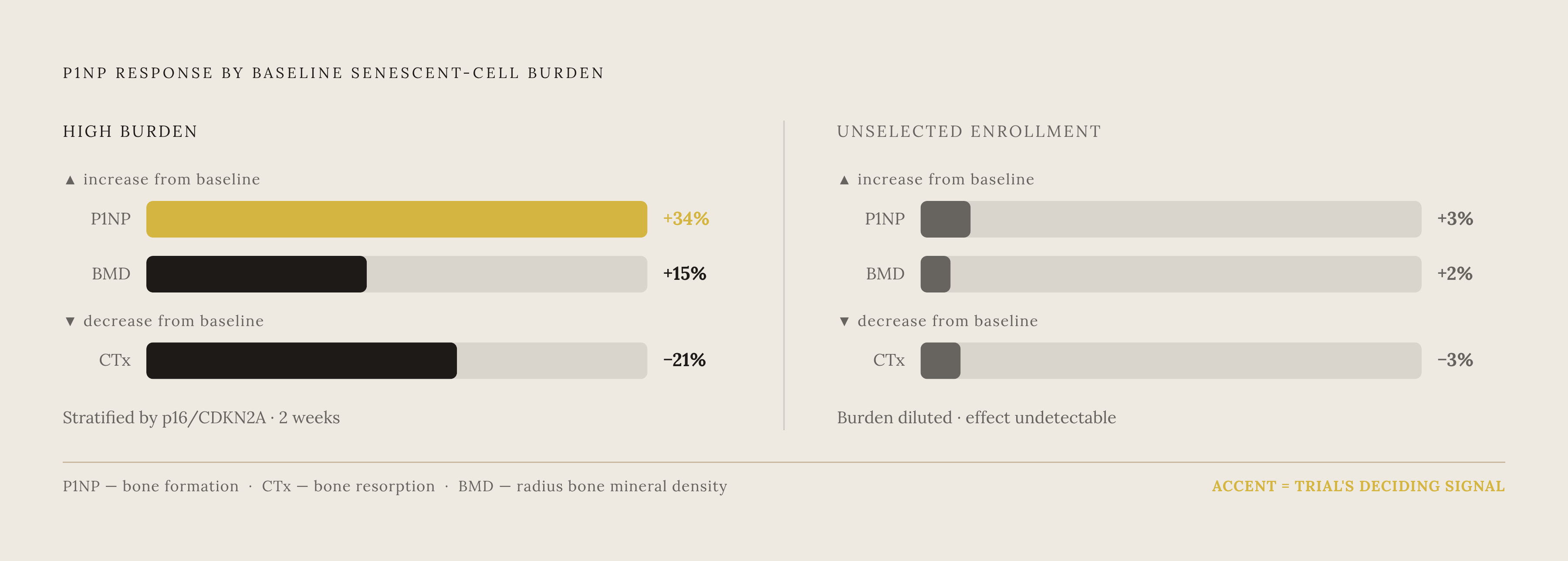
A D+Q trial in postmenopausal women provides a more concrete lesson about who might respond. Women with high baseline senescent-cell burden had a 34% increase in the bone formation marker P1NP at two weeks. The skeletal response also included reduced bone resorption marker CTx and increased radius bone mineral density. The response was driven principally by this high-burden group, identified through T-cell p16, or CDKN2A, mRNA. Subsequent analysis found variant 5 to be the more predictive measure.
Patient selection changed what the analysis could detect. This is the clearest tissue-level human signal in the trial record described here, but it emerged through stratification by baseline burden rather than demonstrating broad efficacy in all participants. Enrolling people regardless of burden could dilute a response confined to a subset. Trial designs should identify high-burden patients before enrollment and use suitable markers to assess treatment activity.
The Unity Biotechnology failure and what it cost the field
Unity Biotechnology was the first senolytic company to reach aging human subjects in randomized trials, although academic studies came earlier. Its Phase 2 trial of UBX0101 in osteoarthritis failed to meet its primary endpoint. Its later ASPIRE trial of UBX1325 in diabetic macular edema narrowly missed non-inferiority at an 88% confidence interval, falling short of the prespecified threshold. Unity has ceased operations in the available account.
Unity pursued local delivery to diseased tissues, which limits treatment to a specific site and may leave other sources of inflammation untouched. Because the SASP acts systemically, clearing senescent cells in a knee joint would not address inflammatory contributions from elsewhere. That makes local treatment potentially insufficient for some diseases, while its role in these failures remains unproven. The results bear on particular drugs and strategies, leaving the broader senolytic hypothesis unresolved.
Where the broader trial landscape stands as of the sources available
The completed studies described here span feasibility, physical function, tissue biomarkers, central nervous system penetration, and a skeletal response linked to patient selection. Most were small and disease-specific, with designs aimed at safety or biological signals and insufficient power for efficacy conclusions. Larger Phase 2 trials are underway across several indications. Fisetin trials cover frailty, vascular function, and cancer survivorship, but their status is mixed. Some are recruiting or active, while others were withdrawn, terminated, or completed without having their efficacy endpoints published.
One inconsistency prevents a categorical verdict about randomized efficacy. The supplied material claims that a Phase 2 placebo-controlled D+Q trial in fibrotic MASH, published in Nature Metabolism in 2026, had a positive result, but it also says that no positive randomized disease-modifying result has arrived. It gives no details from the primary study that would show which claim is right. With those claims unresolved, both the claimed liver result and the claim that no positive result exists remain unproven here. The adequately described trial record supports biological activity without establishing dependable disease-modifying efficacy.
Why the gap between preclinical results and human efficacy is not surprising and what it means for the timeline
Strong animal findings do not make human benefit inevitable. Mouse models of accelerated aging differ from normal human aging, human tissues have a wider mix of senescent cells, and immune clearance works differently across species. These are structural problems shared across the translation of aging biology. The diseases being studied also tend to worsen slowly, so short trials that use surrogate endpoints may miss clinical changes that matter. Longer trials are expensive and difficult to run.
Better measurement can make that uncertainty more tractable. Trials that select patients with high senescent-cell burden and use validated pharmacodynamic markers would be better placed to detect a real effect if one exists. They would also make a negative result easier to interpret by showing whether the intended target was reached. The skeletal findings give this design approach a human foundation, but they do not set a timetable for effective treatment.
What this means for someone who wants to act on their own senescent cell burden now
For an individual reader, the distinction is between participation in a supervised study and buying something described as senolytic. Quercetin or fisetin supplements alone are not equivalent to the Mayo Clinic regimen and have not been validated as senolytics in humans. Clinical protocols set out doses, schedules, and monitoring that products sold to consumers do not match. Dasatinib’s oncology label also does not authorize senolysis or healthy-person prevention. The evidence described here does not justify unsupervised prescription use.
A more grounded action is to monitor inflammatory burden over time. Accessible markers including hs-CRP, IL-6, and TNF-α provide a window into systemic inflammation, although they cannot count senescent cells or establish that a senolytic worked. Older adults with high IL-6 and TNF-α have a strongly linked increase in their risk of death from cardiovascular disease, so these markers matter beyond senolytic research. Baseline measurement and regular monitoring can form part of a proactive health approach, provided those limits remain clear. Follow trial results and resist treating an unvalidated supplement protocol as a substitute for supervised clinical evidence.
Sources
- Characterization of Human Senescent Cell Biomarkers for Clinical Trials - Farr - 2025 - Aging Cell - Wiley Online Library
- Targeting Cellular Senescence With Senolytics to Improve Skeletal Health in Older Humans
- p16(Ink4a) and senescence-associated β-galactosidase can be induced in macrophages as part of a reversible response to physiological stimuli