Resistance Training Effects on Muscle Mass and Mortality
Strength training cuts mortality risk by targeting the muscle loss that fuels age-related disease.
Most people file muscle loss under cosmetics: something that shows up as softer arms or a slower mile, not something that shortens a life. The biology says otherwise. Muscle strength and mass peak somewhere between ages 30 and 40, and from there, the decline is steady and linear, not a sudden event that arrives in old age. So the clock starts decades earlier than most people assume, often while you still feel, by every outward measure, perfectly fine.
By age 60, a meaningful share of adults already meet the diagnostic criteria for sarcopenia, though the exact number shifts depending on which method is used to measure it. Sarcopenia itself means progressive loss of muscle mass, strength, and physical function, and it raises the risk of chronic disease, falls, fractures, and functional disability. If muscle mass is low, outcomes get worse in diabetes, cardiovascular disease, and cancer, not just grip or walking speed. Muscle is a metabolic organ, not just a mechanical one: it supports blood sugar regulation, immune defense, and cardiovascular function, and when it erodes, those systems lose some of their cushion.
Part of what makes this decline self-perpetuating is inflammation. IL-6 and TNF-α are two inflammatory markers, and both show an inverse relationship with muscle mass and strength even in healthy older adults. Lower muscle correlates with higher inflammation, and higher inflammation predicts further muscle loss, so the two feed each other over years. Seen this way, muscle is closer to a vital sign, one that is modifiable well before any disease appears on a chart.
What the mortality data show about resistance training
If muscle loss drives disease risk, the natural question is whether building and keeping muscle can reverse that risk, and the data on resistance training answer that question with more consistency than most casual health coverage lets on. A systematic review and meta-analysis pooling 10 studies found that resistance training, in any amount, was associated with lower risk across all three major mortality categories: all-cause, cardiovascular, and cancer mortality. That's not a narrow result tied to one population or one outcome. It spans the leading causes of death in older adults.
The pattern holds in populations where the stakes are highest. Research on weight training and mortality risk specifically among older adults reinforces the same finding, which matters because older adults are the group losing muscle fastest and, for that same reason, the group with the most to gain from starting. Someone in their 60s or 70s picking up resistance training for the first time isn't playing catch-up on a lost cause. The evidence suggests they're intervening at the point where the return is largest.
What makes this body of evidence credible is that the signal, lower mortality risk tied to resistance training, keeps turning up across different study designs and different groups of people, and that consistency is what justifies treating resistance training as a serious longevity lever.
How dose and frequency shape the mortality benefit
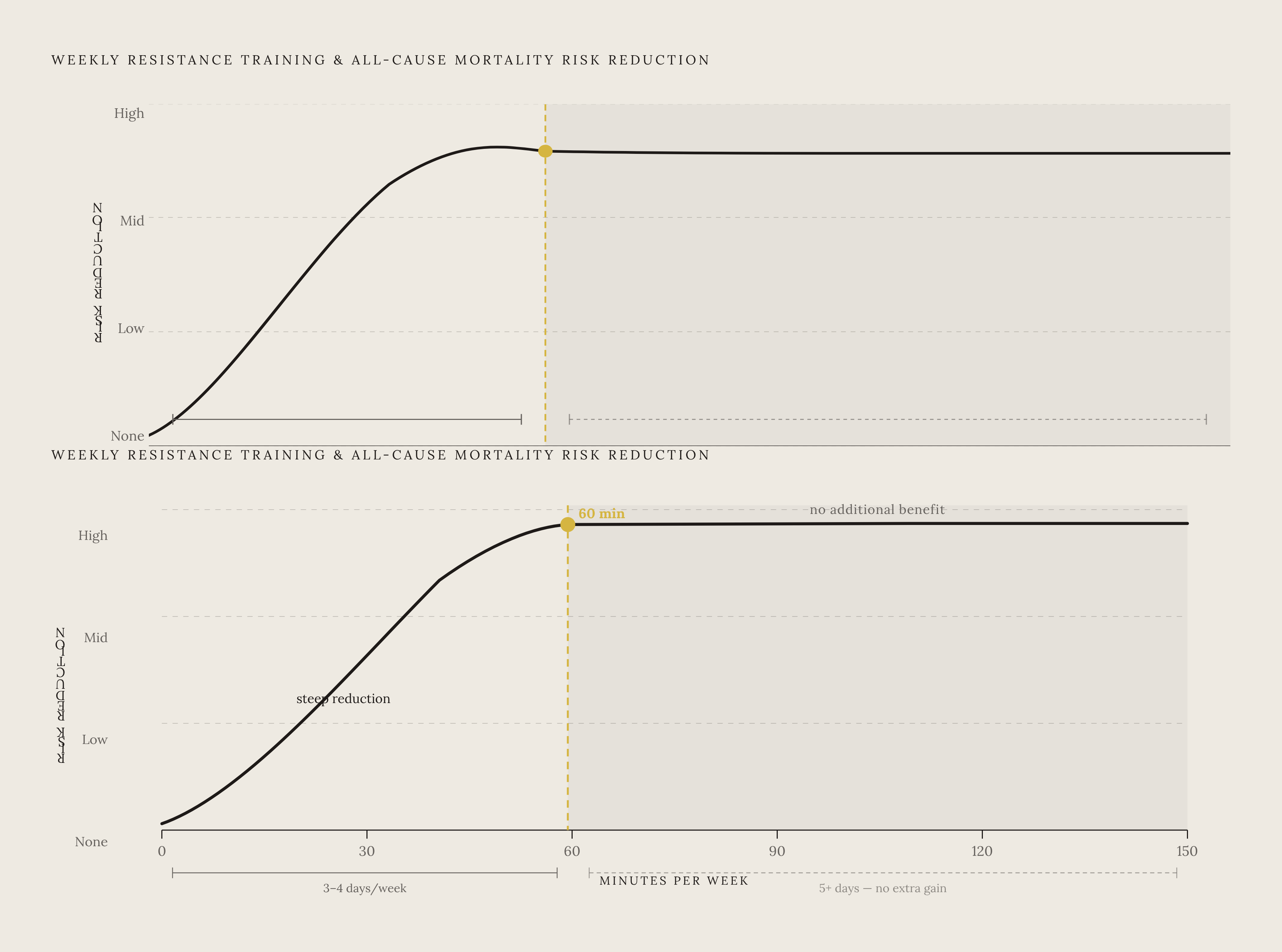
A fair question follows: if resistance training lowers mortality risk, does more training lower it further? The evidence says no, and that's good news for anyone short on time. A dose-response meta-analysis found a nonlinear relationship between training volume and all-cause mortality, with the maximum risk reduction occurring at around 60 minutes of resistance training per week. Past that point, additional volume didn't keep buying additional protection.
Frequency tells a similar story. A nationwide cross-sectional study in Korea found that if you train three to four days a week, you meaningfully cut your risk of low muscle mass. But training five or more days a week didn't produce extra benefit over that three-to-four-day range. The curve bends and flattens well before anyone needs to train daily.
The volume and frequency findings together set a practical target: two to four sessions per week, totaling around an hour, captures most of the benefit the evidence can currently show. Convincing people that an hour a week is enough to matter was always hard, when so much fitness messaging implies that only grueling, daily effort counts. The evidence pushes back on that assumption directly.
Why combining resistance training with aerobic activity multiplies the benefit
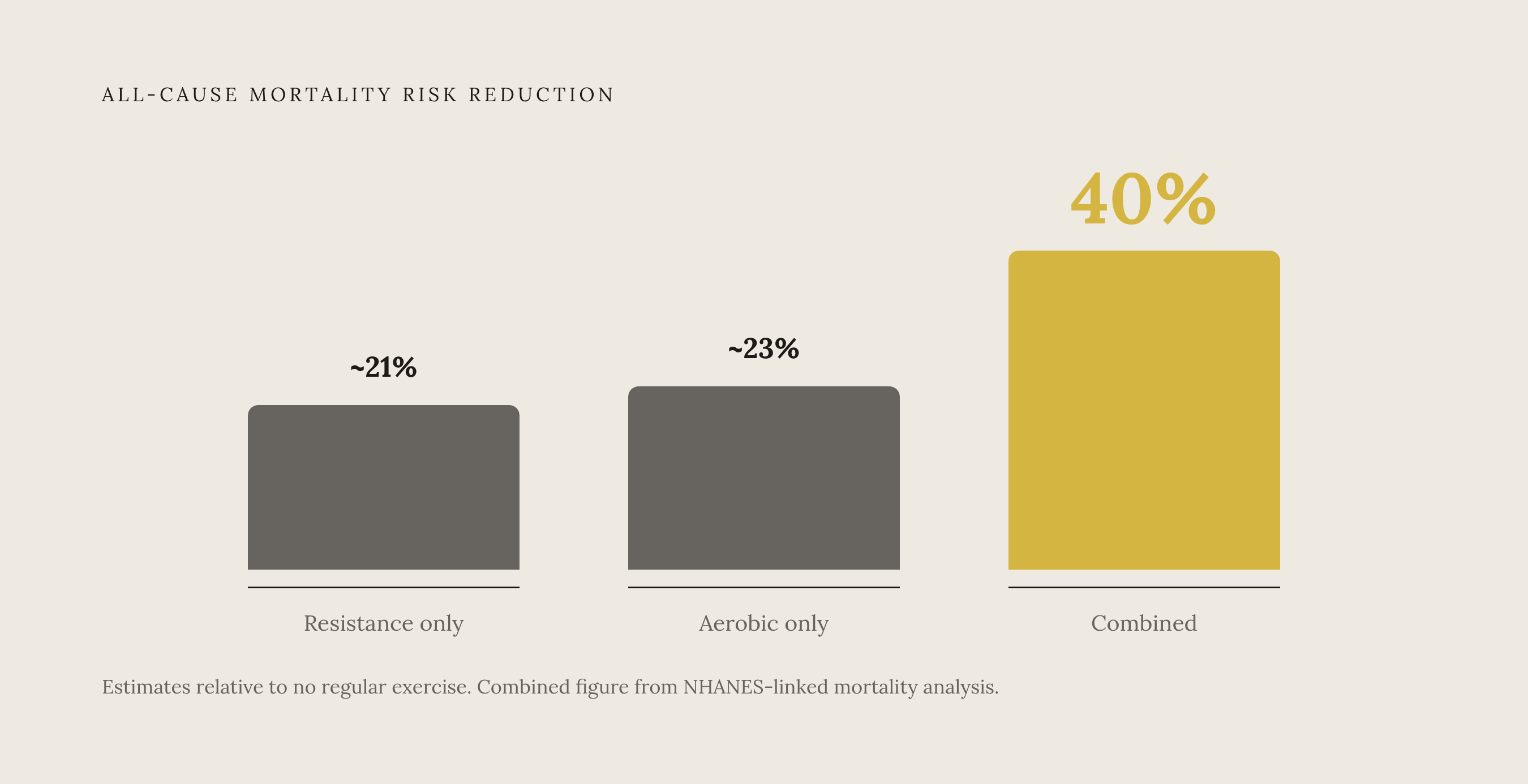
Resistance training alone lowers mortality risk. Paired with aerobic activity, the effect gets considerably larger. The same systematic review that found reductions in all-cause, cardiovascular, and cancer mortality from resistance training also found that combining resistance training with moderate-to-vigorous physical activity was associated with a 40% reduction in all-cause mortality, a far bigger drop than either mode produced on its own.
A 40% reduction in all-cause mortality is an unusually large effect for a lifestyle change, on par with outcomes typically discussed for major pharmaceutical interventions. And it didn't come from extreme volumes of either activity. It came from a reasonable mix of the two.
The practical shape of this, for someone structuring a week, looks like three days of resistance work paired with two or three sessions of moderate aerobic activity. Neither needs to be maximal. The combination effect appears at moderate doses of each, so the goal isn't to pick a side between lifting and cardio but to stop treating them as competitors for the same slot in a calendar. Resistance training stays the core of this piece's argument, but the data make clear it performs best as part of a broader pattern of movement, not as an isolated practice walled off from everything else.
The biological pathways connecting resistance training to longer life
None of this works through a single switch. Resistance training seems to lower mortality risk through several biological pathways that overlap and reinforce each other, and that is why the mortality signal holds up so consistently across different groups of people.
Inflammation suppression looks like one of the strongest and most underappreciated routes. Research shows that people with higher baseline IL-6, hs-CRP, and systolic blood pressure got the greatest benefit from a resistance training intervention, in terms of reductions in those specific inflammatory and blood pressure markers, regardless of how often they trained. In other words, resistance training seems to do the most work precisely where chronic inflammation is already elevated. That matters because chronic low-grade inflammation doesn't just drive sarcopenia. It independently raises cardiovascular and cancer risk on its own. In patients with type 2 diabetes, resistance training produced measurable reductions in CRP, along with trends toward lower TNF-α and IL-6, so this adds another data point to the same inflammatory story.
Metabolic improvement runs a close second. Skeletal muscle is the body's largest site of glucose disposal, so when you preserve muscle mass, you improve insulin sensitivity and lower your risk of metabolic disease. Exercise training that includes resistance work also shifts the ApoB/ApoA-1 ratio in a favorable direction, a cardiovascular risk marker that some research treats as more sensitive than standard cholesterol measures alone.
Two more pathways round out the picture, with somewhat less surprise value but no less importance. Neuromuscular preservation matters because declining strength is a leading contributor to falls, fractures, and functional disability, which are mortality risks in their own right among older adults. Resistance training measurably improves strength, balance, and physical function, so it lowers fall risk at a population level. And muscle functions as a kind of physiological reserve during serious illness: patients with cancer, cardiac disease, or severe infection who carry more muscle mass tend to have more capacity to withstand treatment and recover. Researchers sometimes call this the "muscle buffer" hypothesis. When the body is under acute stress, higher lean mass buys it time.
Biomarkers that reveal where someone stands on the muscle-health spectrum
Sarcopenia and the processes that lead to it develop quietly over decades, so waiting for symptoms, a fall, a slow walk, a hard time standing up from a chair, means waiting until the easy window for intervention has mostly closed. Blood markers offer a way to see the trajectory much earlier.
The most useful biomarkers for muscle health reflect three things: inflammation, anabolic signaling, and muscle turnover. Key markers include IGF-1, myostatin, IL-6, irisin, IL-15, and P3NP. Hormonal status, biological sex, and nutrition all shift these values, which is part of why comparing an individual's numbers to a population average tells only part of the story. If elevated IL-6, TNF-α, and hs-CRP appear alongside low IGF-1 in bloodwork, that combination indicates accelerated muscle breakdown and is worth catching well before it causes weakness. Research on physical frailty and sarcopenia has also reported increased levels of CRP, P-selectin, and interferon-induced protein 10, markers that happen to be available on standard panels most labs already run.
Myostatin deserves a more careful read. It appears better suited as a marker of changes in muscle mass than as a predictor of functional outcomes like strength or mobility, so it signals direction without yet offering a firm clinical threshold to aim for. On the other end of the practicality scale, the creatinine/cystatin C ratio offers an accessible proxy for lean mass: a predicted skeletal muscle mass index built from serum creatinine and cystatin C can come from a standard metabolic panel plus a cystatin C test ordered separately. Most clinicians already order creatinine routinely. Few read it through a muscle-health lens, so a useful signal just sits there, unused, in charts that already exist.
Grip strength remains the simplest functional proxy available, and one of the most predictive. In a large prospective study of adults, every 5-kilogram decrease in grip strength was associated with a 16% greater risk of death at four-year follow-up. A hand dynamometer test takes under two minutes and is available in most clinical settings, which makes it one of the more underused screening tools for longevity risk anywhere in medicine. For a direct look at muscle mass itself, DEXA scanning remains the gold standard, offering the most precise baseline against which to track change over time.
Taken together, these markers answer a practical question: how does someone actually find out where they stand before symptoms force the issue? Grip strength tests, a basic metabolic panel, a cystatin C add-on, and periodic DEXA scanning are existing clinical tools that most routine care just skips applying with a muscle-health lens.
Why the 2025 AWGS update shifts the frame from diagnosis to early interception
Clinical consensus has started to move the same way this evidence points. The Asian Working Group for Sarcopenia's 2025 update built a new framework around early detection and a life-course approach to muscle health, so sarcopenia no longer counts as something that only matters once someone is old. The update expanded the diagnostic criteria to include middle-aged adults, ages 50 to 64, and simplified the diagnostic process at the same time.
The reasoning behind that expansion is straightforward. By the time gait speed and physical performance visibly decline, the easier window for intervention has often already closed. The new emphasis falls on catching low muscle mass and low strength before they turn into mobility problems, making sarcopenia screening a middle-age priority.
For anyone reading this in their 30s or 40s, the behavior change implied here is simple: don't wait for a doctor to bring up muscle health unprompted. Grip strength tests, DEXA scans, bioimpedance measurements, and the blood markers covered above are all available now, mostly without needing a specialist referral. Asking for them proactively, years before any symptom appears, lines up with exactly where the clinical consensus has moved.
The role and limits of protein and creatine
Resistance training does the heavy lifting in this story, literally. Protein and creatine play real, evidence-backed supporting roles, but both have a ceiling, and once you pass it, more doesn't mean better.
Protein is the foundation, and the threshold is fairly specific. Across 46 eligible trials, protein and essential amino acid intake produced consistent hypertrophic benefits when daily intake sat below roughly 1.6 grams per kilogram of body weight per day, or when per-meal leucine fell below 2 to 3 grams. Once intake climbed past roughly 2.0 grams per kilogram per day, the benefits plateaued. Plant and whey protein sources produced comparable hypertrophic effects in this research, so what mattered was hitting the total intake and getting enough leucine per meal, not the source. For most people already training, the more useful fix is spreading protein more evenly across meals, not buying a pricier powder.
Creatine monohydrate holds up as the best-supported supplement in this space, though its effect size is modest. A pooled meta-analysis found a small benefit from combining creatine with resistance training compared to resistance training plus a placebo, real, but far from transformative. A 2026 meta-analysis published in Frontiers in Nutrition raised a more specific caution: positive results based on lean body mass may overstate creatine's actual effect on muscle tissue itself, and the evidence supports creatine more strongly for improving strength gains from training in older adults than for building muscle mass per se. In frail older adults specifically, one randomized controlled trial found no added hypertrophic benefit from whey, leucine, or creatine on top of resistance training alone, a result that puts the exercise itself back at the center as the intervention that actually does the work.
The honest order of priority runs: resistance training first, adequate protein second, creatine as a reasonable extra for people already doing both. Any framing that puts a supplement ahead of training or protein intake isn't supported by this evidence.
Turning the evidence into a starting point, not a prescription
The link between resistance training and mortality risk is about as clear as lifestyle research gets. What makes that evidence usable is knowing where someone currently stands, and that takes measurement, not a guess based on how fit someone feels.
The framework the evidence supports is simple to state. If you do two to four resistance training sessions per week, totaling around 60 minutes, you capture most of the available mortality benefit, a dose most working adults can reach. If you add moderate aerobic activity on top, you capture the largest reduction in risk this research documents. Protein intake at or above 1.6 grams per kilogram of body weight per day, spread across meals with enough leucine at each sitting, is the nutritional cause that supports all of it. Creatine monohydrate is a reasonable addition if you're an older adult or prioritize strength gains, with the evidence treating it as optional.
Population averages hide real variation, so individual measurement earns its place here. If you have elevated hs-CRP and low IGF-1, you sit on a faster path toward sarcopenia than general population numbers would suggest and benefit more, sooner, from starting resistance training now, while strong grip strength and clean inflammatory markers put you at a different starting line for the same dose decision. Neither case is visible without actually checking.
What the broader evidence supports is a view of resistance training as one of the more thoroughly documented longevity interventions available today: a dose that's realistic, mechanisms that are increasingly well mapped, and a set of tools, grip strength tests, DEXA scans, inflammatory and metabolic biomarkers, that turn progress into something measurable. Treating resistance training as optional, or as a purely cosmetic pursuit, doesn't line up with what the mortality data actually show.
Sources
- Resistance Training and Mortality Risk: A Systematic Review and Meta-Analysis - ScienceDirect
- Weight training and risk of all-cause, cardiovascular disease and cancer mortality among older adults
- Effects of Resistance Training on Sarcopenia Risk Among Healthy Older Adults: A Scoping Review of Physiological Mechanisms
- Associations of resistance training levels with low muscle mass: a nationwide cross-sectional study in Korea
- Community Smart Aging Model - Resistance Training
- Long-term resistance training with all-cause and cause-specific mortality: assessing dose-response and joint associations with aerobic physical activity - PMC
- Sarcopenia in the Aging Process: Pathophysiological Mechanisms, Clinical Implications, and Emerging Therapeutic Approaches - PMC