Zone 2 Training and Mitochondrial Biogenesis
The metabolic threshold matters more than heart rate for building mitochondria.
Zone 2 training triggers a real, well-documented cellular process, and it builds new mitochondria while it improves the ones already working inside your muscle cells. But the label "Zone 2" gets used so loosely in fitness circles that most people training in it never actually reach the metabolic state that makes the biology happen.
How Zone 2 training is defined
Most people learn Zone 2 as a heart-rate number: roughly 60 to 70 percent of max heart rate, pulled from a five-zone model that splits effort into even bands. Age-based formulas that generate your "max heart rate" can misjudge your true intensity by a wide margin, depending on your fitness level, genetics, and how well that generic formula happens to fit your body.
The definition that actually matters is a metabolic one. Zone 2 is exercise performed at or just below your first lactate threshold, called LT₁, the point where blood lactate is around 2 mmol/L (the exact number shifts from person to person). Below that threshold, fat oxidation runs the show, and mitochondria work hard but stay sustainable, without spilling over into the glycolytic overflow that floods your blood with lactate.
That threshold also determines which muscle fibers do the work. When you push past LT₁, your body starts recruiting different fibers for a different kind of effort. Get the intensity wrong, and you're not training the fibers this whole mechanism depends on. A heart-rate band can put you well above LT₁ without any warning sign beyond breathing a bit harder than expected, so the number on a chest strap might be lying to you about what's actually happening in your muscle.
What PGC-1α is and its role at the center of the mitochondrial biogenesis process
Every adaptation this article describes runs through one molecule: PGC-1α, short for Peroxisome Proliferator-Activated Receptor Gamma Coactivator-1 Alpha. Think of it as the construction foreman for your cells' power plants. When PGC-1α activity rises, it switches on the genetic program that builds new mitochondria and expands the ones already there.
Mitochondria aren't fixed furniture inside a cell. Their number and their working capacity shift in response to the demands placed on them, and PGC-1α sits upstream of that whole remodeling process, deciding when and how much building happens.
The stakes here reach well past endurance performance. Mitochondrial dysfunction is one of the recognized hallmarks of aging, tied mechanistically to type 2 diabetes, cardiovascular disease, cancer, and Alzheimer's disease. VO2max, the maximum amount of oxygen your body can pull in and use per minute per kilogram of bodyweight, works as the whole-body readout of how healthy that mitochondrial system is. It has become one of the strongest modifiable predictors of long-term health outcomes and lifespan that exercise science has found.
The cellular chain of events that links Zone 2 exercise to mitochondrial growth
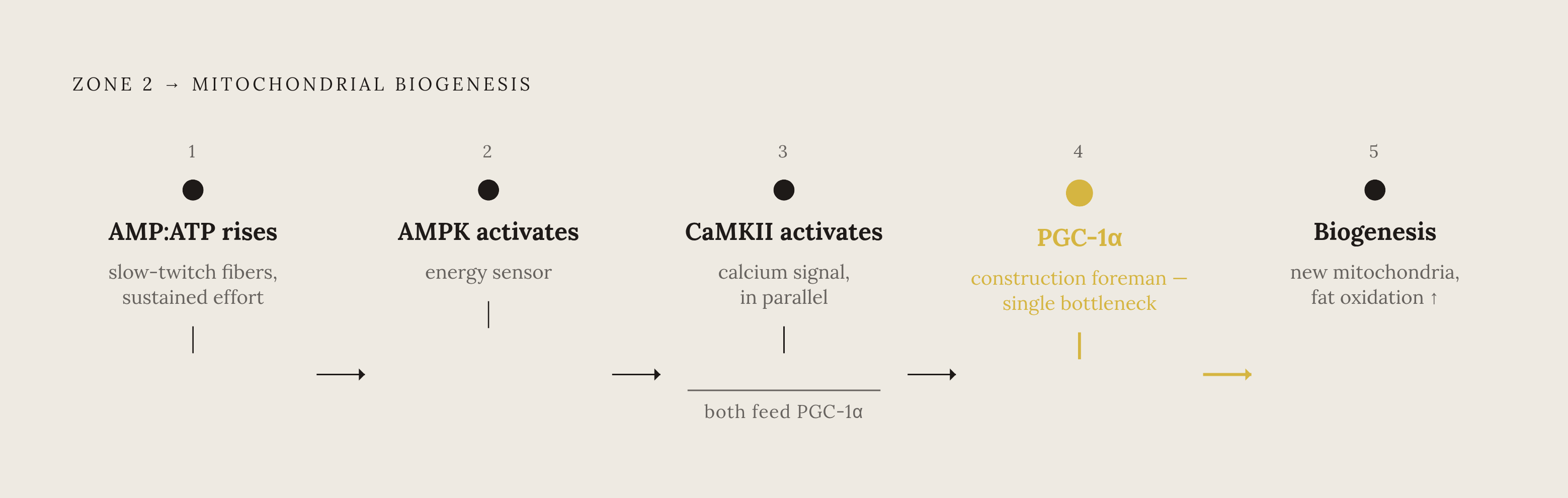
If you walk through what happens step by step, the mechanism stops feeling abstract. Sustained aerobic work asks slow-twitch fibers to keep turning over ATP for long stretches, so that demand can push the ratio of AMP to ATP inside the cell up. That effect depends on intensity and duration, and at very low effort it may barely register at all.
Still, when that shift happens, it acts as an alarm bell. It activates AMPK, short for AMP-activated protein kinase, the cell's built-in energy sensor. Researchers have proposed that this second pathway is fairly specific to lower-intensity, longer-duration efforts, and it differs from what happens during short, hard intervals.
Both signals point toward the same target. AMPK and CaMKII converge on PGC-1α, raising its activity and kicking off the transcriptional program that builds mitochondrial mass: new mitochondria form, the existing ones become more efficient at using oxygen, and the muscle's capacity to burn fat expands.
One more piece keeps the whole system running in the right gear. At Zone 2 intensity, the enzyme pyruvate dehydrogenase, or PDH, works at its best, pushing glucose down the aerobic pathway toward oxidation. That keeps the cell oxidative rather than glycolytic, which sustains the exact signal the rest of the chain depends on.
None of this happens overnight. Full mitochondrial remodeling takes many months of steady work. Anyone designing a protocol around this mechanism needs that timeline in mind, because the biology doesn't compress to fit a two-week program.
What a 2025 peer-reviewed review argues
A 2025 narrative review published in Sports Medicine, written by researchers at Queen's University and McMaster University, asked a direct question: is Zone 2 actually the optimal intensity for building mitochondria and improving fat oxidation? The paper's answer is that current evidence doesn't support that claim.
A companion Master's thesis out of Queen's University, by Moran-MacDonald in 2025, tested this question directly. After six weeks, performance gains on a virtual time trial came out statistically equal between the two groups. So adding Zone 2 volume on top of matched HIIT didn't produce a measurable performance edge.
The review treats the CaMKII pathway, often held up as Zone 2's unique mechanistic selling point, with particular skepticism. It describes the supporting evidence as scarce and contradictory: some studies show no activation at all, while others find effects only on downstream targets.
What the review doesn't examine matters just as much as what it does. It doesn't address cardiac adaptations, injury risk across intensities, how sustainable each approach feels psychologically, or, most importantly, whether intensity distribution changes how much total training volume someone can accumulate across a full season. Those gaps are the practical variables that decide what most people can actually keep doing week after week.
Why training volume is the variable that reconciles the controversy
Taking the review and the Queen's thesis at face value, matched work at higher intensity can produce mitochondrial signals equal to or stronger than Zone 2. The question those studies don't answer is whether most people can sustain high-intensity training at the volume needed to keep accumulating that signal over weeks and months without breaking down.
If you look at how elite endurance athletes actually train, the pattern becomes clear. The large majority of their weekly training happens at low intensity, because low intensity is the only way to accumulate enough volume to support the high-intensity work and stay healthy between hard efforts.
Zone 2 is the intensity most people can repeat several times a week without digging a fatigue hole that wrecks the next session, their sleep, or their recovery. That makes it the main vehicle for building the aerobic base that any higher-intensity work depends on to be productive.
If you train a moderate number of hours each week, Zone 2 alone likely leaves real adaptation on the table. The stronger approach combines Zone 2 for base-building, fat oxidation, and recovery capacity with higher-intensity work, HIIT or threshold sessions, for the VO2max stimulus and the stronger, more time-efficient mitochondrial signal.
Why individual calibration determines whether a Zone 2 protocol works
Not everyone's LT₁ lands at the same heart rate. Percentage of max heart rate and generic age-based formulas produce inconsistent metabolic readings across individuals, and that variability appears both between people at different fitness levels and among people who look similarly fit on paper.
Generic heart-rate-based Zone 2 targets can leave a meaningful share of exercisers training above LT₁ without realizing it. That puts them in a metabolic gray zone, where lactate builds up, glycolysis takes over, and the specific mitochondrial signaling true Zone 2 work produces gets blunted.
The gold-standard calibration method is blood lactate measurement at the first threshold, targeting a reading below roughly 2 mmol/L as the ceiling for the session. Skipping that calibration means the mechanism described earlier in this piece may be largely missing from what someone calls their "Zone 2" session. They're training at a label, not at the metabolic state the biology requires.
If you don't have lab access, a field test works as a reasonable substitute. If you pair perceived effort against an actual lactate reading at least once, future sessions have something real to anchor to.
The biomarkers that show mitochondrial and metabolic adaptation before and after Zone 2 training
Zone 2 training leaves a measurable fingerprint on a specific set of blood markers, and testing that panel before and after a training block gives a clearer signal of what changed than how a workout felt in the moment.
Fasting insulin and HOMA-IR can show metabolic trouble, or metabolic improvement, earlier than almost anything else on a standard panel. Useful targets to aim for: fasting glucose under 99 mg/dL, fasting insulin under 5 µIU/mL, HOMA-IR under 1, HbA1c under 5.7 percent, and a triglyceride-to-HDL ratio under 2.
Zone 2 exercise lowers insulin resistance, a known risk factor for type 2 diabetes and metabolic syndrome, through a mechanism that's fairly direct: trained muscle pulls glucose out of the bloodstream more efficiently, so the body needs less insulin to keep blood sugar steady.
Inflammatory markers move too. Aerobic exercise may reduce circulating CRP and TNF-α, with a smaller and less consistent effect on IL-6, particularly among middle-aged and older adults. High-sensitivity CRP and GlycA reflect systemic inflammation that can quietly drive chronic disease over years, and both markers, especially alongside ApoB and Lipoprotein(a), give you more useful cardiovascular information than a standard lipid panel alone.
VO2max is still the main long-term marker this entire training approach is built to move. Aerobic exercise raises mitochondrial volume density mostly by enlarging the mitochondria already present in a muscle fiber rather than by multiplying their count, and that enlargement is what drives VO2max upward as the whole system's macro-level readout.
A standard fasting glucose and HbA1c panel can't catch the early window at all. Asking for fasting insulin specifically changes how early the problem can be caught.
How Zone 2 training interacts with hormones, metabolism, and body composition
The mitochondrial story isn't the only reason to care about Zone 2. A separate set of hormonal effects runs alongside it, and these matter if your starting concern is low energy, body composition, or thyroid function.
On the insulin and blood sugar side, sustained Zone 2 work trains muscle to clear glucose from the bloodstream more efficiently. Lower chronic insulin matters for body composition as much as it does for metabolic health.
Cortisol and testosterone tell a more cautionary story. The real risk to Zone 2's hormonal case isn't the training itself, it's overdoing the high-intensity side of a program. Zone 2 supports the recovery system that keeps that balance intact: it improves sleep, reduces visceral fat, and improves oxygen efficiency, building the conditions for healthy anabolic hormone signaling rather than the burnout pattern that comes from training hard all the time.
What the NAD+ pathway research suggests about supplementing alongside Zone 2 training
Among supplement questions tied to Zone 2 training, the one with the strongest biological footing is NAD+. The evidence is promising, though it hasn't closed the loop in humans yet.
NAD+ is a coenzyme central to how mitochondria produce energy, and the body's supply of it declines with age. That decline is one proposed contributor to the mitochondrial dysfunction that Zone 2 training works to counteract through an entirely different route.
Nicotinamide riboside and nicotinamide mononucleotide, known as NR and NMN, are NAD+ precursors with a growing body of research behind them. What's missing is a large-scale controlled trial that tests Zone 2 training and an NAD precursor together.
One trial is working to close that gap directly. NCT07344636, run by the Chinese University of Hong Kong, is recruiting to test nicotinamide riboside supplementation alongside Zone 2 training for its effect on metabolic flexibility in adults, the first controlled study designed around this exact pairing.
Until those results come in, the honest position holds steady: the biological reasoning is sound, the precursor research is encouraging, and recommending NMN or NR as a Zone 2 amplifier ahead of confirmed human results would be getting ahead of the evidence.
How to use the Zone 2 mechanism to build a protocol that reflects the biology
These mechanisms, slow-twitch fiber recruitment, AMPK and CaMKII activation, PGC-1α upregulation, depend on training volume, and that dependence is what determines a specific set of protocol decisions.
Calibration comes first. Before you commit to any heart-rate number, get a blood lactate test, or at minimum do a careful talk-test calibration. Target a lactate reading below roughly 2 mmol/L, and if a heart-rate number is all that's available, treat it as a provisional ceiling to check against how the effort actually feels and, where possible, against an actual lactate reading.
Longer sessions give more consistent PGC-1α responses than short ones at the same intensity, so session duration shapes how reliably that signal appears. A brief Zone 2 session may simply not run long enough to build up the metabolic stress the mechanism depends on.
Frequency across the week matters as much as any single session's length. Multiple sessions per week, each sustained for a meaningful duration, let volume build without fatigue piling up faster than recovery can handle it. That structure is what produces the timeline described earlier: fat-oxidation gains within the first several weeks, VO2max improvements over the following months, full mitochondrial remodeling over many months of steady training.
Pair Zone 2 with higher-intensity work. HIIT and threshold sessions drive VO2max and give you the stronger per-session AMPK signal the 2025 review points to, but Zone 2 gives you the aerobic base, the fat-oxidation training, and the recovery capacity that lets you sustain high-intensity work productively and safely.
Track what the mechanism is actually doing. Baseline and follow-up testing of fasting insulin, HOMA-IR, VO2max through a field test or structured assessment, and inflammatory markers gives an objective read on adaptation that effort alone can't supply.