Environmental Toxicant Exposure and Accelerated Aging
Heavy metals and air pollution accelerate biological aging and raise cardiovascular disease risk.

Environmental toxicant exposure can leave a measurable fingerprint on biological aging and raise the prospect of future disease. Evidence that heavy metals, PFAS, and air pollution are linked to faster aging makes exposure a concern for day-to-day health. The useful response to a promise of “detox” is to understand what the measurements show, distinguish exposure from damage, and reduce ongoing contact.
Why biological age matters more than chronological age for environmental health
Chronological age counts elapsed time, while biological age estimates how worn the body is at the molecular level. Those measures can diverge substantially in the same person. That gap gives environmental health research a more precise target than years lived alone. It asks whether exposure is associated with a body aging faster than expected.
Epigenetic clocks estimate biological age by reading DNA methylation patterns, which are chemical marks at specific CpG sites in DNA. A positive deviation from expected age is called epigenetic age acceleration. Researchers use these clocks to study exposures, predict the risk of disease, and track how the body declines as it ages. Faster epigenetic aging has been linked to a higher risk of death and age-related disease that starts earlier, though the link does not show whether changes in the clocks themselves cause those outcomes.
How environmental toxicants get inside the aging machinery
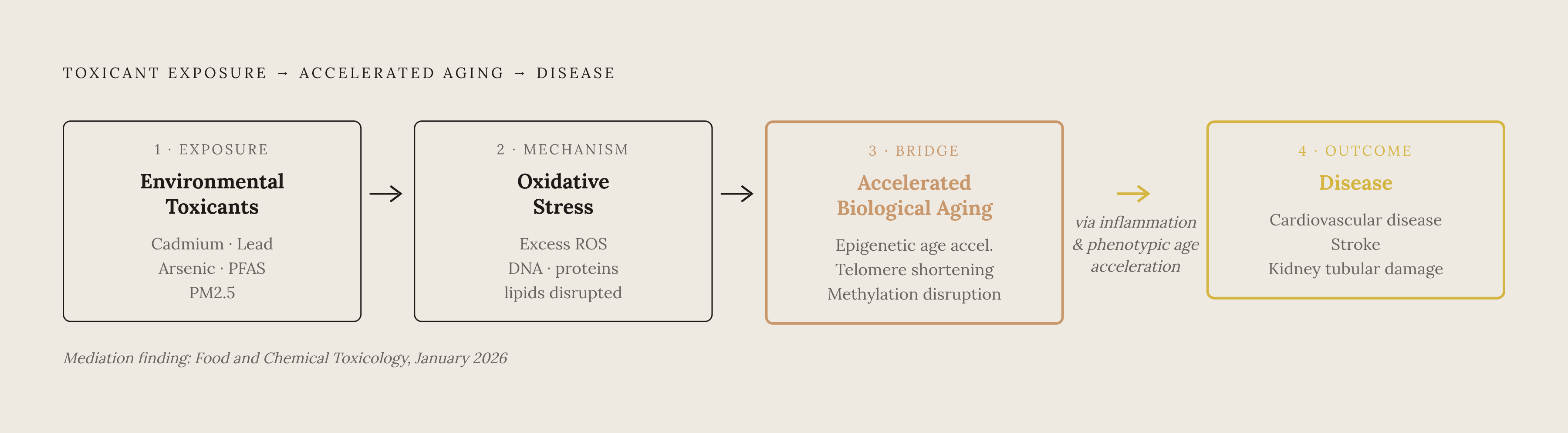
Several major chemical classes converge on a common pathway, namely an excess of reactive oxygen species, or ROS. These reactive molecules create oxidative stress that damages DNA, proteins, and lipids. Different toxicants generate that stress through different routes, including mitochondrial electron transport disruption, oxidase enzyme activation, and redox cycling and Fenton chemistry involving heavy metals. The starting chemistry varies, but the consequence is a shared burden on the processes that maintain cells.
That burden can accelerate telomere shortening and disrupt autophagy, the cell’s recycling process. Both changes involve known hallmarks of aging and go beyond a short-lived change in a measurement of exposure. Oxidative signals also propagate into the DNA methylation changes that epigenetic clocks detect. This gives researchers a plausible connection between an external exposure and an altered aging rate.
Heavy metals are sometimes described as “gerontogens,” meaning chemicals that directly accelerate biological aging in cells and tissues. Cadmium and arsenic illustrate how this can happen through methylation disruption. They can inhibit DNA methyltransferases or deplete methyl donors, producing global hypomethylation and site-specific hypermethylation of tumor suppressor genes.
An exposome-wide study published in Food and Chemical Toxicology in January 2026 found that inflammation and phenotypic age acceleration partly mediated the association between toxicant exposure and cardiovascular disease across chemical families. Mediation means these processes help account for the observed relationship. It supports a connected biological pathway, while leaving questions about causation open.
Which toxicants the evidence most consistently implicates
A 2025 Stanford/NHANES exposome-wide study of adults aged 50–84 linked blood cadmium to faster aging across multiple epigenetic clocks. Cadmium and cotinine, a tobacco exposure biomarker, were among its strongest findings. However, the cadmium association among never-smokers was not significant in that study.
The same Stanford/NHANES study linked lead in the blood to significantly higher epigenetic ages measured by several clocks. Arsenic exposure has also been linked to higher GrimAge and accelerated DunedinPACE DNA methylation scores. In the research on arsenic, accelerated aging partly mediated the link with a higher risk of cardiovascular disease. This makes aging a potential bridge between exposure and disease, rather than merely a measurement that changes at the same time.
PFAS evidence has been less uniform. Earlier studies of exposure at work found no significant effect on aging, but a study that reflected the U.S. population as a whole, published in February 2026, found strong links between two compounds, PFNA and PFOSA, and faster biological aging. The association was particularly apparent in men aged 50 to 64. That finding changes the picture without establishing that every PFAS compound has the same effect.
A Taiwan Biobank study published in Journal of Hazardous Materials in 2026 linked long-term exposure to PM2.5 and PM10 with faster epigenetic aging measured by several clocks. Polycyclic aromatic hydrocarbons, or PAHs, benzene, and pesticides have also been associated with increased DNA methylation age. Copper and tungsten ranked among the strongest associations in the 2026 Food and Chemical Toxicology study, with those findings representing emerging signals from one study.
Why this matters to the average person, not just industrial workers
The Stanford/NHANES study drew from the general U.S. population. It still found aging signals linked to cadmium, lead, and cotinine. The February 2026 PFAS study detected PFNA and PFOSA in the vast majority of participants, indicating widespread background exposure.
Exposure can come from everyday sources, though the burden can differ from one household to another. Lead can come from old paint, contaminated tap water, and some imported goods and ceramics. Arsenic exposure can come from contaminated groundwater and well water, as well as rice and rice-based foods. Cadmium sources include cigarette smoke, industrial pollution, and some foods, including leafy vegetables, shellfish, and organ meats, with cadmium-rich soil relevant to crops. PFAS can come from non-stick cookware, water-resistant clothing and packaging, and some drinking water supplies.
Air quality and secondhand smoke can expose people to toxicants beyond those in what they choose to consume. Cotinine reflects secondhand smoke as well as active smoking, so its relevance is not limited to smokers. Lifestyle still matters, but it does not make environmental exposure an alternative explanation that can be dismissed. A longitudinal multi-cohort study published in eBioMedicine in December 2025 found that smoking, higher BMI, and elevated glucose accelerated aging measured by DunedinPACE.
The downstream health consequences the biomarkers are tracking toward
The medical importance of an aging signal rests on what it tracks toward. Cardiovascular disease is the most consistently identified downstream outcome in this evidence. Large population-based studies associate cadmium, lead, arsenic, and mercury with elevated CRP and hs-CRP, markers of systemic inflammation and cardiovascular risk. CRP has also been identified as a partial mediator of the association between metals and cardiovascular outcomes. Together with the arsenic mediation findings, this supports the biological plausibility of an exposure-to-heart-disease pathway.
Blood lead has been associated with higher NT-proBNP, a marker of cardiac stress, and cadmium has shown a similar association. Even so, an association between exposure and a marker does not mean that the marker identifies the cause of an individual’s cardiac stress.
Stroke is an emerging outcome for epigenetic aging more broadly. Accelerated biological aging measured by DNA epigenetic clocks has been associated more strongly with first-ever stroke than with recurrent events. That suggests the clocks may capture vascular vulnerability not yet apparent in traditional risk factors, but it does not make every such association toxicant-specific. Cadmium also raises a distinct kidney concern. Its tubular damage can be detectable before serum creatinine becomes abnormal, making the choice of marker important.
What to test to see whether environmental toxicant burden is affecting your biological age
Testing needs to ask whether there is exposure, whether toxicants have built up, and whether the body shows signs of stress. Standard laboratory tests can address parts of that question, but they are not interchangeable with epigenetic clocks. An exposure test measures a toxicant, while an organ marker measures a response that may have more than one explanation. An estimate of biological age gives another view, but on its own it cannot show which exposure is responsible.
For cadmium, the distinction between blood and urine is clinically meaningful. Blood cadmium reflects recent exposure, while urine cadmium reflects chronic accumulation. Urine cadmium normalized to creatinine is therefore the more useful marker for most proactive patients concerned about long-term exposure. Blood lead is the standard screen for lead exposure. Urine arsenic is used to assess arsenic burden.
Kidney testing can address damage that an exposure measurement alone cannot describe. Urinary β2-microglobulin is a sensitive early indicator of cadmium-induced tubular injury and has been found elevated with long-term cadmium exposure. It can signal irreversible kidney damage before serum creatinine rises. For cardiovascular pathways, CRP and hs-CRP are accessible inflammatory markers in a standard blood draw. NT-proBNP is less routine but offers a window into subclinical cardiac stress associated with heavy metal exposure.
A large NHANES-III analysis found graded positive associations between GGT and both blood lead and urinary cadmium. Elevated GGT can therefore be relevant to both oxidative stress and liver disease. The same analysis found inverse associations between those metals and serum vitamin C and carotenoids, consistent with depletion of antioxidant reserves. These signals lend support but cannot, on their own, prove that toxicants drove aging.
Homocysteine offers a functional marker of methylation capacity, the process supported by B12, folate, and B6 that heavy metals can disrupt. Epigenetic clocks give a more direct estimate of aging, though there are limits to their use in clinical care. They are powerful research tools moving toward clinical use, but they have yet to become fully standardized clinical diagnostics. Questions remain about reliability in commercial wellness settings. A clock result and standard biomarkers can inform different parts of the picture, but neither alone establishes that a particular exposure caused accelerated aging.
What the evidence actually supports for reducing toxicant-driven biological aging
Cutting down on ongoing exposure has the strongest evidence as a place to start. It is safer, more effective, and better supported than trying to counter continued exposure with a downstream detox protocol. Avoiding cigarette smoke is the highest-impact modifiable exposure in these notes, given the strong tobacco-linked cadmium and cotinine signals. Filtering household drinking water is relevant to lead and arsenic from pipes and groundwater. Choosing PFAS-free cookware and food packaging where available addresses another avoidable source.
A plant-forward, fiber-rich diet helps the body excrete metals and can lower the cadmium it gets from food, while choosing lower-cadmium food sources where practical helps account for differences in cadmium within the diet. Physical activity and a healthier diet were also linked to slower epigenetic aging in the December 2025 eBioMedicine longitudinal study. Those benefits add to toxicant reduction. They are not substitutes for it.
Support for the body’s own protective processes has a narrower role. Glutathione is an endogenous antioxidant and chelator that binds heavy metals, particularly mercury, and helps their excretion through bile. Glutathione and NAC belong in the discussion of endogenous support, but that mechanism should not be mistaken for proof that supplementation reverses toxicant-driven biological aging. B12, folate, and B6 support the methyl group transfer reactions that metals disrupt. Individuals with MTHFR variants may have impaired methylation capacity, and homocysteine testing provides a functional read on whether methylation support is working.
Sauna also needs proportionate framing. Sweat contains measurable lead, cadmium, and arsenic, but sweat excretion represents only a small fraction of renal excretion. Sauna’s evidence is stronger for cardiovascular protection than for direct metal elimination, supporting its role as an adjunct in a metal-detox strategy. Juice cleanses, colon hydrotherapy, zeolite supplements, and detox patches are not evidence-based methods of toxicant elimination. The practical promise of this research is better identification and reduction of exposure.
Sources
- Environmental Health Is Overlooked in Longevity Research - PMC
- Biological Aging Acceleration Due to Environmental Exposures: An Exciting New Direction in Toxicogenomics Research - PMC
- Epigenetic clocks: advancing biological age measures towards meaningful clinical use
- Air pollution and accelerated epigenetic aging: Evidence from multiple epigenetic clocks in the Taiwan Biobank - PubMed
- Air pollution and accelerated epigenetic aging: Evidence from multiple epigenetic clocks in the Taiwan Biobank - ScienceDirect
- Oxidative Stress, Environmental Pollutants, Aging, and Epigenetic Regulation: Mechanistic Insights and Biomarker Advances