Ferritin as an Early Marker of Iron Overload and Inflammation
Elevated ferritin signals iron overload or inflammation, requiring different treatments.

Serum ferritin can warn of iron overload or systemic inflammation, but each calls for a different kind of care. Its value lies in finding out which process is driving the result. Read with transferrin saturation and markers of inflammation, ferritin can help catch problems early and show why it rose before steps are taken to lower it.
Why a single ferritin number can send clinicians in the wrong direction
A patient has routine bloodwork, and ferritin comes back elevated. Should the next step be to reduce iron, investigate inflammation, or look more closely at metabolic health? The result alone cannot answer that question. Ferritin is the body’s main iron storage protein, but its blood level can rise both when iron stores grow and when the immune system changes where iron is kept.
Inflammation prompts the liver to make more hepcidin, which traps iron inside cells and can raise ferritin without genuine iron overload. Infection, obesity, malignancy, and liver cell injury can all make the reading rise. The distinction changes the treatment. True overload calls for lowering iron, while a rise caused by inflammation calls for treating the condition behind it, and treating that rise as excess iron can cause harm.
What ferritin actually measures, and what it does not
Most iron in adults is bound in hemoglobin or myoglobin, or stored as ferritin and hemosiderin in the liver, spleen, and bone marrow. Serum ferritin is the small circulating fraction measured in blood. Without inflammation, it reflects total iron stores. During inflammation, though, the body makes more ferritin regardless of its iron content, so the test reflects both inflammation and the amount of iron in storage.
Signals from fat tissue, including IL-6 and leptin, increase hepcidin production, while high insulin levels promote iron uptake by liver cells. Estrogen suppresses hepcidin, helping explain lower ferritin in pre-menopausal women, while testosterone favors iron incorporation into red blood cells over storage. These effects complicate comparisons between two people. A lean person with hereditary hemochromatosis and a person with obesity and low-grade inflammation can have the same ferritin result for different reasons.
How common inflammatory hyperferritinemia is compared with true iron overload
Most elevated ferritin results in routine practice have a metabolic or inflammatory origin. A 2025 analysis put the share attributable to iron overload at fewer than 10%. The workup needs to find out why ferritin is high before excess iron is assumed to be the cause.
Metabolic dysfunction-associated steatotic liver disease, or MASLD, is a major setting for this finding. Its ferritin elevation can reflect both inflammation and iron redistribution. Obesity, metabolic syndrome, infections, malignancy, and liver cell injury broaden the range of possible explanations. This is reassuring only in a limited sense. An elevated result is more likely to point toward metabolic or inflammatory burden than hemochromatosis, but that burden can still be clinically important and deserves its own investigation.
What the numbers mean: diagnostic thresholds and the graded MASLD framework
Ferritin above 300 µg/L in males and above 200 µg/L in females suggests possible excess iron accumulation. Neither threshold establishes the cause. A result above the reference range needs interpretation in the context of transferrin saturation, inflammation, and the person’s metabolic health. A much higher reading, such as ferritin above 1,000 ng/mL with elevated transferrin saturation, raises a different level of concern and warrants investigation for iron overload, including hereditary hemochromatosis.
A 2025 expert panel framework brings a graded approach to metabolic hyperferritinemia, separating it conceptually from hemochromatosis. Interpreting elevated ferritin requires assessing how the elevation fits the metabolic picture and whether it is progressing. Its Grade 2 and Grade 3 categories give patients words to use with a clinician as results grow more severe and help them see how abnormal results differ.
Another proposal asks whether standard ranges are too broad for adults as they age. Researchers linked to the FeAST trial suggested that a range of 20–100 ng/mL should be studied. That remains a prospective argument whose applicability as a treatment target for everyone has yet to be established.
Why transferrin saturation is the essential companion test to ferritin
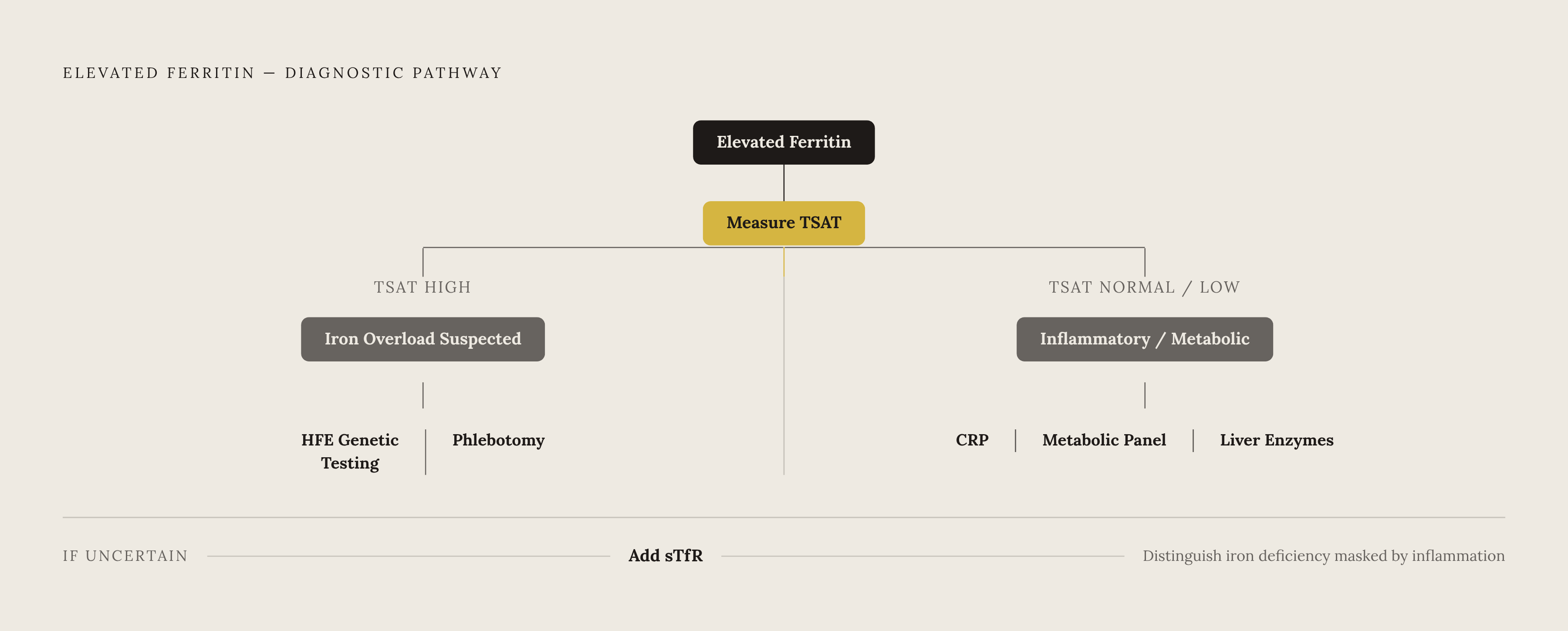
Transferrin saturation, or TSAT, helps distinguish a storage signal from iron overload. In hereditary hemochromatosis, it often rises before ferritin does, serving as both an early warning and a confirmatory test. Ferritin flags a problem. TSAT points toward its cause. For someone discussing an elevated result with a clinician, the practical question is whether the two have been measured together.
The contrast is clearest in inflammatory hyperferritinemia. Hepcidin keeps iron inside cells, so ferritin can rise while TSAT remains within the normal range, rather than showing the increase expected with iron overload. This pattern points toward metabolic and inflammatory causes. It does not resolve every case. When the picture remains unclear, soluble transferrin receptor, or sTfR, adds another perspective because it rises in iron deficiency but is not elevated by inflammation alone.
What genuine iron overload does to the body over time
When excess iron is genuinely present, the danger comes from its chemistry. Excess Fe2+ drives Fenton chemistry, which produces reactive oxygen species that damage cell fats and interfere with how mitochondria work. In iron-laden liver cells, these processes can lead to ferroptosis, a form of cell death. Over time, iron overload can accelerate fatty liver disease toward inflammation and fibrosis, while chronic accumulation can also cause heart dysfunction, liver cirrhosis, and increased risk of hepatocellular carcinoma.
The route into overload is not always genetic. Each unit of transfused red blood cells delivers approximately 200–250 mg of elemental iron, so frequent transfusions can produce a cumulative burden that damages the heart and liver. Çalışkan Kamış and colleagues’ 2026 pediatric oncology study found that ferritin monitoring combined with T2* MRI enabled early detection and timely management. This widens the population in view. Iron overload can arise when transfusions bypass normal dietary iron regulation or when inherited changes disrupt iron control.
Hereditary hemochromatosis as the canonical case for ferritin-guided early detection
Hereditary hemochromatosis shows what early detection can achieve. The condition can go years without symptoms, yet treatment before organs are damaged can prevent complications such as cirrhosis and cardiomyopathy. When diagnosed and treated early, life expectancy does not differ from that of the general population. The diagnostic pathway combines ferritin, TSAT, and genetic testing for an HFE mutation.
Treatment is usually phlebotomy, which takes iron out of the body by removing blood. Each 500 mL phlebotomy removes approximately 250 mg of iron, and repeat ferritin measurements guide the response. The approach is simple, but not always easy. A 2025 Delphi consensus study found that a large majority of respondents considered the frequency and duration of phlebotomy significant limitations, particularly when adverse effects or other conditions limit tolerance.
The same consensus identified hepcidin-ferroportin-targeted therapies, used with or instead of phlebotomy, as promising options for people with a high treatment burden. These remain an emerging direction to discuss with specialists. Early testing creates room for that care before symptoms or organ injury force the issue.
What elevated ferritin means for metabolic health and cardiovascular risk beyond iron overload
If iron overload is excluded, does the ferritin result lose its significance? It can still matter, because inflammatory hyperferritinemia can be a sign of metabolic strain. Ferritin correlates positively with BMI, fasting glucose, triglycerides, blood pressure, and neutrophils. The link also works both ways, as insulin resistance can raise ferritin through inflammation while excess iron impairs insulin signaling and helps fat build up in the liver.
Cardiovascular findings add to the picture but do not prove that ferritin causes disease. In an analysis of a specific type of heart attack, elevated ferritin at presentation independently predicted adverse cardiovascular outcomes. Research on heart failure also found that people in the highest ferritin index tertile had a higher risk of a major adverse cardiovascular event. Yet the index had only modest standalone discrimination, with an AUC of 0.560. That limitation supports interpreting ferritin within a panel.
The FeAST trial, a Veterans Affairs phlebotomy trial in people with peripheral artery disease, tested calibrated iron reduction targeting ferritin of approximately 25 ng/mL. It reported reductions in cancer risk, cancer-specific mortality, and all-cause mortality. The findings matter, but more work is needed to test whether they could help people live longer more broadly. It does not establish that people with inflammatory hyperferritinemia should undergo phlebotomy or aim for the trial’s target.
How to build a clinically interpretable ferritin panel and what each component adds
For a practical initial workup, the three-test panel consists of ferritin, serum iron, and total iron-binding capacity, or TIBC. Their billing codes are CPT 82728, CPT 83540, and CPT 83550, respectively. Serum iron and TIBC generate TSAT, giving the ferritin result its essential companion.
High ferritin with high TSAT calls for investigation of iron overload. With marked elevations, hereditary hemochromatosis becomes an important possibility and HFE genetic testing is warranted. High ferritin with normal or low TSAT instead makes iron overload less likely and directs the workup toward CRP, a metabolic panel, and liver enzymes. CRP adds evidence about inflammation. When it is elevated with high ferritin and normal TSAT, an inflammatory or metabolic explanation becomes more probable.
If uncertainty remains, sTfR can help identify iron deficiency that inflammation has obscured. Derived indices need care as well. Gonzales and colleagues’ 2025 study found that TSAT×SF correlated with iron status independently of inflammation, while SF/TSAT correlated with both, showing that different calculations do not measure the same signal.
T2* MRI belongs later in the pathway. It quantifies tissue iron in the heart and liver, particularly when transfusional overload is known or suspected.
What this panel costs, and how to access it without overpaying
The laboratory cost of ferritin testing and the amount billed to a patient can differ sharply. Medicare reimbursement for ferritin is a fraction of the approximately $76.78 average provider charge, for which out-of-pocket costs can vary. It also covers ferritin alone, rather than the complete three-test panel needed to generate TSAT.
Direct-to-consumer testing is another way to get the panel. As of October 2026, standalone ferritin tests were available at low prices, with bundled iron panels available at a modest premium. The useful comparison is therefore between clinically interpretable combinations. For a physician-ordered workup, the practical step is to ask whether the order can go to an independent lab rather than the hospital’s in-house laboratory, where the same testing can cost substantially more.
When to retest, what to track, and how to interpret change over time
Retesting is most useful when its timing follows the reason for testing. In hemochromatosis treatment, ferritin is monitored every four phlebotomies, with an induction target of 50–100 ng/mL. In metabolic syndrome or MASLD, successive ferritin results become more informative when read with fasting glucose, triglycerides, and CRP. The trend needs that surrounding context. A ferritin level that falls or rises cannot, on its own, show whether iron stores or inflammation have changed.
The end of menstruation removes a major route of iron loss, so ferritin can rise as a woman’s risk profile changes. Post-menopausal women should track ferritin in routine annual panels, with a pre-menopause baseline providing a useful reference. A significant increase between tests, especially toward higher MASLD grades, warrants a fuller panel with TSAT and CRP to investigate the cause.
For readers planning follow-up testing, a stable, healthy period is preferable to an episode of acute illness or infection, which can distort ferritin and the inflammatory picture. Older adults can also discuss the proposed narrower ranges with a clinician without treating them as settled guidance. Tracking ferritin with its companion markers turns an ambiguous warning into an ongoing practice of understanding what is changing and why.
Sources
- Explor Dig Dis. 2025;4:100599
- Evaluation of iron accumulation during childhood cancer treatment
- A novel diagnostic approach to differentiate iron overload from inflammation in children using transferrin saturation (TSAT) and ferritin-based indices: A cross-sectional study - Gustavo F Gonzales, Julio Aguilar, Sandra Yucra, Cinthya Vásquez-Velásquez, 2025
- Iron Overload: Pathophysiology, Diagnosis and Monitoring - Chatzikalil - 2026 - International Journal of Laboratory Hematology - Wiley Online Library
- Updating the diagnosis and management of elevated serum ferritin levels in the era of routine ferritin testing of blood donors by Australian Red Cross Lifeblood
- Full article: Integrating systemic inflammation and liver biomarkers: prognostic implications of the ferritin index in heart failure